Challenges for Transfer Pricing in an Economic Downturn
Transfer pricing rules are under stress given the current economic crisis. The OECD should provide transfer pricing guidance during the coronavirus crisis.
13 min read

Transfer pricing rules are under stress given the current economic crisis. The OECD should provide transfer pricing guidance during the coronavirus crisis.
13 min read
The OECD presented its preliminary impact assessment on the Pillar 1 and Pillar 2 proposals. The impact assessment includes estimated revenue and investment effects presented at a country group level (low-, middle- and high-income countries and investment hubs). The OECD estimates global corporate income tax revenues to increase by 4 percent if both pillars get implemented, equaling $100 billion annually.
4 min read
As policymakers consider ways to facilitate investment, effective average tax rates provide a valuable perspective on where burdens on those activities are high and where they are low.
16 min read
For Colombia, as well as for other countries in the world that are not capital exporters, one important question is whether CFC rules are necessary or are indirectly a requirement to be part of world organizations like the OECD (which Colombia is not a member) in order to be on the radar of larger economies.
5 min read
Germany has had a Controlled Foreign Corporation (CFC) regime since 1972, when the German Foreign Transactions Tax Act was enacted. Under the German regime, a CFC is a foreign company where its capital or voting rights are either directly or indirectly majority-owned by German residents at the end of its fiscal year.
6 min read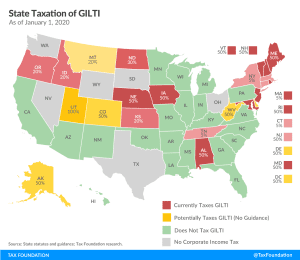
Taxing GILTI puts states at a competitive disadvantage compared to their peers—all for a tax that makes very little sense at the state level, and which legislators never sought in the first place.
5 min read
Though they are limited by both data and assumptions, the OECD will face similar limitations. As policymakers work to fine-tune the proposals under both Pillar 1 and 2 the impact assessment should be a critical part of that discussion.
6 min read
The CFC legislation in Spain is not as complicated as it is in some other countries, and it is aligned with the standards recommended by the OECD. The Spanish rules have evolved in a way that the rules are designed to comply with the EU principles not to interrupt the functioning of the Union and its single market.
4 min read
The OECD has been working to assess the impact of their program of work, and it will be critical for this assessment to take into account impacts not only on revenues, but also on growth and investment.
7 min read
In France, Controlled Foreign Corporation (CFC) rules were first enacted in 1980. The French tax regime operates on a strict territorial basis, where only profits generated in the country are subject to tax in France.
5 min read

The Chinese approach to base erosion and profit shifting is more focused on the application of transfer pricing rules and not on the application of CFC rules. Even with the rules in place, the Chinese tax authorities have not enforced the rules as much as other countries have.
3 min read
The tax base for the income-inclusion rule will be just as important as determining the rate, and both the base and the rate will likely impact business decisions. Additionally, policymakers need to determine how the choice for blending fits with the overarching goal of the policy. And as the example of GILTI shows, it is essential to assess how current international tax regulations would interact with a global minimum tax.

Unifying the proposal under sound principles in the context of clear economic analysis should allow the Inclusive Framework to minimize both the administrative and economic burdens that the Secretariat’s proposal could create.

Addressing tax avoidance is a key political issue for many countries, but these policies should not be discussed without accounting for the size of the current problem, how recent policy changes have addressed it, and what potential impacts might come from this new approach.
4 min read
If there is double taxation due to digital services taxes or because a country is unwilling to conform to the structure of the Secretariat’s proposal, the impact would be a net negative for many businesses.
8 min read
The continuation of this work is important, but the OECD and policymakers around the world should carefully consider whether these proposals will lead to more certainty, or if they will undermine that goal by simply be a step toward more unilateralism. The impact on cross-border investment will also be a critical issue to consider, and the ongoing impact assessment by the OECD is an important part of the work.
6 min read
Countries around the world often design their tax policies to become attractive targets for foreign investment. These policies can be anything from a system with special preferences for certain industries to a well-designed tax system based on principles of sound tax policy. Systems that are rife with special preferences and complexities can create distortions in local jurisdictions and across the global economy.
3 min read