Options Guide Shows the “No Tax On” Deductions Are Costly and Complex
The “no tax on” deductions show the drawbacks of using narrowly tailored provisions to provide tax relief.
6 min read

The “no tax on” deductions show the drawbacks of using narrowly tailored provisions to provide tax relief.
6 min read
Jock taxes on highly paid athletes and entertainers are here to stay, but states could make life easier for the rest of us, at very little cost, by adopting reasonable nonresident filing and withholding thresholds for ordinary taxpayers.
5 min read
Investment in digital assets, long thought of as a niche interest reserved for enthusiasts, has broken into the mainstream. In 2026, about one in five US adults report being invested in or using cryptocurrency.
5 min read
Economists and journalists have been pointing to a labor share of income series from the Bureau of Labor Statistics (BLS) as evidence that capital is taking an ever-increasing slice of the economic pie. But a closer look at the national income accounts shows a different story.
7 min read
Tax Foundation’s new resource, Options for Reforming America’s Tax Code 3.0, demonstrates that not all revenue-raising options are created equal—some do more harm to the economy than others for the same amount of revenue.
7 min read
When properly measured, consistent with how we assess progressivity in tax policy, Social Security benefits are progressive.
5 min read
While uncapping the payroll tax and raising individual income tax rates are often the go-to reform options for policymakers, base broadeners like ESI and other fringe benefits are much better alternatives. They can raise significant revenue, while improving the neutrality of the tax code and preventing the need for increases in statutory tax rates.
6 min read
Poland taxes its individual business owners through alternative regimes and a series of thresholds, several of them sharp notches that imply significant tax costs for businesses crossing them.
11 min read
The California Billionaire Tax Act (Proposition 40), which imposes a one-time 5 percent tax on billionaires’ net worth, is vulnerable to numerous constitutional challenges, any of which could invalidate the tax in whole or in part.
28 min read
Some taxes have more powerful economic effects than others, and that’s a lesson policymakers should absorb as they work to craft a tax code that encourages growth and raises sustainable revenue.
8 min read
Though they are often framed as affecting only the richest households, the economic effects of wealth taxes extend much further by reducing capital formation, discouraging entrepreneurship, curtailing wage and employment growth, and ultimately weakening the overall economy.
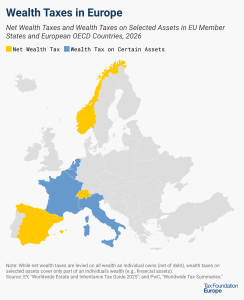
Wealth taxes not only collect little revenue and create legal uncertainty, but an OECD report argues that they can also disincentivize entrepreneurship, harming innovation and long-term growth.
5 min read
The California Billionaire Tax Act’s residency provisions are exceptionally vulnerable to legal challenge. Even if the tax passes and survives challenges to its broader constitutionality, billionaires who leave California sometime in 2026 have good reason to believe they can escape some or all of the tax.

If voters approve Amendment 5 on the primary election ballot this August, Missouri policymakers must pass legislation to gradually phase out the state’s income tax while choosing how to pay for this goal.

The Tax Foundation uses and maintains a General Equilibrium Model, known as our Taxes and Growth (TAG) Model to simulate the effects of government tax and spending policies on the economy and on government revenues and budgets.
9 min read
It is good to see senators talking about the Social Security crisis that is rapidly unfolding. But any serious proposal has to grapple with the trade-offs of different reforms and accept that the fix will come from both sides of the ledger: taxes and expenditures.
5 min read
A study from the Fraser Institute finds the US tax code is highly progressive relative to other OECD countries.
7 min read
The Reform UK proposal to exempt overtime pay from income tax—framed as a “hard work bonus”—may be politically appealing, but it’s a flawed idea that undermines economic fairness, distorts labor markets, and jeopardizes tax revenues.
4 min read
Policies that increase the tax burden on high earners makes states less competitive, increase revenue volatility, discourage investment, and risk accelerating outmigration of talent and capital. Many top-earners are already leaving high-tax states for Florida, North Carolina, and other low-tax jurisdictions.
9 min read
Voters in California this fall will have to determine whether the state will institute a billionaire tax. Advocates of this proposal have been pushing for these kinds of money grabs for decades—and their arguments often run the same. The base is narrow, the lifespan is limited, the cause is sympathetic.