Not all taxA tax is a mandatory payment or charge collected by local, state, and national governments from individuals or businesses to cover the costs of general government services, goods, and activities. hikes bring in more revenue. Setting the rate too high might not yield as much as a lower tax rate would, because tax rates influence how much people work and how much businesses invest—both activities that affect the income tax baseThe tax base is the total amount of income, property, assets, consumption, transactions, or other economic activity subject to taxation by a tax authority. A narrow tax base is non-neutral and inefficient. A broad tax base reduces tax administration costs and allows more revenue to be raised at lower rates.. Economists and policymakers, therefore, are keen on determining the “Goldilocks rate.” A new research paper sheds some light on this question, finding that the income tax rate that maximizes revenue may actually be lower than previously estimated.
Is the Peak of the Laffer Curve Actually 73 Percent?
An influential policy paper in the “optimal tax theory” literature was published by economists Peter Diamond and Emmanuel Saez in 2011, “The Case for a Progressive Tax.” That paper sought to identify the “peak” of the Laffer curve—the marginal tax rateThe marginal tax rate is the amount of additional tax paid for every additional dollar earned as income. The average tax rate is the total tax paid divided by total income earned. A 10 percent marginal tax rate means that 10 cents of every next dollar earned would be taken as tax. at which tax revenue is maximized.
Building on earlier theoretical work from Saez, the 2011 paper estimated a top revenue-maximizing tax rate of 73 percent in the US. The findings of that paper were frequently misunderstood by policymakers and commentators, including by some who thought that the paper’s findings meant the top tax rate should be set at that rate.
To start, the top revenue-maximizing rate estimated in the paper was inclusive of all taxes at the federal, state, and local levels, including all payroll taxes and sales taxes. That is, the paper did not estimate that revenue would be maximized if the top individual income taxAn individual income tax (or personal income tax) is levied on the wages, salaries, investments, or other forms of income an individual or household earns. The U.S. imposes a progressive income tax where rates increase with income. The Federal Income Tax was established in 1913 with the ratification of the 16th Amendment. Though barely 100 years old, individual income taxes are the largest source rate (35 percent at the time) was increased to 73 percent.
A second, and critically overlooked, contributor to the 73 percent figure was the assumption of a tax base that is broader than our system was at the time (and still is). The authors estimated that using the existing, narrower tax base, with numerous deductions and credits, would yield a top revenue-maximizing rate of 54 percent, or 48 percent for just the top federal income tax rate. For context, that rate is not much higher than the combined federal and state income tax rates faced by high-income taxpayers in states such as New York and California.
New Evidence Points to Flatter Laffer Curves
Diamond and Saez’s 2011 paper was certainly not the last word on this topic. Many papers published since have taken different approaches, producing a range of total government revenue-maximizing tax rates from all sources between 46 percent and 73 percent.
In a new paper building on this work, economists Rachel Moore, Brandon Pecoraro, and David Splinter argue that these papers used tax bases that were either too broad or too narrow, often missing important behavioral adjustments. Given our current tax system, they find that the Laffer curves are flatter than Saez and other authors estimate, implying that the revenue gains from increasing top tax rates are smaller than what those previous estimates suggest.
Policymakers are largely interested in how the change in the top ordinary income would impact revenue, but a large share of income at the top actually falls outside this tax base. For example, while the ordinary income tax base includes some capital income—such as short-term capital gains and pass-through businessA pass-through business is a sole proprietorship, partnership, or S corporation that is not subject to the corporate income tax; instead, this business reports its income on the individual income tax returns of the owners and is taxed at individual income tax rates. profits—other types of capital income, such as long-term capital gains and qualified dividends, are taxed at lower rates. The ordinary income tax base is reduced further by deductions and credits for various kinds of investment.
The authors improve upon previous studies by constructing different tax bases and using detailed administrative data covering high-income taxpayers to estimate behavioral responses along the Laffer curve. The model allows them to capture different margins of adjustment in response to changes in tax rates. For example, corporations may switch organizational forms to noncorporate structures if tax rates on pass-through business income fall. Similarly, individual income taxpayers may increase tax-deductible activities, such as charitable giving, when their tax rates rise.
Accounting for these additional margins, the authors find that the revenue losses from federal rate increases roughly double compared to previous estimates that use only one tax base. Using a single broad tax base yields a revenue-maximizing federal income tax rate of 55 percent. That revenue-maximizing rate falls to 48 percent when using multiple bases and accounting for all possible behavioral responses (the “true” base), yielding an additional $43 billion in revenue at that rate, or 0.2 percent of GDP.
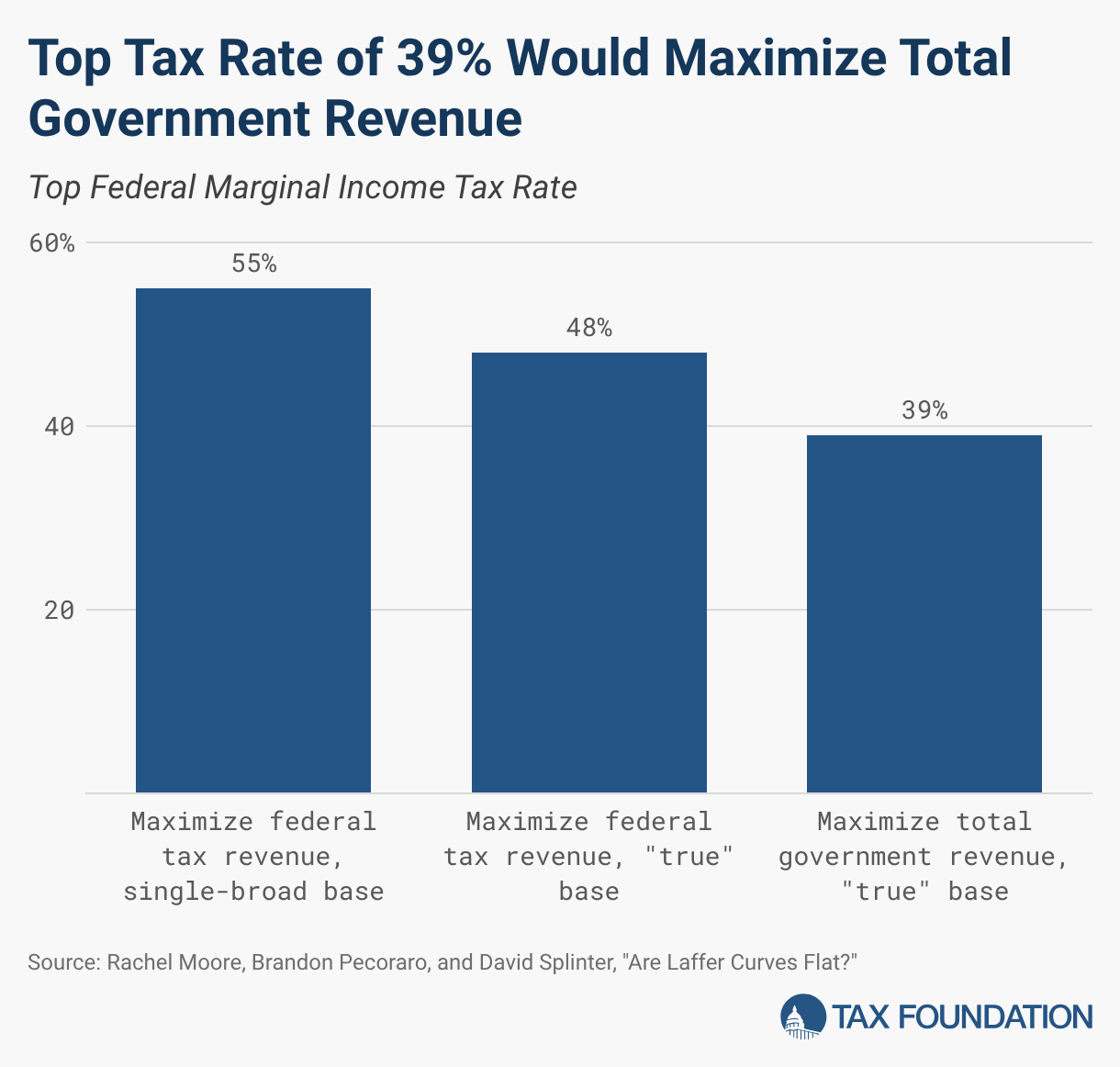
Taking into consideration all taxes at the federal, state, and local levels, the top federal income tax that maximizes revenue falls even further. The top federal individual income tax rate that would maximize total government revenue from all sources is 39 percent, with an increase to that rate yielding $1 billion in additional total tax revenue. At that rate, the losses to state and local revenue almost fully offset the federal revenue gains. A rate of 39 percent is also very close to the current top federal income tax rate of 37 percent.
Overall, this new paper shows raising top income tax rates on the current tax base may not yield as much revenue as previously estimated, due to opportunities to shift income to different tax bases within the tax code. Policymakers should keep this in mind when thinking about increasing tax rates on high-income taxpayers without making other reforms to the tax code.
Stay informed on the tax policies impacting you.
Subscribe to our free newsletter to get the latest tax data, news and analysis.
Subscribe