Ideas, Not Mandates: Lessons Learned from a Decade of International Tax Reform
The past decade’s record suggests that countries have reliable legislative methods to improve their tax systems through ordinary tax reforms.
22 min read
The past decade’s record suggests that countries have reliable legislative methods to improve their tax systems through ordinary tax reforms.
22 min read
New Mexico’s SB 151 decouples from the OBBBA’s full expensing provision, making the state’s tax climate less competitive.
4 min read
Our analysis of the major tax provisions included in the OBBBA finds it will increase long-run GDP by 0.7 percent. The major tax provisions will reduce federal tax revenue by nearly $5.2 trillion between 2025 and 2034, on a conventional basis.
12 min read
The Trump administration has rightly shifted its focus from pursuing legislative changes to implementing new permanent rules. But in this shift, it’s crucial that the White House doesn’t lose focus on the larger task at hand.
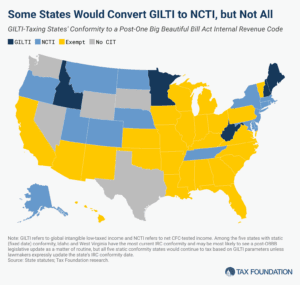
Several states have decoupled from GILTI by name rather than statutory citation. Lawmakers in those states should amend these statutes to ensure that their tax code does not accidentally incorporate a much more aggressive tax on international income than the tax from which they previously decoupled.
6 min read
Due to the incentive for jurisdictions to implement a qualified domestic minimum top-up tax (QDMTT), Pillar Two leaves a geographic asymmetry. Additional tax revenues would predominantly accrue to low-tax jurisdictions, with high tax jurisdictions receiving little to no increase.
2 min read
22 of the 27 EU Member States have implemented both the income inclusion rule and the qualified domestic minimum top-up tax in 2025.
4 min read
New evidence shows the scale and distribution of compliance costs for EU firms affected by Pillar Two, i.e., the “Global Minimum Tax.”
6 min read
Massachusetts lawmakers should look for opportunities to reform the tax code, revamp the state’s competitiveness, and stem the tide of outmigration. This bill, by contrast, would double down on the economically uncompetitive features of the Commonwealth’s existing tax code. Aggressively expanding NCTI inclusion is not productive or competitive.
5 min read
Rather than returning to a world of retaliatory tax measures and transatlantic disputes, the OECD should continue to decrease the compliance costs of Pillar Two by simplifying the rules to reduce any possible risk that the US has a compliance cost advantage and working with G7 countries on a side-by-side solution.
6 min read
Congress may have passed the One Big Beautiful Bill Act (OBBBA), but state lawmakers now face big choices. Most states link their tax codes to the federal system, meaning OBBBA’s provisions—good and bad—are about to ripple across state budgets.
The agreement represents a major change for tax competition as well, and many countries will rethink their tax policies for multinationals. However, the US will continue to chart its own course, and other countries may prefer to do the same, depending on the final outcome of the G7 statement.
8 min read
The OBBBA moved the US international tax system in the right direction on several fronts. However, some of the changes, while encouraging certain domestic activity and exports, may harm physical activity abroad that supports US competitiveness and domestic activity.
8 min read
For Congress, work on the One Big Beautiful Bill Act is done. But in state capitols, the work has not yet begun. Many of the tax changes in the federal reconciliation act flow through to state tax codes—automatically in some states, and subject to an update in states’ Internal Revenue Code conformity date in others.
39 min read
Our experts explain how this major tax legislation may affect you and how policymakers can better improve the tax code.
24 min read
The One Big Beautiful Bill Act makes many of the individual tax cuts and reforms of the TCJA permanent. It improves upon the TCJA by making expensing for R&D and equipment permanent. However, for the most part, it does not include further structural reforms, and instead introduces many new, narrow tax breaks to the code, adding complexity and raising revenue costs.
7 min read
The One Big Beautiful Bill’s changes to the taxation of international income have surprising implications for state codes, yielding tax increases and a revised tax base that, through quirks of state incorporation, bears very little resemblance to the federal base and almost nothing of its purpose.
10 min read
The BEPS project’s 15 actions were decisive responses to real problems in cross-border taxation, offering real benefits but also real costs. A decade of implementation experience has revealed a critical side effect: sharply higher compliance costs for both tax administrations and the business community.
Lawmakers should consider maintaining QBAI and applying the several billion dollars from the Senate’s change toward other pro-growth international tax reforms instead.
6 min read
The Senate draft overall makes more changes to international tax policy than the House draft. On net the changes are positive.
8 min read