IRS Report Shows Closing the Tax Gap Would Not Close the Deficit
The latest tax gap report from the IRS has generated much media attention—and much misunderstanding.
The earned income tax credit (EITC) is a targeted subsidy for low-income working families. It was enacted in 1975 as a temporary credit to help low-income workers with children.
The value of the EITC is a fixed percentage of a household’s earned income until the credit reaches its maximum. The EITC stays at its maximum value as a household’s earned income continues to increase, until earnings reach a phaseout threshold, above which the credit falls by a fixed percentage for each additional dollar of income over the phaseout threshold. The EITC is a fully refundable credit.


The latest tax gap report from the IRS has generated much media attention—and much misunderstanding.


Income taxes impose steeper economic costs, and often steeper administrative and compliance costs, than consumption taxes. Moving to a consumption tax would end the tax bias against saving and investment and provide an opportunity to greatly simplify anti-poverty programs embedded in the tax code.


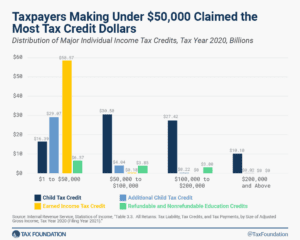
In tax year 2020, taxpayers claimed more than 159 million tax credits on their individual income tax returns worth a total of more than $277 billion. That was an increase of $35.3 billion from tax year 2019, largely due to an influx of pandemic relief administered through the tax code in 2020.


Explore IRS clean energy tax credits, including Direct Pay, the IRA and CHIPS Act tax provisions, and Section 1603 grant program. See more.


The federal tax code remains a major source of frustration and controversy for Americans, and a hindrance to economic growth and opportunity. Other countries, such as Estonia, have proven that sufficient tax revenue can be collected in a less frustrating and more efficient way.


Lawmakers should focus on simplifying the federal tax code, creating stability, and broadly improving economic incentives. There are incremental steps that can be made on the path to fundamental tax reform.


Lawmakers should avoid delivering social and economic benefits through the tax code whenever possible and work to simplify or repeal the tax expenditures already in the tax code.


Lawmakers should simplify the tax code so that taxpayers can understand the laws and the IRS can administer them with minimum cost and frustration.


Federal spending, deficits, and debt are at unsustainable levels. The proposed federal budget is laden with redundant programs, obsolete programs, corporate welfare, and nationalized industries. As Congress begins to craft the FY 2024 federal budget, it needs to establish a process of systematically reviewing programs and priorities.


According to our analysis, President Biden’s budget would reduce long-run economic output by about 1.3 percent and eliminate 335,000 FTE jobs. See what tax policies the president is proposing.


President Biden’s new budget proposal outlines several major tax increases targeted at businesses and high-income individuals that would bring U.S. income tax rates far out of step with international norms.


Policymakers face a difficult balancing act this year in what is likely to be an unusual tax extenders season.


As we near this year’s “lame duck” session of Congress, there has been renewed interest in reforming the child tax credit as part of a tax deal. Our new analysis highlights the trade-offs that policymakers will face


The IRS recently released the new inflation adjusted 2023 tax brackets and rates. Explore updated credits, deductions, and exemptions, including the standard deduction & personal exemption, Alternative Minimum Tax (AMT), Earned Income Tax Credit (EITC), Child Tax Credit (CTC), capital gains brackets, qualified business income deduction (199A), and the annual exclusion for gifts.


Research has shown that spikes in tax rates can act as barriers to upward mobility. High marginal tax rates might directly influence the decisions workers make about accepting a raise, working additional hours, or whether they might remain on government benefits.


The United States needs to grow its way out of inflation and set the economy up for continued growth—the tax code provides tools for policymakers to do just that.


Efforts to improve the taxpayer experience should focus on the IRS’s operations and include structural improvements to the tax code.


As the deadline for tax filing nears, the IRS faces scrutiny for its backlog of returns, inaccessible taxpayer service, and delays in issuing certain refunds.


In times of inflation, a review of the tax code shows that some provisions are automatically indexed, or adjusted, to match inflation, while others are not. And that creates unfair burdens for taxpayers. But it’s not always as simple as just “adjusting for inflation.”


After a whirlwind of cuts and reforms in 2021, it looks like 2022 might be an even bigger year for state tax codes. Republican and Democratic governors alike used their annual State of the State addresses to call for tax reform, and there is already serious momentum from state lawmakers nationwide to get the job done.