Budget Reconciliation: Tracking the 2025 Trump Tax Cuts
Our experts are providing the latest details and analysis of proposed federal tax policy changes.
14 min read
The mission of our federal program is to promote tax and fiscal policy that leads to greater U.S. competitiveness, higher economic growth, and improved quality of life for all taxpayers.
We have several projects, such as the Growth and Opportunity Agenda and Options for Reforming America’s Tax Code, which help us educate taxpayers, journalists, and policymakers on how the U.S. tax system works and the impact of federal tax changes on taxpayers and the economy.
Our Center for Federal Tax Policy hosts Tax Foundation University, a crash course designed to educate congressional staff on the economics of tax policy. Our experts are also a go-to source in the media and are frequently cited in top outlets like The Wall Street Journal, The New York Times, and The Washington Post. See Our Experts
Since 2012, we have used our Taxes and Growth (TAG) macroeconomic model to analyze dozens of legislative and campaign tax proposals, including every major tax plan put forth during the 2016 presidential campaigns, the House GOP’s 2016 Tax Reform Blueprint, the Tax Cuts and Jobs Act, and President Biden’s tax reform agenda. See Our Economic and Tax Modeling
For a look at where tax modeling started, explore the extensive body of work from the Institute for Research on the Economics of Taxation (IRET), the think tank that pioneered dynamic tax modeling. Explore the IRET Archives
Tax Cuts and Jobs Act Tariffs & Trade Debt & Deficits Trump Tax Plan
Cost Recovery | Taxes & Inflation | Taxes on Savers & Investors | Carbon Taxes
Our experts are providing the latest details and analysis of proposed federal tax policy changes.
14 min read
Permanently extending the Tax Cuts and Jobs Act would boost long-run economic output by 1.1 percent, the capital stock by 0.7 percent, wages by 0.5 percent, and hours worked by 847,000 full-time equivalent jobs.
6 min read
The tariffs amount to an average tax increase of nearly $1,200 per US household in 2025.
37 min read
Unless Congress acts, Americans are in for a tax hike in 2026.
3 min read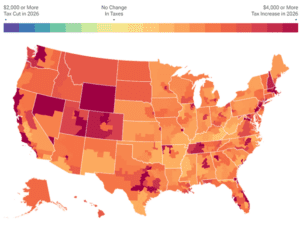
At the end of 2025, the individual tax provisions in the Tax Cuts and Jobs Act (TCJA) expire all at once. Without congressional action, most taxpayers will see a notable tax increase relative to current policy in 2026.
4 min read
Policymakers should have two priorities in the upcoming economic policy debates: a larger economy and fiscal responsibility. Principled, pro-growth tax policy can help accomplish both.
21 min read
This tax reform plan would boost long-run GDP by 2.5%, grow wages by 1.4%, and add 1.3M jobs, all while collecting a similar amount of tax revenue as the current code and reducing the long-run debt burden.
38 min read
Given the poor state of the budget process and worsening debt trajectory, lawmakers should move boldly and quickly to address the issue, including via a fiscal commission process. Issues to consider should include reforms to both spending and taxes.
42 min read
A growing international tax agreement known as Pillar Two presents two new threats to the US tax base: potential lost revenue and limitations on Congress’s ability to set its own tax policy.
39 min read

Making the Tax Cuts and Jobs Act’s individual provisions permanent combined with a carbon tax can be a revenue-neutral trade and increase the long-run size of the economy by 1 percent, making it a sustainable pro-growth option.
23 min read
The highway trust fund is on track to run out of money by 2021, states are struggling to cover their transportation spending, and increased fuel economy, plus inflation, is chipping away at gas tax revenue year. How can Congress and state governments ensure they have the revenue necessary to fund our highways? One solution is the vehicle miles traveled (VMT) tax.
35 min read
The LIHTC has subsidized over 3 million housing units since it was established in 1986, the largest source of affordable housing financing.
24 min read
Senators Ted Cruz and Martha McSally introduced the CREATE JOBS Act that would make two significant changes to incentivize investment in the United States.
3 min read
The Tax Reform Act of 1986 extended depreciation schedules for both commercial and noncommercial of real estate, reducing the attractiveness of those investments.
21 min read