Top Personal Income Tax Rates in Europe, 2026
Denmark (55.9 percent), France (55.4 percent), and Austria (55 percent) levy the highest top personal income tax rates in Europe.
4 min read
Providing journalists, taxpayers and policymakers with basic data on taxes and spending is a cornerstone of the Tax Foundation’s educational mission. We’ve found that one of the best, most engaging ways to do that is by visualizing tax data in the form of maps.
How does your country collect revenue? Every week, we release a new tax map that illustrates one important measure of tax rates, collections, burdens and more.

Denmark (55.9 percent), France (55.4 percent), and Austria (55 percent) levy the highest top personal income tax rates in Europe.
4 min read
More than 175 countries worldwide—including all major European countries—levy a value-added tax (VAT) on goods and services. EU Member States’ VAT rates vary across countries, though they’re somewhat harmonized by the EU.
5 min read
Some European countries have raised their statutory corporate rates over the past year, including Estonia, Lithuania, and Slovakia.
4 min read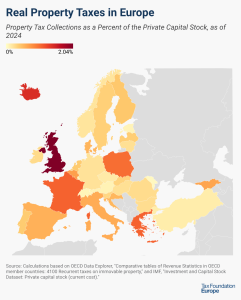
High property taxes levied not only on land but also on buildings and structures can discourage investment in infrastructure, which businesses would have to pay additional tax on.
3 min read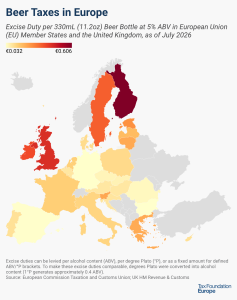
With much of the continent celebrating Oktoberfest, it is a great time to examine beer taxes across Europe. Hefty beer taxes increase the price consumers pay for their libations.
5 min read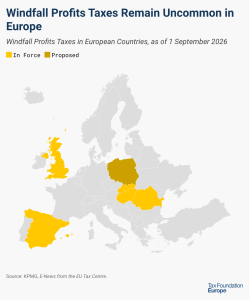
As energy prices have declined, European countries have switched the focus of their windfall profits taxes—a one-time tax levied on a company or industry when economic conditions result in large, unexpected profits—from energy providers to the banking and financial sector.
7 min read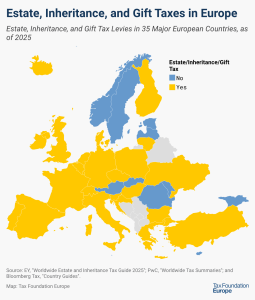
Twenty-four out of the 35 European countries covered in this map currently levy estate, inheritance, or gift taxes.
4 min read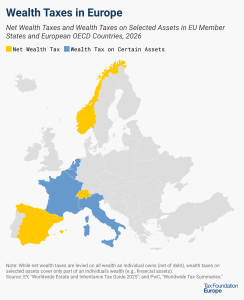
Wealth taxes not only collect little revenue and create legal uncertainty, but an OECD report argues that they can also disincentivize entrepreneurship, harming innovation and long-term growth.
5 min read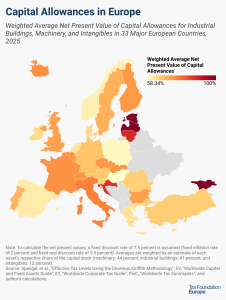
Although sometimes overlooked in discussions about corporate taxation, capital allowances play an important role in a country’s corporate tax base and can impact investment decisions—with far-reaching economic consequences.
6 min read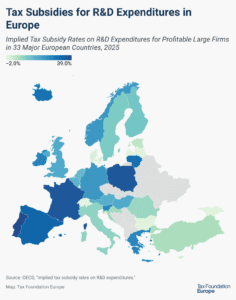
Many countries incentivize business investment in research and development (R&D), intending to foster innovation. A common approach is to provide direct government funding for R&D activity. However, a significant number of jurisdictions also offer R&D tax incentives.
5 min read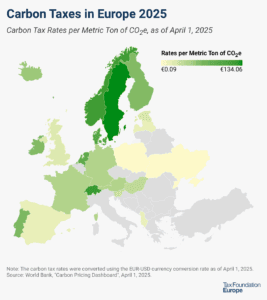
In recent years, several countries have taken measures to reduce carbon emissions, including instituting environmental regulations, emissions trading systems (ETSs), and carbon taxes.
5 min read
Worldwide, 175 countries—including all major European countries—levy a value-added tax (VAT) on goods and services. However, to reduce compliance and administrative costs, most countries have VAT exemption thresholds: if a business is below a certain annual revenue threshold, it is not required to participate in the VAT system.
3 min read
Fourteen countries in Europe—Belgium, Finland, France, Greece, Hungary, Ireland, Italy, Malta, Poland, the Slovak Republic, Spain, Switzerland, Turkey, and the United Kingdom—currently levy a type of financial transaction tax.
3 min read
Carryover provisions help businesses “smooth” their risk and income, making the tax code more neutral across investments and over time.
5 min read
Currently, about half of all European OECD countries have either announced, proposed, or implemented a digital services tax. Because these taxes mainly impact US companies and are thus perceived as discriminatory, the US responded with retaliatory tariff threats.
5 min read
To make the taxation of labor more efficient, policymakers should understand their country’s tax wedge and how their tax burden funds government services.
5 min read
Cigarette smokers in the European Union pay far more in excise taxes than they do for the cigarettes themselves. Our latest map illustrates the wide variance in cigarette excise taxes across EU Member States.
6 min read
Many countries’ personal income tax systems tax various sources of individual income—including investment income such as dividends and capital gains.
4 min read
Capital gains taxes create a bias against saving, leading to a lower level of national income by encouraging present consumption over investment.
4 min read
Fuel taxes continue to be a central policy consideration for European countries amid geopolitical conflicts, increased emphasis on environmental policy, and economic conditions experienced by average consumers.
6 min read
Denmark (55.9 percent), France (55.4 percent), and Austria (55 percent) levy the highest top personal income tax rates in Europe.
4 min read
More than 175 countries worldwide—including all major European countries—levy a value-added tax (VAT) on goods and services. EU Member States’ VAT rates vary across countries, though they’re somewhat harmonized by the EU.
5 min read
Some European countries have raised their statutory corporate rates over the past year, including Estonia, Lithuania, and Slovakia.
4 min read