Tracking the Impact of the Trump Tariffs & Trade War
The Trump tariffs have not meaningfully altered the trade balance and amount to an average tax increase per US household of $700 in 2026.
55 min read
The Tax Foundation is the world’s leading independent tax policy 501(c)(3) nonprofit. For over 85 years, our mission has remained the same: to improve lives through tax policies that lead to greater economic growth and opportunity.
Our Center for Federal Tax Policy, Center for State Tax Policy, and Center for Global Tax Policy each produce timely and high-quality research and analysis that influences the debate toward economically principled tax policies. Our experts are continuously analyzing the day’s most relevant tax policy topics and are relied upon routinely for presentations, testimony, and media appearances on tax issues spanning every level of government.
Likewise, providing journalists, taxpayers, and policymakers with basic data on taxes and spending has been a cornerstone of the Tax Foundation’s educational mission since its founding. As we wrote in our first edition of Facts & Figures in 1941, “Facts give a broader perspective; facts dissipate predilections and prejudices…[and are] an important step to meet the challenge presented by the broad problems of public finance.”
The Trump tariffs have not meaningfully altered the trade balance and amount to an average tax increase per US household of $700 in 2026.
55 min read
How will recent federal tax changes affect you?
4 min read
The State Tax Competitiveness Index enables policymakers, taxpayers, and business leaders to gauge how their states’ tax systems compare. While there are many ways to show how much state governments collect in taxes, the Index evaluates how well states structure their tax systems and provides a road map for improvement.
122 min read
Lawmakers can constrain the growth of property taxes without creating new problems. But the details matter.
Our experts explain how this major tax legislation may affect you and how policymakers can better improve the tax code.
24 min read
For Congress, work on the One Big Beautiful Bill Act is done. But in state capitols, the work has not yet begun. Many of the tax changes in the federal reconciliation act flow through to state tax codes—automatically in some states, and subject to an update in states’ Internal Revenue Code conformity date in others.
39 min read
As a rule, an individual’s income can be taxed both by the state in which the taxpayer resides and by the state in which the taxpayer’s income is earned.
52 min read
Notably, the OBBBA makes permanent the individual tax changes first put in place by the TCJA, which avoids a tax hike on an estimated 62 percent of tax filers in 2026.
4 min read
Facts & Figures serves as a one-stop state tax data resource that compares all 50 states on over 40 measures of tax rates, collections, burdens, and more.
2 min read
While there are many factors that affect a country’s economic performance, taxes play an important role. A well-structured tax code is easy for taxpayers to comply with and can promote economic development while raising sufficient revenue for a government’s priorities.
93 min read
New IRS data shows the US federal income tax system continues to be progressive as high-income taxpayers pay the highest average income tax rates. Average tax rates for all income groups remain lower after the Tax Cuts and Jobs Act (TCJA).
6 min read
The variety of approaches to taxation among European countries creates a need to evaluate these systems relative to each other. For that purpose, we have developed the European Tax Policy Scorecard—a relative comparison of European countries’ tax systems.
55 min read
Sources of state revenue have come under closer scrutiny in light of the impact of the coronavirus pandemic, as different tax types have differing volatility and economic impact—although even beyond these unique circumstances, it is important for policymakers to understand the trade-offs associated with different sources of tax revenue.
4 min read
In addition to its economic impact on Maryland businesses and the likelihood of serious legal challenges, Maryland’s proposed digital advertising tax is incredibly vague on vital definitions, creating uncertainty about where revenue is sourced and when it is subject to the tax.
17 min read
By failing to keep pace with modern consumption patterns, sales taxes have become less neutral, less equitable, and less economically efficient over time.
16 min read
The consultation on the EU’s digital levy provides an opportunity for policymakers and taxpayers to reflect on the underlying issues of digital taxation and potential consequences from a digital levy. Unless the EU digital levy is designed with an OECD agreement in mind, it is likely to cause more uncertainty in cross-border tax policy.
12 min read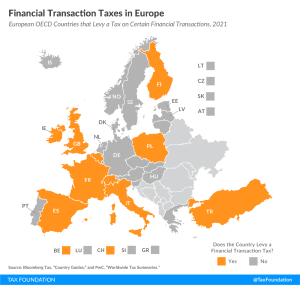
Belgium, Finland, France, Ireland, Italy, Poland, Spain, Switzerland, Turkey, and the United Kingdom currently levy a type of financial transaction tax
2 min read
The latest IRS data shows that the U.S. federal individual income tax continued to be progressive, borne primarily by the highest income earners.
8 min read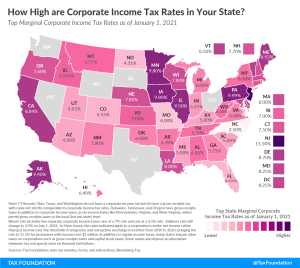
North Carolina’s 2.5 percent corporate tax rate is the lowest in the country, followed by Missouri (4 percent) and North Dakota (4.31 percent). Seven other states impose top rates at or below 5 percent: Florida (4.458 percent), Colorado (4.55 percent), Arizona (4.9 percent), Utah (4.95 percent), and Kentucky, Mississippi, and South Carolina (5 percent).
7 min read
We identify 13 of the highest tax reform priorities Nebraska policymakers should consider in their effort to create a more growth-friendly tax code. We also offer a sample comprehensive tax reform plan to show one way policymakers could begin tackling these objectives over the next couple legislative sessions, with further progress to be made in the years ahead.
8 min read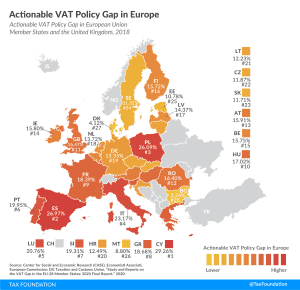
Value-added taxes (VAT) make up approximately one-fifth of total tax revenues in Europe. However, European countries differ significantly in how efficiently they raise VAT revenues. One way to measure a country’s VAT efficiency is the VAT Gap.
4 min read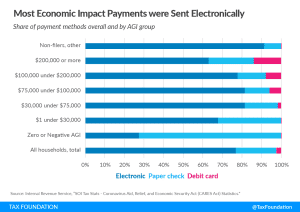
Newly published data from the Internal Revenue Service (IRS) shows that the first round of economic impact payments primarily benefited households earning less than $100,000.
3 min read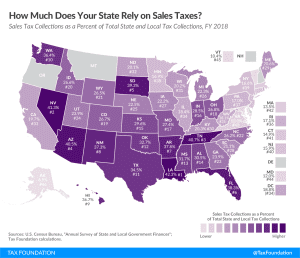
Consumption taxes (like sales taxes) are more economically neutral than taxes on capital and income because they target only current consumption. Consumption taxes are generally more stable than income taxes in economic downturns as well.
3 min readJoe Biden has proposed an ambitious agenda that would make the federal fiscal system more progressive, and the huge budget deficits caused by the numerous COVID-19 relief packages could heighten the call for more tax revenues. What is needed are benchmark facts to guide these debates.
13 min read
Despite the potential of consumption taxes as a neutral and efficient source of tax revenues, many governments have implemented policies that are unduly complex and have poorly designed tax bases that exclude many goods or services from taxation, or tax them at reduced rates.
40 min read
Some lawmakers have expressed interest in repealing the SALT cap, which was originally imposed as part of the Tax Cuts and Jobs Act (TCJA) in late 2017. It is important to understand who benefits from the SALT deduction as it currently exists, and who would benefit from the deduction if the cap were repealed.
6 min read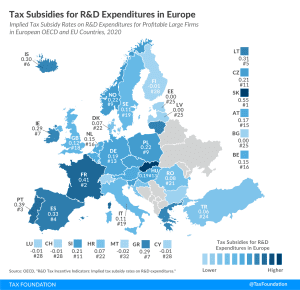
Many countries incentivize business investment in research and development (R&D), intending to foster innovation. A common approach is to provide direct government funding for R&D activity. However, a significant number of jurisdictions also offer R&D tax incentives.
4 min read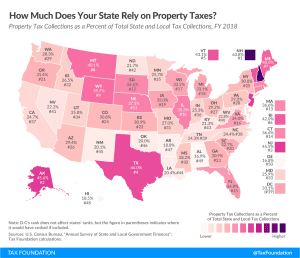
New Hampshire and Alaska rely most heavily on property taxes. Neither have individual income taxes, and in New Hampshire, significant government authority often vested in state government is devolved to the local level, where services are overwhelmingly funded by property taxes.
4 min read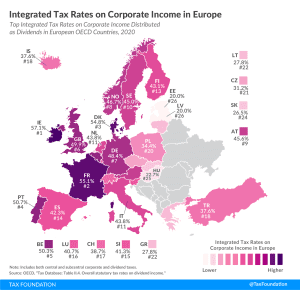
The integrated tax rate on corporate income reflects both the corporate income tax and the dividends or capital gains tax—the total tax levied on corporate income. For dividends, Ireland’s top integrated tax rate was highest among European OECD countries, followed by France and Denmark
4 min read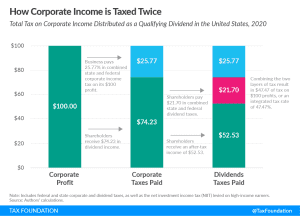
Biden’s proposal to increase the corporate income tax rate and to tax long-term capital gains and qualified dividends at ordinary income tax rates would increase the top integrated tax rate above pre-TCJA levels, making it the highest in the OECD and undercutting American economic competitiveness.
17 min read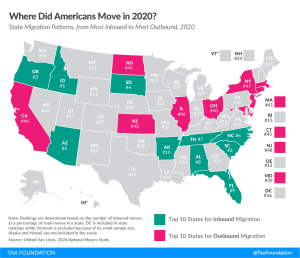
States compete with each other in a variety of ways, including in attracting (and retaining) residents. Sustained periods of inbound migration lead to (and reflect) greater economic output and growth. Prolonged periods of net outbound migration, however, can strain state coffers, contributing to revenue declines as economic activity and tax revenue follow individuals out of state.
4 min read
Expensing for capital investments is a powerful tax policy for economic growth. But expensing can also help shift the economy to a more sustainable future through increased investment in new, less carbon-intensive technology. Expensing for capital investment would eliminate a tax bias against energy efficiency improvements that reduce operating costs but involve high upfront investments. It could also serve to accelerate the existing trend of movement towards more green energy power sources.
28 min read