Skip to content
Katherine Loughead Tax Foundation
Expert

Katherine Loughead

Director of State Tax Projects

Katherine Loughead is the Director of State Tax Projects at the Tax Foundation, where she oversees the state tax policy team’s research agenda and serves as a resource to policymakers in their efforts to modernize and improve the structure of their state tax codes.

Katherine has testified before legislators in seven states and has authored or coauthored tax reform options guides on Kansas, Kentucky, Nebraska, and Wisconsin. Her work has been cited in The New York Times, The Economist, USA TODAY, Forbes, Bloomberg, the Associated Press, and numerous state media outlets across the country.

Prior to joining the Tax Foundation in 2018, Katherine worked for a US senator and a member of the US House of Representatives, where she advised on tax policy during the consideration of the historic Tax Cuts and Jobs Act. A graduate of the John Wesley Honors College at Indiana Wesleyan University, Katherine holds a degree in English and business administration, as well as a paralegal certificate from Georgetown University.

Originally from Belvidere, Illinois, Katherine now lives in Nashville, Tennessee, where she enjoys rock climbing and taking flying trapeze classes in her spare time.

Latest Work

2025 State Tax Competitiveness Index

2025 State Tax Competitiveness Index

The State Tax Competitiveness Index enables policymakers, taxpayers, and business leaders to gauge how their states’ tax systems compare. While there are many ways to show how much state governments collect in taxes, the Index evaluates how well states structure their tax systems and provides a road map for improvement.

115 min read
2024 state and local tax ballot measures details analysis and tax ballot measure results

State Tax Ballot Measures to Watch in 2024

Taxes are on the ballot this November—not just in the sense that candidates at all levels are offering their visions for tax policy, but also in the literal sense that voters in some states will get to decide important questions about how their states raise revenue.

9 min read
Nonresident Income Tax Filing Threshold Laws by State Remote Work Tax Burden

Nonresident Income Tax Filing Laws by State, 2024

One relatively easy but meaningful step policymakers can take to make future tax seasons less burdensome is to modernize their state’s nonresident income tax filing, withholding, and reciprocity laws.

7 min read
2024 state capital gains tax rates on long term capital gains

State Tax Rates on Long-Term Capital Gains, 2024

Savings and investment are critical activities, both for individuals’ and families’ financial security and for the health of the national economy as a whole. As such, policymakers should consider how they can help mitigate—rather than add to—tax codes’ biases against saving and investment.  

5 min read
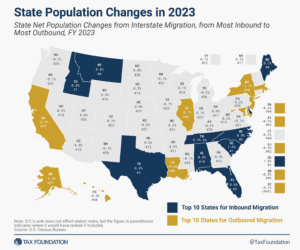
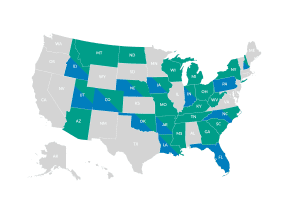
State population changes in 2023 low-tax states and high-tax states United Van Lines U-Haul and Census data

Americans Moved to Low-Tax States in 2023

The pandemic has accelerated changes to the way we live and work, making it far easier for people to move—and they have. As states work to maintain their competitive advantage, they should pay attention to where people are moving, and try to understand why.

5 min read
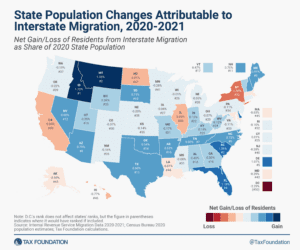
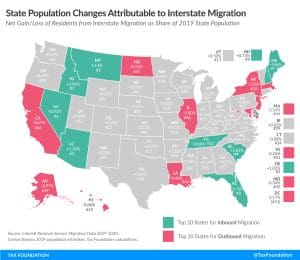
Do taxes affect where people move? Do taxes affect interstate migration?

Taxes and Interstate Migration: 2023 Update

The latest IRS and Census data show that people and businesses favor states with low and structurally sound tax systems, which can impact the state’s economic growth and governmental coffers.

8 min read
2024 State Business Tax Climate Index

2024 State Business Tax Climate Index

In recognition of the fact that there are better and worse ways to raise revenue, our Index focuses on how state tax revenue is raised, not how much. The rankings, therefore, reflect how well states structure their tax systems.

111 min read
2023 state tax changes taking effect july 1

State Tax Changes Taking Effect July 1, 2023

At least 32 notable tax policy changes recently took effect across 18 states, including alterations to income taxes, payroll taxes, sales and use taxes, property taxes, and excise taxes. See if your state tax code changed.

16 min read