Summary of the Latest Federal Income Tax Data, Tax Year 2020
The latest IRS data shows that the U.S. federal individual income tax continued to be progressive, borne primarily by the highest income earners.
43 min read
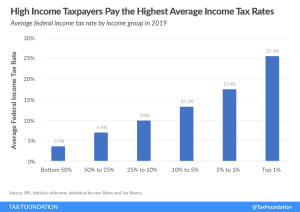
The latest IRS data shows that the U.S. federal individual income tax continued to be progressive, borne primarily by the highest income earners.
43 min read
When we discuss tax policy, the conversation inevitably turns to who pays, who should pay, and how much they should pay. Unfortunately, the tax burdens debate is often missing a key point: how income transfer programs—like Social Security or Medicaid—affect households’ tax burdens.
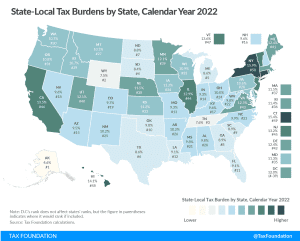
Tax burdens rose across the country as pandemic-era economic changes caused taxable income, activities, and property values to rise faster than net national product. Tax burdens in 2020, 2021, and 2022 are all higher than in any other year since 1978.
24 min read
What happens when voters decide tax policy directly? This November, roughly 40 tax measures are on the ballot across 17 states. Some states want higher taxes on top earners, others want to write low rates into their constitutions, and Missouri voters will decide whether to start a fund that could one day replace every state tax.

California’s billionaire tax is on the ballot this November, and it raises more questions than answers. From lost government revenue to legal battles that could drag on for years, what would this first-in-the-nation wealth tax actually do?

Jock taxes on highly paid athletes and entertainers are here to stay, but states could make life easier for the rest of us, at very little cost, by adopting reasonable nonresident filing and withholding thresholds for ordinary taxpayers.
5 min read
Tax Foundation’s new resource, Options for Reforming America’s Tax Code 3.0, demonstrates that not all revenue-raising options are created equal—some do more harm to the economy than others for the same amount of revenue.
7 min read
When properly measured, consistent with how we assess progressivity in tax policy, Social Security benefits are progressive.
5 min read
The California Billionaire Tax Act (Proposition 40), which imposes a one-time 5 percent tax on billionaires’ net worth, is vulnerable to numerous constitutional challenges, any of which could invalidate the tax in whole or in part.
28 min read
Some taxes have more powerful economic effects than others, and that’s a lesson policymakers should absorb as they work to craft a tax code that encourages growth and raises sustainable revenue.
8 min read
Though they are often framed as affecting only the richest households, the economic effects of wealth taxes extend much further by reducing capital formation, discouraging entrepreneurship, curtailing wage and employment growth, and ultimately weakening the overall economy.
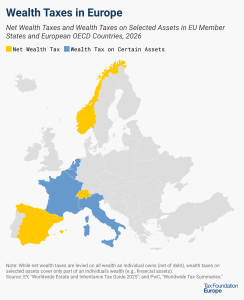
Wealth taxes not only collect little revenue and create legal uncertainty, but an OECD report argues that they can also disincentivize entrepreneurship, harming innovation and long-term growth.
5 min read
The California Billionaire Tax Act’s residency provisions are exceptionally vulnerable to legal challenge. Even if the tax passes and survives challenges to its broader constitutionality, billionaires who leave California sometime in 2026 have good reason to believe they can escape some or all of the tax.

A study from the Fraser Institute finds the US tax code is highly progressive relative to other OECD countries.
7 min read
Policies that increase the tax burden on high earners makes states less competitive, increase revenue volatility, discourage investment, and risk accelerating outmigration of talent and capital. Many top-earners are already leaving high-tax states for Florida, North Carolina, and other low-tax jurisdictions.
9 min read
Voters in California this fall will have to determine whether the state will institute a billionaire tax. Advocates of this proposal have been pushing for these kinds of money grabs for decades—and their arguments often run the same. The base is narrow, the lifespan is limited, the cause is sympathetic.

If approved by voters, the wealth tax will face a flurry of serious legal challenges—some to its overall constitutionality, and some regarding who can be taxed and to what degree if the tax survives broader legal scrutiny.
24 min read
Tax collections vary widely by state, making per capita collections figures—a measure of collections per person—especially useful, as they allow comparisons across differences in tax rates and bases, economic capacities, and policy decisions that impact the size and scope of government.
5 min read
The economic literature overwhelmingly finds that an income tax increase of this magnitude would negatively affect economic growth and opportunity in Rhode Island.

A new bill introduced in the Minnesota House seeks to tax non-real assets, imposing an annual tax of 1 percent on “taxable wealth” exceeding $10 million for individuals and trusts from tax year 2026 onward.
6 min read
These debates are often framed in terms of fairness. Raise taxes on a few to provide benefits for most, the thinking goes. But in policy, the more important question should focus on mechanics: will this change achieve its stated goal?

This study simulates several large tax increases and consistently finds that even tax increases large enough to close the primary deficit in the near term will lose ground over time and fail to put the debt on a sustainable course.
41 min read
Illinois’ proposed Millionaire’s Tax would raise taxes on Illinois families and businesses in an economically damaging way, further harming the state’s competitiveness and reducing economic opportunity even for those Illinois residents who would not owe the tax directly.