Summary of the Latest Federal Income Tax Data, Tax Year 2020
The latest IRS data shows that the U.S. federal individual income tax continued to be progressive, borne primarily by the highest income earners.
43 min read
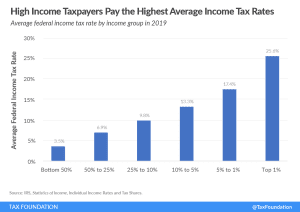
The latest IRS data shows that the U.S. federal individual income tax continued to be progressive, borne primarily by the highest income earners.
43 min read
When we discuss tax policy, the conversation inevitably turns to who pays, who should pay, and how much they should pay. Unfortunately, the tax burdens debate is often missing a key point: how income transfer programs—like Social Security or Medicaid—affect households’ tax burdens.
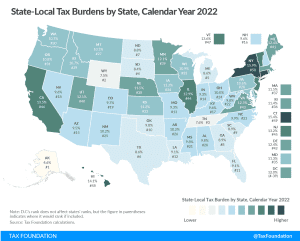
Tax burdens rose across the country as pandemic-era economic changes caused taxable income, activities, and property values to rise faster than net national product. Tax burdens in 2020, 2021, and 2022 are all higher than in any other year since 1978.
24 min read
In the spirit of change and improvement, it’s worth looking back to see which states have truly embraced tax competitiveness since 2020, and which ones have lagged behind.
6 min read
Spain’s 2026 election presents a clear divide in economic policy, with the Socialist Workers’ Party favoring higher taxes on capital and businesses, while the People’s Party and Vox advocate tax cuts to encourage investment, stimulate economic growth, and improve competitiveness.
13 min read
The State Tax Competitiveness Index enables policymakers, taxpayers, and business leaders to gauge how their states’ tax systems compare. While there are many ways to show how much state governments collect in taxes, the Index evaluates how well states structure their tax systems and provides a road map for improvement.
121 min read
In red and blue states alike, voters showed wariness toward novel changes to the tax code, with two notable exceptions.
3 min read
A new paper shows raising top income tax rates on the current tax base may not yield as much revenue as previously estimated, due to opportunities to shift income to different tax bases within the tax code.
5 min read
While there are many factors that affect a country’s economic performance, taxes play an important role. A well-structured tax code is easy for taxpayers to comply with and can promote economic development while raising sufficient revenue for a government’s priorities.
72 min read
Wealth taxes have been a failure everywhere they’ve been tried, which may be why advocates for the California amendment are saying this is a new frontier. But the countries that have tried this gamble know the frontier well, and they’ve left it in the dust.

Washington’s new income tax on high earners doesn’t take effect until 2028, but it is already generating a lot of activity. A measure on the ballot this November, Initiative 645, would reverse the legislature’s decision, preventing the new tax from taking effect.
5 min read
What happens when voters decide tax policy directly? This November, roughly 40 tax measures are on the ballot across 17 states. Some states want higher taxes on top earners, others want to write low rates into their constitutions, and Missouri voters will decide whether to start a fund that could one day replace every state tax.

California’s billionaire tax is on the ballot this November, and it raises more questions than answers. From lost government revenue to legal battles that could drag on for years, what would this first-in-the-nation wealth tax actually do?

Jock taxes on highly paid athletes and entertainers are here to stay, but states could make life easier for the rest of us, at very little cost, by adopting reasonable nonresident filing and withholding thresholds for ordinary taxpayers.
5 min read
Tax Foundation’s new resource, Options for Reforming America’s Tax Code 3.0, demonstrates that not all revenue-raising options are created equal—some do more harm to the economy than others for the same amount of revenue.
7 min read
When properly measured, consistent with how we assess progressivity in tax policy, Social Security benefits are progressive.
5 min read
The California Billionaire Tax Act (Proposition 40), which imposes a one-time 5 percent tax on billionaires’ net worth, is vulnerable to numerous constitutional challenges, any of which could invalidate the tax in whole or in part.
28 min read
Some taxes have more powerful economic effects than others, and that’s a lesson policymakers should absorb as they work to craft a tax code that encourages growth and raises sustainable revenue.
8 min read
Though they are often framed as affecting only the richest households, the economic effects of wealth taxes extend much further by reducing capital formation, discouraging entrepreneurship, curtailing wage and employment growth, and ultimately weakening the overall economy.
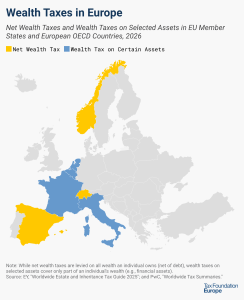
Wealth taxes not only collect little revenue and create legal uncertainty, but an OECD report argues that they can also disincentivize entrepreneurship, harming innovation and long-term growth.
5 min read
The California Billionaire Tax Act’s residency provisions are exceptionally vulnerable to legal challenge. Even if the tax passes and survives challenges to its broader constitutionality, billionaires who leave California sometime in 2026 have good reason to believe they can escape some or all of the tax.

A study from the Fraser Institute finds the US tax code is highly progressive relative to other OECD countries.
7 min read
Policies that increase the tax burden on high earners makes states less competitive, increase revenue volatility, discourage investment, and risk accelerating outmigration of talent and capital. Many top-earners are already leaving high-tax states for Florida, North Carolina, and other low-tax jurisdictions.
9 min read