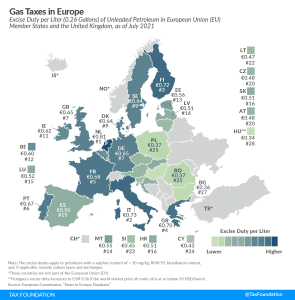
Excise Taxes and Fees on Wireless Services Increase Again in 2021
Taxes and fees on the typical American wireless consumer increased again this year, to a record 24.96 percent.
32 min read
Our dedicated excise tax experts, Adam Hoffer and Jacob Macumber-Rosin, provide leading tax policy research, analysis, and commentary of the latest proposals and trends related to excise taxes. Explore the vast and changing world of excise taxation.
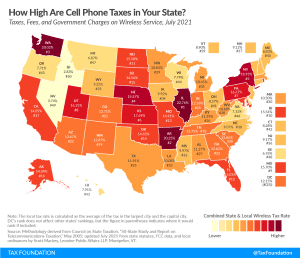
Taxes and fees on the typical American wireless consumer increased again this year, to a record 24.96 percent.
32 min read
In an effort to raise roughly $100 billion, the House proposal would double cigarette taxes and increase all other tobacco and nicotine taxes to comparable rates—a strategy with severe unintended consequences.
5 min read
One of the Senate’s proposals to pay for the Build Back Better Act is a federal excise tax on virgin plastics, which are plastics that are not reprocessed or recovered.
4 min read
A carbon tax would be a less economically harmful pay-for than either personal or corporate income tax hikes and a more efficient way to reduce carbon emissions than green energy tax credits, but would come with other trade-offs.
4 min read

The potential federal tax increase of over 1,600 percent on dipping tobacco as a result of the House Democrats’ proposal could result in state taxes and retail prices increasing by more than 50 percent in certain states.
4 min read
As Congress considers several tax proposals designed to raise taxes on high-income earners, it’s worth considering the distribution of the existing tax code.
3 min read
House Democrats’ newly released $3.5 trillion tax legislation includes a tax increase on tobacco, nicotine, and vapor products levied on tobacco manufacturers. But ultimately it would fall heavily on tobacco consumers—many of the group that earns less than $400,000 that President Biden pledged would not see a tax increase.
6 min read
The Biden administration does have a point about how some components of the infrastructure bill could put downward pressure on inflation in the long term. However, the taxes chosen to pay for those investments would counteract those effects, by reducing investment and productivity growth.
4 min read
Congressional lawmakers are putting together a reconciliation bill to enact much of President Biden’s Build Back Better agenda. Many lawmakers including Senate Finance Committee Chair Ron Wyden (D-OR), however, want to make their own mark on the legislation.
5 min read
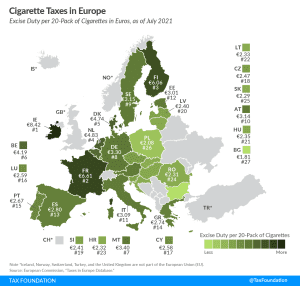
Ireland and France levy the highest excise duties on cigarettes in the EU, at €8.42 ($9.60) and €6.61 ($7.53) per 20-cigarette pack, respectively. This compares to an EU average of €3.34 ($3.80). Bulgaria (€1.81 or $2.06) and Poland (€2.08 or $2.37) levy the lowest excise duties.
3 min read
Taxes will play an important role in the success or failure of federal cannabis reform. Since the federal government is late to the party, it should proceed with caution when imposing new taxes.

How should policymakers view crypto? How big is the issue of tax evasion in the cryptocurrency market and what can realistically be done to curb it? Is it possible to design a rational tax system around what, at times, can appear to be a less-than-rational market and, if so, what should it look like?
While the excise tax penalty in H.R. 3 is referred to as a 95 percent tax rate, it actually amounts to a 1,900 percent tax rate because of how the proposal defines the tax base. In other words, under the H.R. 3 tax penalty, a drug that sells for $100 would incur a $1,900 tax.
3 min read
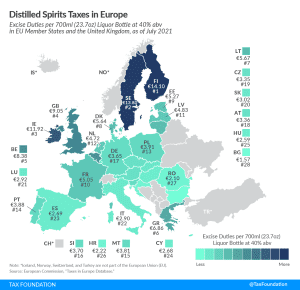
The highest excise duties are applied in Finland, Sweden, and Ireland, where the rates for a standard-size bottle of liquor are €14.10 ($16.08), €13.80 ($15.73), and €11.92 ($13.59), respectively.
3 min read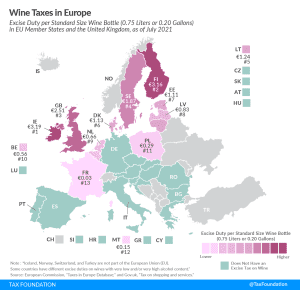
As one might expect, southern European countries that are well-known for their wines—such as France, Greece, Portugal, and Spain—either don’t tax it or do so at a very low rate. But travel north and you’ll see countries that tend to levy taxes on wine—and often hefty taxes.
3 min read
Tackling climate change and shifting the economy towards renewable energy has been a key part of the Biden administration’s agenda. However, this effort must first confront an overly complicated and non-neutral tax code, particularly in how it treats nuclear energy, for the White House to reach its ambitious goals.
6 min read