Spain’s Tax Competitiveness Has Declined Since 2018
Under Spain’s current Social Democratic government, the country has fallen from 27th to 35th (out of 38 OECD countries) in the International Tax Competitiveness Index.
8 min read
Academic studies show that higher corporate tax rates depress worker wages and lead to fewer jobs. An Organisation for Co-operation and Development (OECD) study has found that the corporate tax is the least efficient and most harmful way for governments to raise revenue.

Under Spain’s current Social Democratic government, the country has fallen from 27th to 35th (out of 38 OECD countries) in the International Tax Competitiveness Index.
8 min read
Nearly half of all hospitals are exempt from paying US corporate income taxes. As healthcare spending rises, lawmakers have questioned whether hospitals are providing as much in community benefits as they derive from tax exemptions.
11 min read
As scrutiny over data center investment and AI rises, some commentators are concerned about how expensing interacts with these ongoing investments. Most of these concerns misunderstand what expensing does.
5 min read
Hall’s research helped economists understand how taxes distort investment decisions, while his work with Rabushka shows how to minimize those distortions. Although the US remains far from a pure consumption tax, Hall’s work informs efforts to reduce the tax burden on investment, improve neutrality, and promote long-run economic growth.
3 min read
While there are many factors that affect a country’s economic performance, taxes play an important role. A well-structured tax code is easy for taxpayers to comply with and can promote economic development while raising sufficient revenue for a government’s priorities.
72 min read
The federal government’s debt burden and interest on the debt are near record levels and headed higher, raising legitimate concerns about an eventual debt crisis. Given the increasingly dysfunctional budget process, the most viable option on the table to stave off such a crisis is a statutory bipartisan fiscal commission with buy-in from leaders of both parties.
6 min read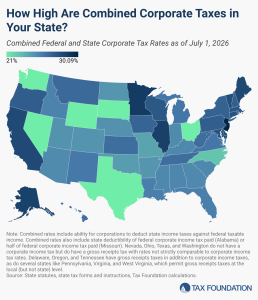
Corporations in the United States pay federal corporate income taxes levied at a 21 percent rate. Forty-four states and DC also levy taxes on corporate income, with top marginal rates ranging from 2.5 percent in North Carolina to 11.5 percent in New Jersey.
2 min read
On Election Day, Coloradans will get to decide on two competing measures on income taxes: an initiated statute that would cap income taxes at the current 4.4 percent rate; and a constitutional amendment that would authorize a graduated-rate individual and corporate income tax, paired with an initiated statute setting new rates, with a top rate of 8.4 percent.
6 min read
The Rental Housing Investment Act (RHIA) would remove much of that tax penalty by allowing developers of new rental housing to immediately deduct up to $150,000 of cost per unit.
7 min read
Congress has passed some major simplifying reforms in recent years, but the tax code has still grown more complex over the past few decades. New carveouts, savings vehicles, and targeted tax increases would complicate it further.
8 min read
Americans will spend 6.9 billion hours complying with IRS tax filing and reporting requirements in 2026, costing about $387 billion in lost productivity. Including an additional $157 billion in out-of-pocket costs, complying with the federal tax code will cost Americans more than $544 billion this year, over 1.7 percent of GDP.
10 min read
Expensing for capital investment is not a special tax break. Expensing aligns the timing of tax deductions with the timing of actual capital expenditures so that the tax code does not discourage marginal investment projects.
7 min read
There is a real danger that the well-founded admiration of expensing can slip into the belief that rates will not matter if the business tax base is correctly designed. Avi-Yonah’s article is a recent and well-articulated version of this intellectual undercurrent.
7 min read
A Destination-Based Cash Flow Tax (DBCFT) reduces the tax code’s penalty on investment, narrows its bias toward debt over equity, and removes much of the incentive to shift profits abroad.
7 min read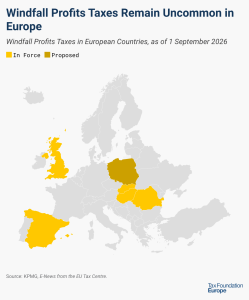
As energy prices have declined, European countries have switched the focus of their windfall profits taxes—a one-time tax levied on a company or industry when economic conditions result in large, unexpected profits—from energy providers to the banking and financial sector.
7 min read
Economists and journalists have been pointing to a labor share of income series from the Bureau of Labor Statistics (BLS) as evidence that capital is taking an ever-increasing slice of the economic pie. But a closer look at the national income accounts shows a different story.
7 min read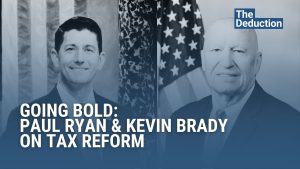
Ten years ago, then-Speaker Paul Ryan and Ways and Means Chairman Kevin Brady released the “Better Way” Tax Plan, the blueprint that would eventually become the Tax Cuts and Jobs Act of 2017—the largest overhaul of the US tax code in over 30 years.

If America’s leaders today want to learn how to build a lasting system on the foundation of simplicity and neutrality, they should follow the Siim Kallas blueprint.
4 min read
The Belgian proposal departs significantly from sound tax policy principles and risks generating substantial economic distortions, legal uncertainty, and trade frictions while raising relatively little revenue.

Federal government debt is over $32 trillion, around the size of the nation’s annual economic output (its gross domestic product, or GDP). Debt levels this high mean US borrowing costs are sensitive to interest rate changes that may otherwise seem small.
5 min read