

All Related Articles

Fiscal Forum: Future of the EU Tax Mix with Dr. Jean-Philippe van West
Sean Bray interviews Dr. Jean-Philippe van West, Professor of International and European tax law at Vrije Universiteit Brussel, about the future of the EU tax mix.
10 min read
The Transatlantic Balancing Act
Instead of getting stuck in a reactionary posture, European countries should simply aim for competitiveness, and the EU can support that work with stronger, more stable trade relationships.

Does the G7 Global Minimum Tax “Side-by-Side” Solution Give US Multinationals an Advantage?
Rather than returning to a world of retaliatory tax measures and transatlantic disputes, the OECD should continue to decrease the compliance costs of Pillar Two by simplifying the rules to reduce any possible risk that the US has a compliance cost advantage and working with G7 countries on a side-by-side solution.
6 min read
Testimony: Kansas Sales Tax Modernization and Income and Property Tax Relief Considerations
Kansas policymakers’ proposal to expand the sales tax base is well-intentioned but could be designed more prudently.

Windfall Profits Taxes in Europe, 2025
As energy prices have declined, European countries have switched the focus of their windfall profits taxes—a one-time tax levied on a company or industry when economic conditions result in large, unexpected profits—from energy providers to the banking and financial sector.
6 min read
One Big Beautiful Bill Act’s Corporate Tax Changes Benefit US Manufacturing the Most
The industry breakdown of the OBBBA corporate tax cuts shows firms in industries involved with tangible production, such as manufacturing, are the biggest winners, as measured by changes in tax liability.
3 min read
Fiscal Forum: Future of the EU Tax Mix with Dr. Irma Mosquera Valderrama
Sean Bray interviews Dr. Irma Mosquera Valderrama, Full Professor of Tax Governance at Leiden Law School (Leiden University) and EU Jean Monnet Chair Holder on EU Tax Governance about the EU tax mix.
24 min read
Tax Complexity Now Costs the US Economy over $536 Billion Annually
Americans will spend almost 7.1 billion hours complying with IRS tax filing and reporting requirements in 2025. This is equal to 3.4 million full-time workers—almost the population of Los Angeles and nearly 38 times the workforce the IRS employed in FY 2024—doing nothing but tax return paperwork for a full year.
9 min read
Trump Tariffs Explained: Grocery Prices and Rebate Checks
Trump’s 2025 tariffs will hit nearly three-quarters of US food imports, raising prices on products that are often difficult or impossible to produce domestically. Senator Hawley has proposed a rebate program to return some of the revenue to households—but would it actually help?

Reviewing the International Tax Provisions in the One Big Beautiful Bill Act
The OBBBA moved the US international tax system in the right direction on several fronts. However, some of the changes, while encouraging certain domestic activity and exports, may harm physical activity abroad that supports US competitiveness and domestic activity.
8 min read
State Tax Implications of the One Big Beautiful Bill Act
For Congress, work on the One Big Beautiful Bill Act is done. But in state capitols, the work has not yet begun. Many of the tax changes in the federal reconciliation act flow through to state tax codes—automatically in some states, and subject to an update in states’ Internal Revenue Code conformity date in others.
39 min read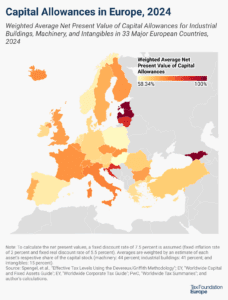
Capital Allowances in Europe, 2025
Although sometimes overlooked in discussions about corporate taxation, capital allowances play an important role in a country’s corporate tax base and can impact investment decisions—with far-reaching economic consequences.
6 min read
The Future of BEAT
Even when international relations are frayed, there is value in finding ways to combat corporate profit shifting while also fostering a healthy commercial atmosphere and positive trade relations.
7 min read
FAQ: The One Big Beautiful Bill, Explained
Our experts explain how this major tax legislation may affect you and how policymakers can better improve the tax code.
24 min read
The OBBBA Gets Expensing Right. States Should Follow Suit.
However states choose to respond to other tax provisions of the One Big Beautiful Bill Act, they should conform to the pro-growth provisions, which represent a marked improvement in the corporate tax code.
12 min read
Oklahoma Continues to Pursue Pro-Growth Tax Reforms, but the Job Is Not Done
Oklahoma can continue to enhance its competitiveness by pursuing a variety of reforms to the corporate and individual income tax, but it should avoid policies that would negatively impact the economy, like enacting a wholesale elimination of the property tax.
6 min read
The EU Budget’s CORE Is Rotten
The European Commission proposed new budget options for 2028 to 2034. It is worth zooming in on one new proposal for revenues that would support EU-level spending. The “Corporate Resource for Europe,” or CORE, provides a good opportunity to think through how best to raise revenue for the EU budget.
5 min read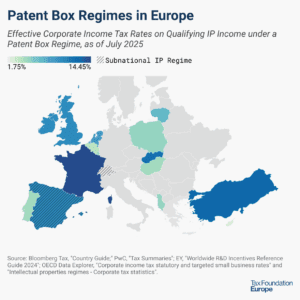
Patent Box Regimes in Europe, 2025
The aim of patent boxes is generally to encourage and attract local research and development (R&D) and to incentivize businesses to locate IP in the country. However, patent boxes can introduce another level of complexity to a tax system, and some recent research questions whether patent boxes are actually effective in driving innovation.
4 min read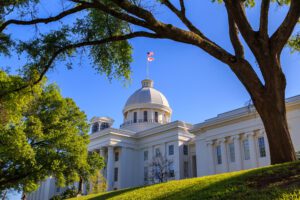
Alabama’s 2025 Legislative Session Advances Pro-Growth Tax Reforms
Alabama’s 2025 legislative session mostly demonstrates a commitment to pro-growth tax policies that enhance competitiveness and reduce compliance burdens.
4 min read