New Congressional Data Center Tax Proposals Threaten US AI Investment
US policymakers have put forward two new tax proposals to address concerns about how artificial intelligence (AI) will impact land, energy, and the workforce.
7 min read
US policymakers have put forward two new tax proposals to address concerns about how artificial intelligence (AI) will impact land, energy, and the workforce.
7 min read
If Canada doesn’t make these provisions permanent, it will drop to 12th place in the capital cost recovery ranking once provisions expire in 2034.
5 min read
Some taxes have more powerful economic effects than others, and that’s a lesson policymakers should absorb as they work to craft a tax code that encourages growth and raises sustainable revenue.
8 min read
The OBBBA made substantial improvements to cost recovery, but more opportunities remain for policymakers looking to improve the investment climate in the US.
48 min read
The EU Tax Omnibus proposal would create an EU-wide minimum standard for full expensing, but it confines that standard to qualifying tangible assets used in research and development (R&D) rather than to broader asset classes.
16 min read
Rather than adopt temporary policies that phase out and expire, policymakers should focus their efforts on long-term reforms to support investment.
7 min read
Foreign R&D generally complements domestic innovation rather than substituting for it, so penalizing foreign R&D weakens US firms in cross-border mergers and acquisitions and in domestic production that depends on global scale.
7 min read
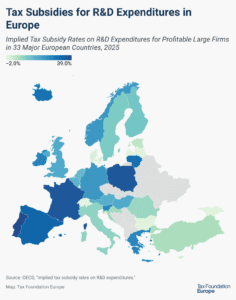
Many countries incentivize business investment in research and development (R&D), intending to foster innovation. A common approach is to provide direct government funding for R&D activity. However, a significant number of jurisdictions also offer R&D tax incentives.
5 min read
Debates over tax fairness and anti-avoidance rules have dominated European tax policy circles for over a decade. However, as geoeconomic pressures increase around the world, policymakers are looking for ways to boost European competitiveness and economic growth.
18 min read
Revenue-neutral proposals, like many things in politics, have become a relic of the past.
Carryover provisions help businesses “smooth” their risk and income, making the tax code more neutral across investments and over time.
5 min read
This study simulates several large tax increases and consistently finds that even tax increases large enough to close the primary deficit in the near term will lose ground over time and fail to put the debt on a sustainable course.
41 min read
For many, the OBBBA made tax filing easier and put more money back into their pockets. But it didn’t improve the grade for overall tax complexity for the US. It may actually make the situation worse.
New IRS data shows the US federal income tax system continues to be progressive as high-income taxpayers pay the highest average income tax rates. Average tax rates for all income groups remain lower after the Tax Cuts and Jobs Act (TCJA).
6 min read
Policymakers should broaden and make permanent full expensing for additional asset classes and pursue structural reforms that reduce distortions in how businesses are taxed. A more consistent and predictable policy environment, paired with targeted improvements to loss treatment, R&D incentives, and compliance burdens, would give small business owners greater confidence to invest, hire, and grow.
The past decade’s record suggests that countries have reliable legislative methods to improve their tax systems through ordinary tax reforms.
22 min read
Smaller corporate tax bills after the OBBBA are not evidence of new giveaways or loopholes. They are evidence the tax code is finally treating investment the way it should.
The OBBBA significantly boosted economic prospects by improving the treatment of investment. By making key expensing provisions permanent, the OBBBA created better conditions for long-term growth. However, there’s still work to be done, and the OBBBA provided a blueprint for policymakers to follow.
4 min read
One year later, the evidence shows the tariffs were not reciprocal, did not generate the promised investment boom, raised less revenue than projected, and contributed to higher prices.
Facts & Figures serves as a one-stop state tax data resource that compares all 50 states on over 40 measures of tax rates, collections, burdens, and more.
2 min read