In a statement released on September 15th, Canada’s Minister of Finance and National Revenue François‑Philippe Champagne announced that full expensing for machinery, equipment, and patent rights will be made permanent. This is good news for capital investment in Canada since permanence gives investors a reliable expectation of low cost of capital and reduces the tax bias against long-term investments.
In contrast, the gradual expiration of full expensingFull expensing allows businesses to immediately deduct the full cost of certain investments in new or improved technology, equipment, or buildings. It alleviates a bias in the tax code and incentivizes companies to invest more, which, in the long run, raises worker productivity, boosts wages, and creates more jobs. after 2029 would have forfeited these gains by gradually returning to less competitive cost recoveryCost recovery refers to how the tax system permits businesses to recover the cost of investments through depreciation or amortization. Depreciation and amortization deductions affect taxable income, effective tax rates, and investment decisions. provisions between 2030 and 2033. Future budgets can build on this crucial step forward by extending permanence to full expensing for manufacturing and processing buildings and accelerated depreciationDepreciation is a measurement of the “useful life” of a business asset, such as machinery or a factory, to determine the multiyear period over which the cost of that asset can be deducted from taxable income. Instead of allowing businesses to deduct the cost of investments immediately (i.e., full expensing), depreciation requires deductions to be taken over time, reducing their value and disco for other buildings and structures.
Background
In 2018, the Canadian government increased its capital allowances as a response to the temporary bonus depreciationBonus depreciation allows firms to deduct a larger portion of certain “short-lived” investments in new or improved technology, equipment, or buildings in the first year. Allowing businesses to write off more investments partially alleviates a bias in the tax code and incentivizes companies to invest more, which, in the long run, raises worker productivity, boosts wages, and creates more jobs. provided by the 2017 TaxA tax is a mandatory payment or charge collected by local, state, and national governments from individuals or businesses to cover the costs of general government services, goods, and activities. Cuts and Jobs Act (TCJA) in the United States. In 2018, Canada adopted temporary immediate expensing for equipment and machinery used in the manufacturing and processing of goods, and for qualified clean energy investments. It also adopted accelerated depreciation schedules for non-residential buildings and intangible assets.
These temporary policies initially began phasing out in 2024. However, they were reinstated in 2025 and were supposed to stay in effect until 2029, after which they would have gradually phased out between 2030 and 2033. Immediate expensing was also implemented for patents, data network infrastructure equipment, and general‑purpose electronic data-processing equipment and systems software acquired after April 15, 2024, and that becomes available for use before 2027.
The rest of these policies were scheduled to phase out until they fully expired after 2033. Buildings used in manufacturing and processing would have seen their first-year write-off drop from 15 percent in 2025 to 10 percent in 2034; other nonresidential buildings would have decreased from 9 percent to 6 percent. Without permanent full expensing, Canada’s deduction for equipment and machinery would have decreased from 100 percent in 2025 to 93.5 percent in 2034, measured in net present value terms. Additionally, by the end of 2027, intangible assets would have experienced the second-lowest capital cost recovery in the Organisation for Economic Co-operation and Development (OECD), at just 43 percent. Although Canadian businesses could deduct 85 percent of their capital investments across all asset types in 2025, this figure was projected to decline to 72.8 percent by 2034.
Additionally, a second bill that would implement provisions from the 2025 budget is currently making its way through the Senate and is expected to introduce immediate expensing for manufacturing and processing buildings. If passed, temporary immediate expensing would apply to eligible buildings acquired on or after November 4, 2025.
The Proposal for Permanent—and Broader—Full Expensing
The Canadian government’s proposal, dubbed the “Productivity Mega Deduction,” would make full expensing permanent for machinery and equipment as well as patent rights instead of letting the provisions phase out after 2029. The Ministry of Finance claims that the measure would also broaden the scope of full expensing from 15 percent to about two thirds of private business capital investment. However, it would still keep phasing out temporary full expensing of manufacturing and processing buildings and accelerated depreciation for other non-residential buildings.
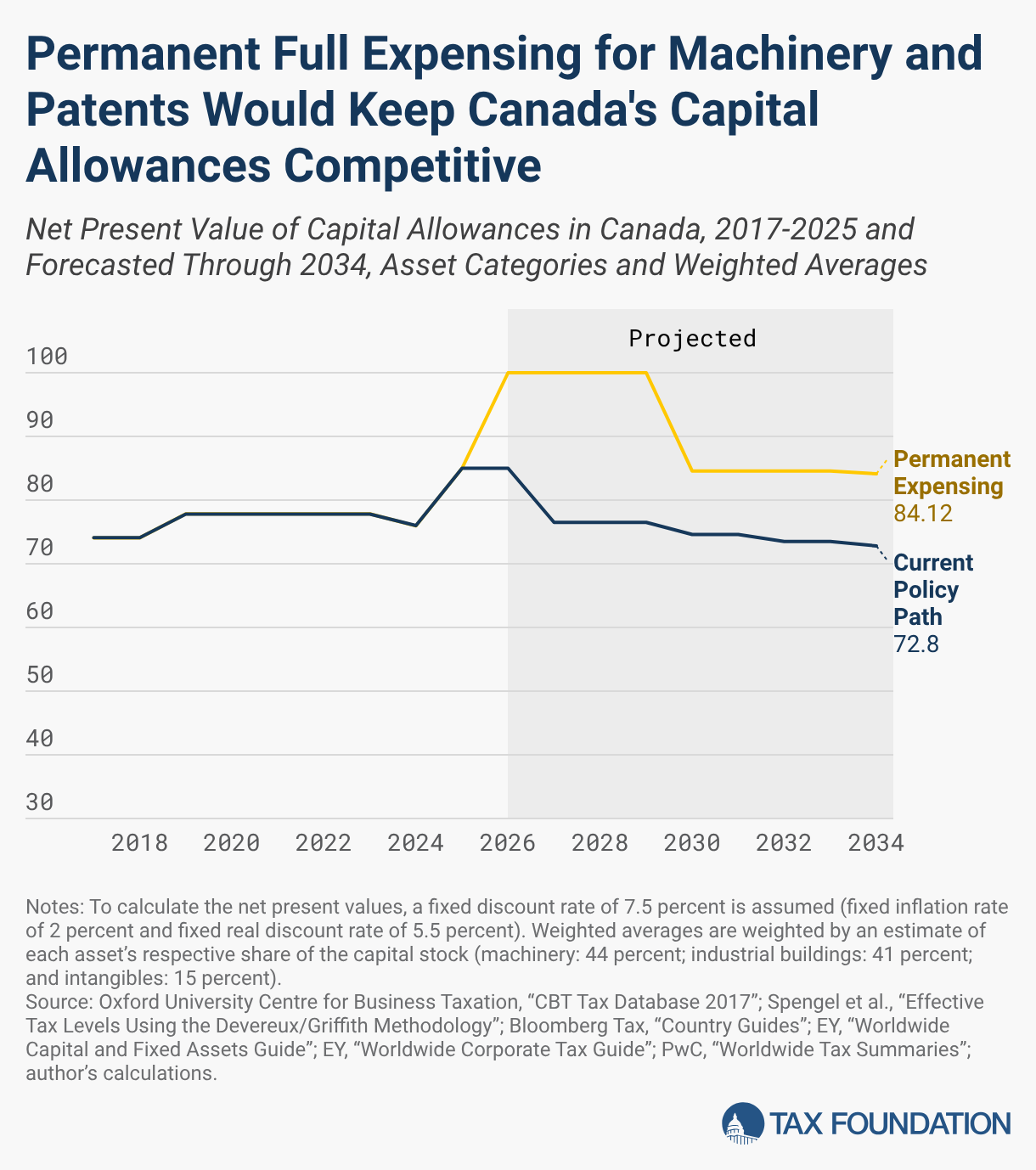
If enacted, the government’s proposal would keep allowing businesses to immediately deduct the full cost of their capital expenditures on machinery and equipment upon availability for use.
In 2030, full expensing for manufacturing and processing buildings would start phasing out, reducing its value from 100 to 61.4 percent of purchasing costs by 2034. After that, businesses could still permanently deduct 84.1 percent of their capital investment costs across the capital stock, instead of eroding down to 72.8 percent by 2034 if Canada were to let its full expensing provisions phase out as scheduled.
The proposal would give businesses a more reliable investment environment that keeps the cost of capital investment low across the economy, supporting private sector capital investment and long-term economic growth.
The Productivity Mega Deduction Would Mostly Consolidate the Competitiveness of Canada’s Capital Cost Recovery Regime
In international comparison, the government’s proposal for full expensing permanence would lift Canada’s capital cost recovery up to 4th best among all 38 OECD countries instead of dropping back to 7th after the United States’ temporary full expensing provisions for industrial buildings phase out between 2028 and 2030. For 2026 to 2029, before phasing out its own full expensing for manufacturing and processing buildings, Canada will have the best capital cost recovery in the OECD, together with Estonia and Latvia.
By 2030, Canada’s broad full expensing regime would give businesses the best cost recovery among any large, developed economy, with a net present value of around 84.1 percent across the capital stock, compared to a current OECD average of 68.8 percent. Canada would outperform large economies with broad full expensing regimes like the United States, the United Kingdom, and the European Union, should the European Commission’s narrower R&D full expensing proposal within the Omnibus come into effect. The three Baltics would be an exception.
While Lithuania introduced permanent full expensing for machinery and equipment as well as most acquired intangible rights starting in 2026, Estonia and Latvia operate distribution-based corporate tax systems under which profits are not taxed annually but only upon distribution to shareholders, granting them cost recovery equivalent to full expensing for all investments. Their cost recovery can even be more beneficial than that for companies which are unable to take full advantage of deductions immediately (due to temporary losses or unused loss carryforwards) and during long delays between capital outlays for an asset and its availability for use.
The United States made full expensing permanent for machinery and equipment and temporarily extended it to most industrial buildings, including roughly 10-15 percent of all buildings and structures, currently offering a broader expensing regime than Canada. However, as the US full expensing provision for industrial buildings is set to phase out between 2028 and 2030, before the Canadian accelerated depreciation for non-residential buildings, Canadian capital allowances are on track to become more favorable than those of its southern neighbor under the current proposal.
When viewed through the lens of the International Tax Competitiveness Index 2025 (ITCI), the reform largely consolidates Canada’s recently improved position over time. Among the 38 OECD countries in the Index, the temporary expensing provisions of the 2025 budget, if approved in their totality, would lift Canada’s corporate rank up by eight spots, from 22nd to 14th. Making full expensing for machinery and patents permanent would consolidate its position at 19th in 2030 given the current trajectory of other countries’ capital allowances and prevent it from falling back to 22nd position again.
Stay informed on the tax policies impacting you.
Subscribe to our free newsletter to get the latest tax data, news and analysis.
Subscribe