Sources of US Tax Revenue by Tax Type, 2024
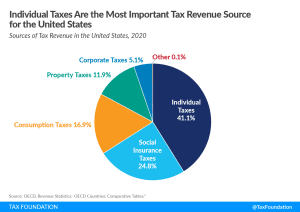
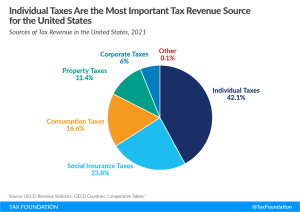
Different taxes have different economic effects, so policymakers should always consider how tax revenue is raised and not just how much is raised.
3 min read
Different taxes have different economic effects, so policymakers should always consider how tax revenue is raised and not just how much is raised.
3 min read
Designing tax policy in a way that sustainably finances government activities while minimizing distortions is important for supporting a productive economy.
3 min read
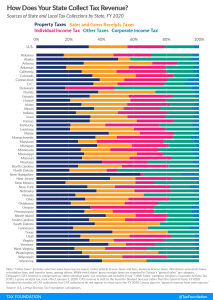
Contrary to initial expectations, the pandemic years were good for state and local tax collections, and while the surges of 2021 and 2022 have not continued into calendar year 2023, revenues remain robust in most states and well above pre-pandemic levels even after accounting for inflation.
5 min read
Lawmakers should simplify the tax code so that taxpayers can understand the laws and the IRS can administer them with minimum cost and frustration.
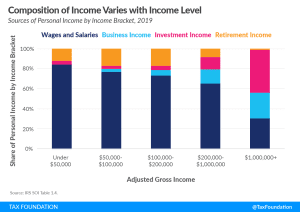
Reviewing reported income helps to understand the composition of the federal government’s revenue base and how Americans earn their taxable income. The individual income tax, the federal government’s largest source of revenue, is largely a tax on labor.
10 min read
Lawmakers should focus on simplifying the federal tax code, creating stability, and broadly improving economic incentives. There are incremental steps that can be made on the path to fundamental tax reform.
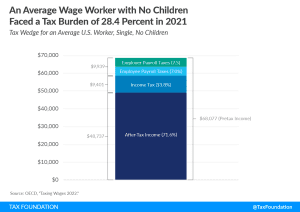
Although the U.S. has a progressive tax system and a relatively low tax burden compared to the OECD average, average-wage workers still pay more than 30 percent of their wages in taxes.
4 min read
Our recent policy conference brought together academics and political leaders to present research on some of the most pressing issues in global tax policy and to discuss solutions that can unlock genuine global growth.
9 min read
Spain should follow the examples of Italy and the UK and enact tax reforms that have the potential to stimulate economic activity by supporting private investment while increasing its international tax competitiveness.
7 min read


When designed well, excise taxes discourage the consumption of products that create external harm and generate revenue for funding services that ameliorate social costs. The effectiveness of excise tax policy depends on the appropriate selection of the tax base and tax rate, as well as the efficient use of revenues.
83 min read
Younger and healthier Brits have created a $17.1 billion budget hole by smoking and drinking less. Yet, despite this resounding piece of positive news, some see any decline in tax revenues as a public finance crisis. Excise taxes target a tax base that is intended to shrink. Less consumption is a stated goal of the policy.
3 min read
The overall U.S. tax and transfer system is overwhelmingly progressive, and understanding the extent—and source—of that progressivity is essential for lawmakers considering the trade-offs associated with each tax policy decision.
23 min read
Federal spending, deficits, and debt are at unsustainable levels. The proposed federal budget is laden with redundant programs, obsolete programs, corporate welfare, and nationalized industries. As Congress begins to craft the FY 2024 federal budget, it needs to establish a process of systematically reviewing programs and priorities.
Different taxes have different economic effects, so policymakers should always consider how tax revenue is raised and not just how much is raised.
4 min read
California is losing tax revenue while consumers turn to cross-border purchases or, often, illicit trade of flavored cigarettes, which makes everyone worse off.
4 min read
Designing tax policy in a way that sustainably finances government activities while minimizing distortions is important for supporting a productive economy.
5 min read
The FairTax is a proposal to replace all major sources of the federal government’s revenue—the individual income tax, corporate income tax, estate and gift taxes, and payroll tax—with a national sales tax and rebate, abolishing the IRS in the process.
7 min read
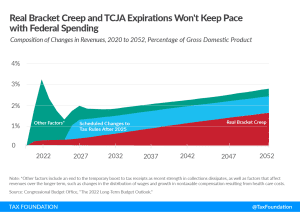
Federal tax collections are approaching the highest levels in U.S. history set during World War II and again during the dot-com bubble in 2000. Meanwhile, federal spending in FY 2022 was over 25 percent of GDP—a level only exceeded during the height of the pandemic in 2020 and 2021, and during World War II.
4 min read
Alaska policymakers are understandably concerned about the long-term viability of the state’s overwhelming reliance on the oil and gas industry for revenue, but the state’s unique economy and geography, and low population density make some of the “traditional” taxes less efficient than they might be elsewhere.
55 min read