Spain’s Tax Competitiveness Has Declined Since 2018
Under Spain’s current Social Democratic government, the country has fallen from 27th to 35th (out of 38 OECD countries) in the International Tax Competitiveness Index.
8 min read

Under Spain’s current Social Democratic government, the country has fallen from 27th to 35th (out of 38 OECD countries) in the International Tax Competitiveness Index.
8 min read
While there are many factors that affect a country’s economic performance, taxes play an important role. A well-structured tax code is easy for taxpayers to comply with and can promote economic development while raising sufficient revenue for a government’s priorities.
72 min read
Wealth taxes have been a failure everywhere they’ve been tried, which may be why advocates for the California amendment are saying this is a new frontier. But the countries that have tried this gamble know the frontier well, and they’ve left it in the dust.

On September 15th, Canada announced that full expensing for machinery, equipment, and patent rights will be made permanent and broadened from around 15 percent to two thirds of business capital investment.
6 min read
While economic levers like sanctions and tariffs have long been recognized as geoeconomic tools, tax policies have rarely been considered a part of this toolkit.
36 min read
The new public country-by-country reporting regimes adopted by the EU and Australia, and changes from the Financial Accounting Standards Board for financial accounts, are meant to promote transparency by multinational enterprises but have ubiquitous structural differences.
10 min read
In June, the Dominican Republic rushed through a package of tax legislation in seven days. International examples demonstrate that consultation, transparency, and clarity are key factors for successful tax reform.
5 min read
If Canada doesn’t make these provisions permanent, it will drop to 12th place in the capital cost recovery ranking once provisions expire in 2034.
5 min read
Though they are often framed as affecting only the richest households, the economic effects of wealth taxes extend much further by reducing capital formation, discouraging entrepreneurship, curtailing wage and employment growth, and ultimately weakening the overall economy.
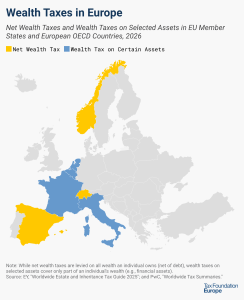
Wealth taxes not only collect little revenue and create legal uncertainty, but an OECD report argues that they can also disincentivize entrepreneurship, harming innovation and long-term growth.
5 min read
The EU Tax Omnibus proposal would create an EU-wide minimum standard for full expensing, but it confines that standard to qualifying tangible assets used in research and development (R&D) rather than to broader asset classes.
16 min read
Rather than adopt temporary policies that phase out and expire, policymakers should focus their efforts on long-term reforms to support investment.
7 min read
The ongoing economic uncertainty from global geopolitical threats, supply chain disruptions, rising interest rates, and lagging economic growth in many developed countries have highlighted the importance of private business investment.
32 min read
The 12-year history of Tax Foundation’s ITCI shows that tax policy is constantly in flux around the world and that tax policy design choices matter for economic growth.
5 min read
The EU public country-by-country data provides information on taxes and profits that do not align with standard financial disclosure requirements.
6 min read
Because withholding taxes can create double taxation and administrative friction even where foreign tax credits are available, the European Commission’s 2026 Tax Omnibus proposal to eliminate them on dividend, interest, and royalty payments between EU companies regardless of holding percentage would foster stronger cross-border savings and investment.
6 min read
The new data disclosures will draw significant attention in 2026 and beyond. However, because the data is rooted in financial accounting concepts, affected by timing issues, and shaped by inconsistent reporting regimes, it is poorly suited for drawing strong conclusions about tax policy or corporate behavior.
7 min read
A study from the Fraser Institute finds the US tax code is highly progressive relative to other OECD countries.
7 min read
Europe’s turn toward the UN is ultimately not a sign that governments are ready to resolve fundamental disputes over taxing rights. If anything, international cooperation on the goal that matters most—fair treatment of cross-border trade—is crumbling.

Currently, the European Commission has plans to generate more tax revenue to fund the forthcoming MFF, the long-term budget running from 2028 to 2034. But the truth is, without serious reform, the EU isn’t ready for new taxation.