






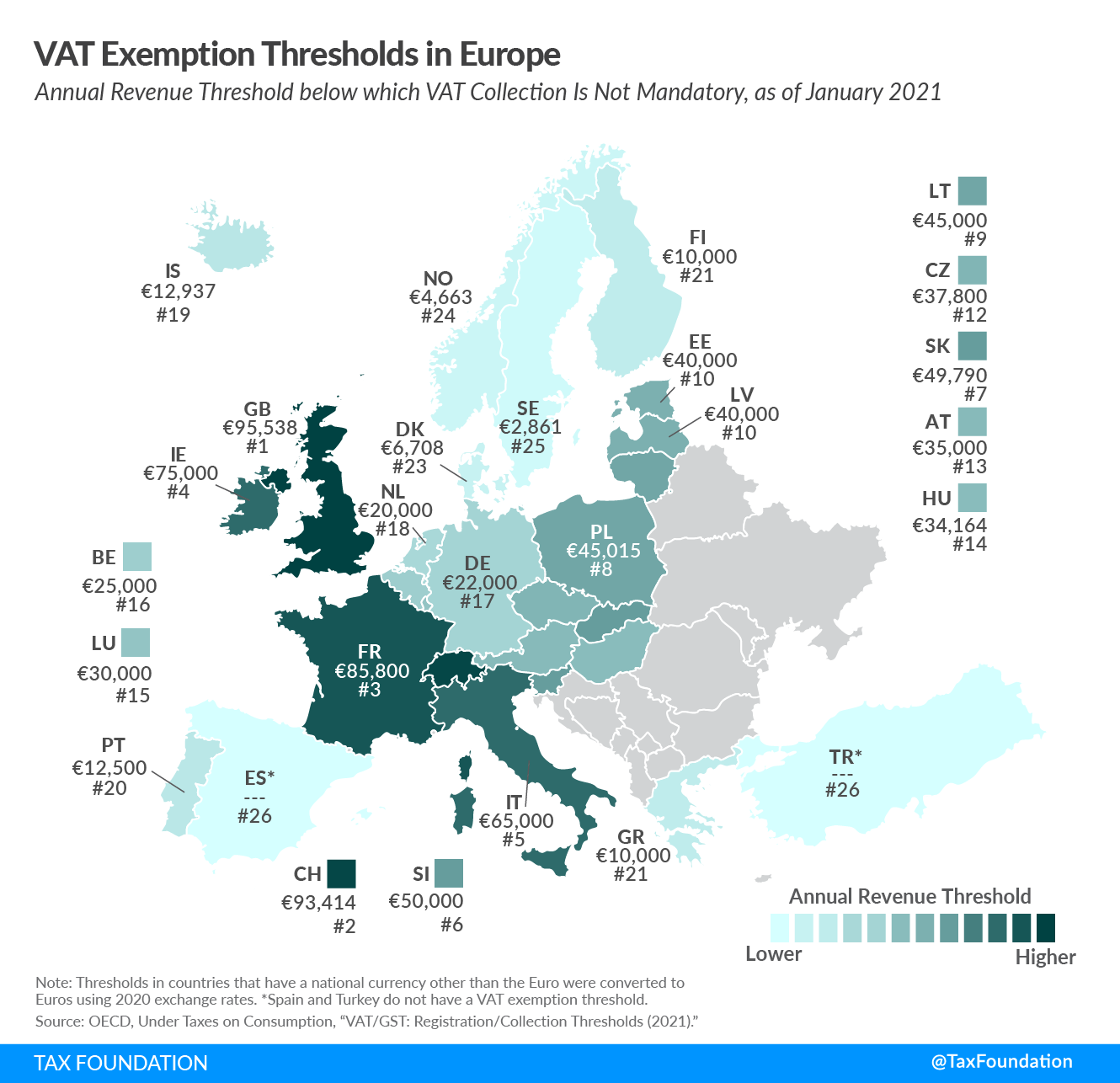
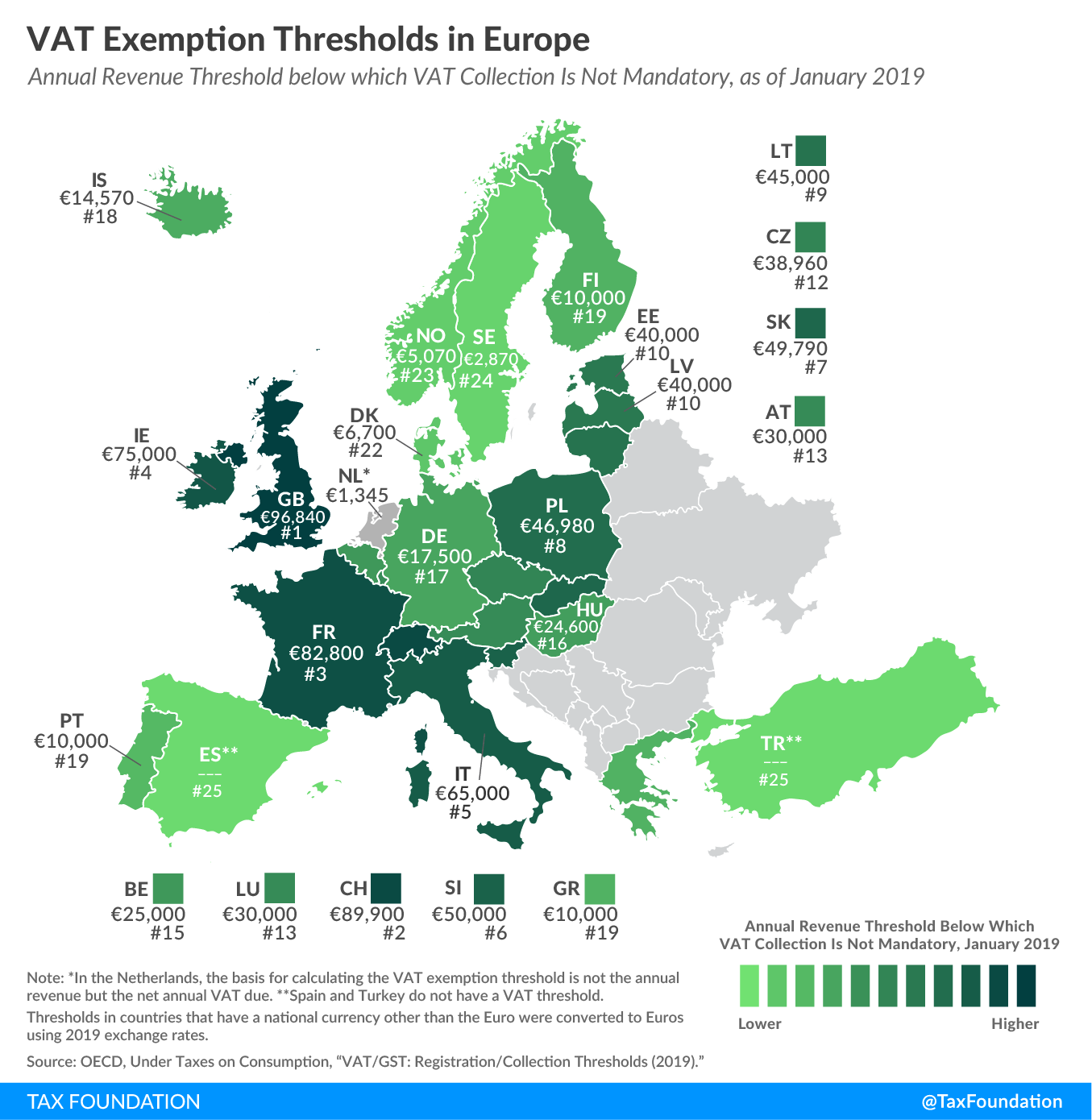
Across 32 major European countries, Switzerland has the highest absolute VAT exemption threshold, at CHF 100,000 (€106,724). The United Kingdom and France follow, at £90,000 (€105,043) and €87,000. Spain and Turkey are the only countries that do not have a threshold, meaning that all businesses are enrolled in the VAT system.
The same nominal amount can carry different economic weight across countries with varying price levels. Adjusting for purchasing power parity (PPP), Romania has the highest threshold at RON 395,000 ($202,206), followed by the Czech Republic and Italy, at CZK 2,000,000 ($155,039) and €85,000 ($140,246) respectively.
While VAT registration thresholds reduce administrative and compliance costs, they do so at the expense of taxA tax is a mandatory payment or charge collected by local, state, and national governments from individuals or businesses to cover the costs of general government services, goods, and activities. revenue. They also introduce a distortion by favoring smaller firms over larger ones, which can prevent businesses from realizing economies of scale as tax-advantaged micro-enterprises crowd out more productive competitors.
High thresholds also create a large "notch," or tax cliff, at the cutoff. A firm whose turnover edges one euro above the threshold suddenly owes VAT on its entire value added, not just the marginal amount. Empirical work consistently finds that firms respond by underreporting turnover or scaling back real activity to stay below the line.

The Czech Republic illustrates this effect. It maintains one of the highest VAT exemption thresholds in Europe in PPP terms, and the distribution of Czech corporations spikes sharply just below the cutoff, with the bunching point shifting together with the increase in the threshold. High VAT exemption thresholds can create substantial economic costs by distorting business size and incentivizing bunching behavior. Policymakers should seek to lower these costs by reducing or eliminating VAT exemption thresholds.
Recent Changes
Several European countries have recently increased their VAT registration thresholds. Hungary lifted its threshold from HUF 18 to 20 million (€45,250 to €50,280) in 2026 and is scheduled to increase it further to HUF 22 million (€55,310) by 2027. Poland lifted its threshold from PLN 200,000 to 240,000 (€47,170 to €56,610) from 2026, and Romania increased its threshold from RON 300,000 to RON 395,000 (€59,500 to €78,340) earlier in September 2025. The Belgian parliament has approved raising the VAT threshold from €25,000 to €30,000 in April 2026, with entry into force still pending.
Stay informed on the tax policies impacting you.
Subscribe to our free newsletter to get the latest tax data, news and analysis.
SubscribeAbout the Authors

Alex Mengden is an Economist at the Tax Foundation, where he focuses on international tax issues and tax policy in Europe. He holds a BA in philosophy and economics from the University of Bayreuth and an MSc in economics from the Ludwig Maximilian University of Munich.

Julius Graack is a European Tax Policy Fellow with Tax Foundation Europe, where he primarily focuses on the EU’s Multiannual Financial Framework and VAT.
Previous Versions
-
VAT Exemption Thresholds in Europe
3 min read -
VAT Exemption Thresholds in Europe
4 min read