On November 14 of last year, President Trump issued tariffTariffs are taxes imposed by one country on goods imported from another country. Tariffs are trade barriers that raise prices, reduce available quantities of goods and services for US businesses and consumers, and create an economic burden on foreign exporters. exemptions for various US food products, including beef, fruits, spices, and coffee. While these exemptions will reduce costs for US households, especially on food products that cannot be grown in the US, tariffs still apply to more than half of imported food products and will continue to raise prices for consumers.
In 2024, the US imported about $222 billion in food products, 74 percent of which ($164 billion) we originally estimated would face the International Emergency Economic Powers Act (IEEPA) tariffs prior to the new exemptions. The top five exporters of food products to the US in 2024, in order, were Mexico, Canada, the EU, Brazil, and China, accounting for 62 percent of total US food imports. As goods covered under the United States-Mexico-Canada Agreement (USMCA) are exempt from the tariffs, we originally estimated that about 63 percent of food imports from Canada and Mexico would continue to be imported into the US tariff-free. However, the share of Canada and Mexico imports that are USMCA-compliant has risen significantly since the tariffs were imposed, with the most recent data available showing that 82 percent of Canadian and Mexican food imports are now entering tariff-free.
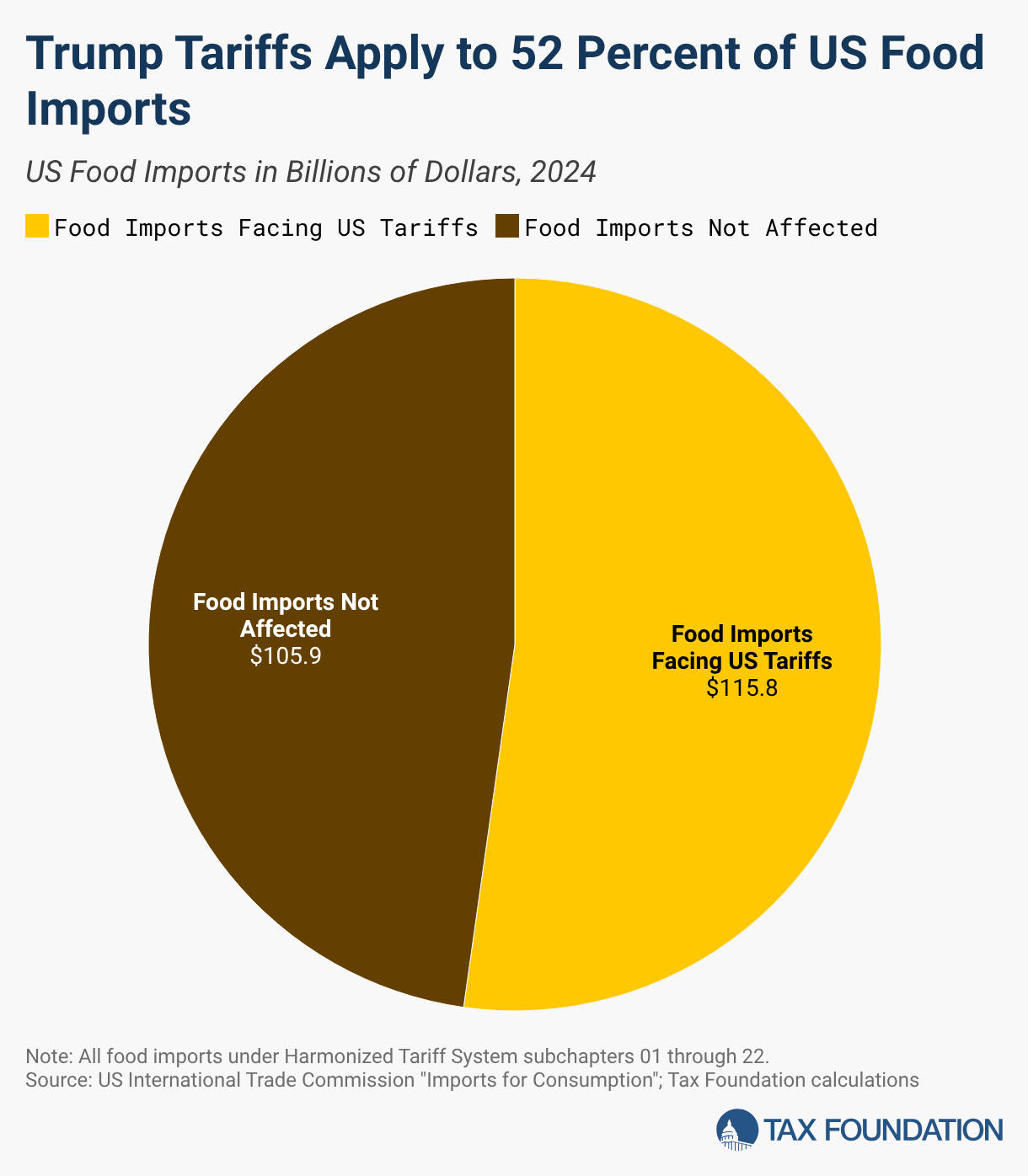
Accounting for increased USMCA coverage, the November 14 agriculture exemptions, and additional exemptions granted to Brazil, Malaysia, and Cambodia, we find that 52 percent of food imports worth about $116 billion face the IEEPA tariffs based on 2024 values. The top five food products that remain tariff-exposed are spirits and liqueurs ($11.3 billion), bread and other baked goods ($10.3 billion), beer ($7.5 billion), fresh fish fillets ($7.5 billion), and crustaceans like crabs and shrimp ($7.0 billion).
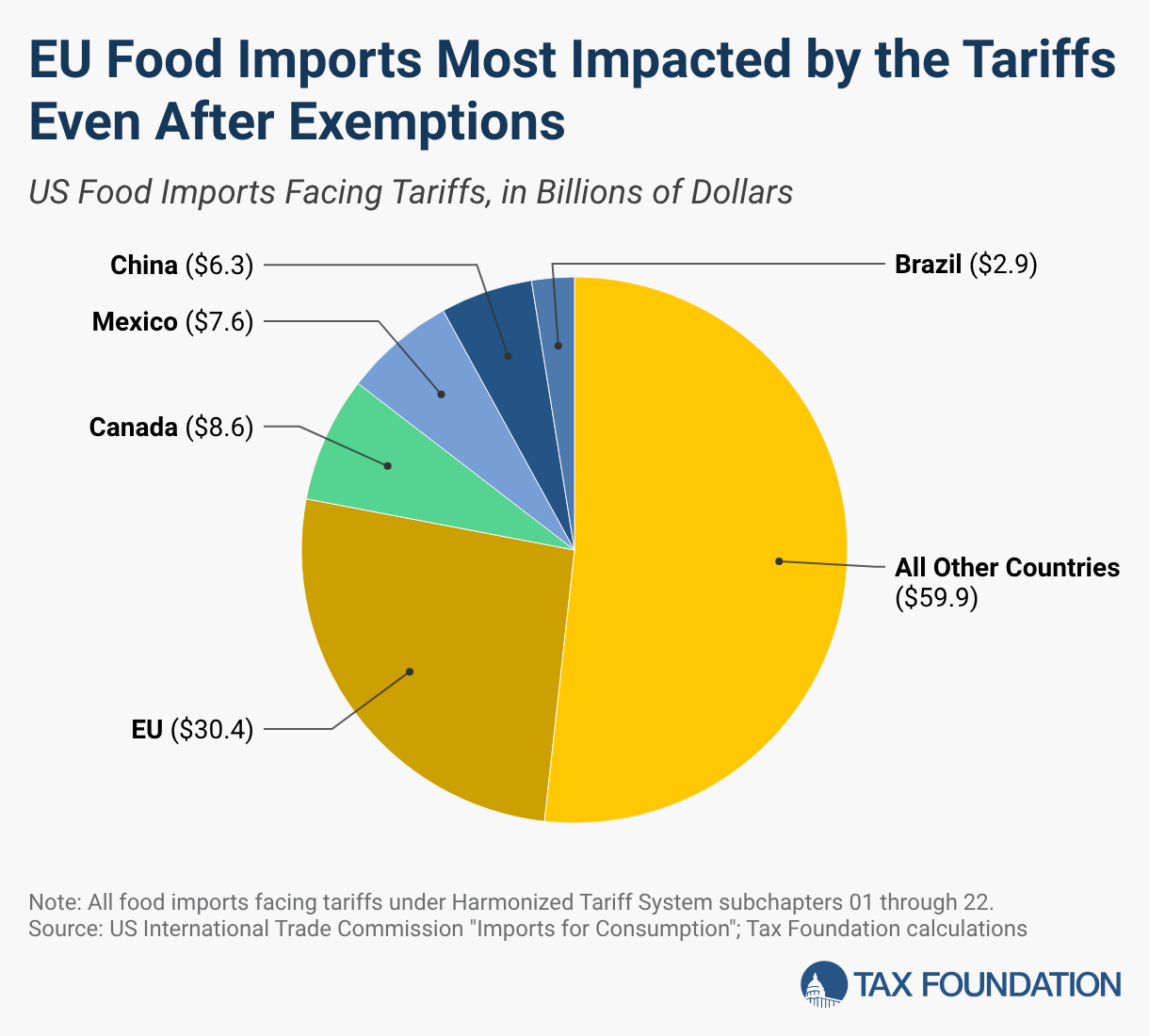
Accounting for exemptions, the chart below shows total food imports subject to the tariffs by country. Of the top five food exporters to the US, EU imports are affected the most: as of February 1, 96 percent of EU food imports continue to face an IEEPA tariff of 15 percent, including various wines and spirits, baked goods, and seafood.
Tariffs on the food sector have different impacts on the US economy compared to tariffs on manufacturing inputs and consumer goods. Consider, for instance, how a domestic manufacturer of soda could respond to a tariff on aluminum. The firm could continue to source aluminum for its cans from abroad, paying the higher import price due to the tariff. Or it could switch to the now relatively cheaper domestic supplier of aluminum.
However, in the case of food imports, the ability to switch to a domestic producer is not always available. Take bananas, for example. In 2023, the US imported over $2 billion worth of bananas, mostly from Guatemala and other Central American countries. The US has a limited ability to produce bananas, with few locations possessing the proper climate. As land is a scarce resource, banana producers in Florida and Hawaii would not be able to expand banana production as easily to meet US demand. The end result is that a tariff on banana imports would simply lead to US consumers paying higher prices for imported bananas, as happened through most of 2025. Notably, bananas were included on the November 14 exemptions list.
Returning to the soda can example, consumers are generally indifferent toward the sourcing of raw materials. That is, there is nothing special about US aluminum compared to Canadian aluminum, and, in this scenario, consumers would be fine paying for the same soda can made with domestic aluminum, though soda prices would still go up to the extent US aluminum costs more than Canadian aluminum.
However, consider a product like Brazilian coffee, which, until President Trump issued an agriculture exemptions list for Brazil in November, was facing a 50 percent tariff. To the extent that Brazilian coffee may have a unique flavor profile, US producers cannot simply make “Brazilian coffee” in the US. In this situation, some consumers may opt to simply pay the higher import price for Brazilian coffee rather than switch to another type.
President Trump has often defended tariffs on the grounds that they will boost domestic production and create jobs. However, in the case of food imports, it is often difficult or impossible to onshore production due to land scarcity and a lack of suitable climates for certain goods. Consumers also often prefer the foreign alternative to American-grown products, such as European wine and spirits. While the administration has tacitly recognized that the tariffs have impacted food prices by introducing new exemptions, consumers are still made worse off by the tariffs that remain on more than half of food imports.
Stay informed on the tax policies impacting you.
Subscribe to our free newsletter to get the latest tax data, news and analysis.
Subscribe