Digital Tax Deadlock: Where Do We Go from Here?
We recently hosted an exclusive webinar discussion to get up to speed on recent digital tax developments and gain insight from leading international tax experts on the OECD’s BEPS project.
9 min readScott Hodge is President Emeritus of the Tax Foundation, which he led as President for over two decades, between 2000 and 2022. Scott Hodge is recognized as one of Washington’s leading experts on tax policy, the federal budget, and government spending. After taking over the Tax Foundation, he grew the organization from a modest, six-person group with a storied brand into a national powerhouse with a staff of over 30, informing smarter tax policy at the federal, state, and global levels.
Scott led the development of the Tax Foundation’s most successful programs, the Taxes and Growth Dynamic Tax Modeling project and the State Business Tax Climate Index, two projects that have changed the terms of the tax debate, encouraged competition towards pro-growth tax policies, and demonstrated to policymakers and taxpayers alike the impact of the tax code on our daily lives. Combined with his experience in tax policy of more than 35 years, Scott was one of the driving forces of tax reform that culminated in the historic 2017 Tax Cuts and Jobs Act (TCJA). Congress and the White House turned to Scott and the Tax Foundation for guidance in crafting the once-in-a-generation legislation.
The TCJA was just the latest in a string of developments in tax policy that Scott helped foster. During the 1990s, he helped design the major tax components of the Contract with America that became the eventual centerpieces of the 1997 tax bill and the Bush tax cuts in 2001 and 2003.
Scott has written and edited three books on the federal budget and streamlining the government and has authored hundreds of studies on tax policy and government spending. He has also written dozens of editorials and opinion pieces for publications such as The Wall Street Journal, The Washington Post, USA TODAY, the New York Post and The Washington Times. And he has conducted more than 1,000 radio and television interviews—including with NBC Nightly News, CBS Evening News, CNN, Fox, Hardball with Chris Matthews, and C-SPAN.
Before joining the Tax Foundation, Scott was Director of Tax and Budget Policy at Citizens for a Sound Economy. He also spent ten years at The Heritage Foundation as a fellow analyzing budget and tax policy. He holds a degree in political science from the University of Illinois at Chicago.
We recently hosted an exclusive webinar discussion to get up to speed on recent digital tax developments and gain insight from leading international tax experts on the OECD’s BEPS project.
9 min read
By updating the tax code to allow developers to more fully cover their investments, construction costs will fall, which, in turn, means that federal affordable housing assistance dollars will go that much further in helping low-income tenants.
3 min read
Based on the CBO’s assessment of the economic and budgetary effects of federal investment, lawmakers should look to spur private sector investment rather than try to enact a massive federal infrastructure bill.
5 min read
What changed in the global economy that disrupted traditional means of taxation? Is it worth finding a way to include tax digital goods and services in the tax base? Why are digital services taxes so problematic? Are there better options—ways to adapt our current system without introducing complex and economically harmful policies?
2 min read
What are the best tax policies to encourage a smooth transition and strong economic recovery? How should goals of economic recovery and growth be balanced with revenue needs?
1 min read
Alesina’s work suggests that raising taxes to reduce the federal deficit and national debt would be an economic mistake. The less economically damaging path is to cut spending, what some have called austerity policies.
3 min read
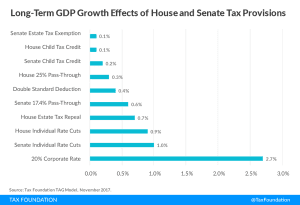
The Tax Foundation’s General Equilibrium Model suggests that allowing businesses to immediately deduct or “expense” their capital investments in the year in which they are purchased delivers the biggest bang for the buck in spurring economic growth and jobs compared to other tax policies.
7 min read
What challenges should we expect to face as the U.S. economy begins to re-open? When is the right time for legislators to start focusing on long-term recovery vs. short-term needs? What policies should federal legislators pursue to clear a path to recovery?
1 min read
Governments at all levels must work to remove the tax policy barriers that stand in the way of economic recovery and long-term prosperity following the COVID-19 crisis. Our new guide outlines several comprehensive options that policymakers can take at the federal and state levels.
26 min read
Seemingly unconcerned about how the digital project could impact the economy at this crisis moment, officials at the OECD recently released a statement boasting that they are continuing to work “full steam” on their global digital tax project.
5 min read
In contrast to the sweeping economic relief plan being considered by the U.S. Congress, the approach taken by the Australian government is much more targeted to supporting individuals and small to medium-sized businesses.
2 min read
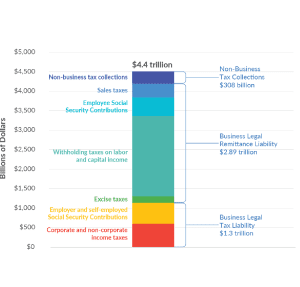
Setting aside the debate over whether a low tax bill is fair, what is missed in such stories is that American businesses are critical to the tax collection system at every level of government—federal, state, and local. Businesses either pay or remit more than 93 percent of all the taxes collected by governments in the U.S. Without businesses as their taxpayers and tax collectors, American governments would not have the resources to provide even the most basic services.
5 min read
Though the challenges to international tax policy are many, the OECD has a chance to work toward a system that creates fewer distortions and negative economic effects than the current one. However, given the policies on the table, it will certainly take quite an effort to avoid further complexity of international tax rules that creates challenges to global trade and economic prosperity.
The fall and then rise of entrepreneurial income claimed on the wealthy’s 1040 tax returns clearly tracks the seeming decline of inequality from 1950 to 1980, followed by the sudden rise in inequality since 1986. The shifting composition of income claimed by the rich due to changes in tax laws explains this illusion.
12 min read
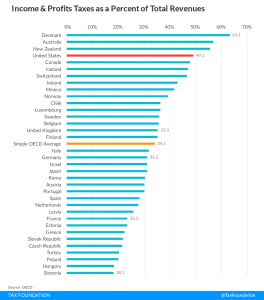
The structure of a country’s tax code is an important determinant of its economic performance. Our 2018 international tax rankings provide a road map for each of the 35 OECD countries to improve the structure of their tax codes and achieve a more neutral, more competitive tax system.
11 min read
Tax Foundation President, Scott Hodge, provides written testimony before the United States Joint Economic Committee on the economic growth effects of TCJA.