Gov. Hogan Vetoes Maryland Digital Advertising Tax Legislation
Gov. Hogan vetoed a proposed first-in-the-nation digital advertising tax that would have imposed rates of up to 10 percent on digital advertising served to Marylanders.
3 min read

Jared Walczak is a Senior Fellow at the Tax Foundation, where he spent five years as Vice President of State Projects, and president of Walczak Policy Consulting.
Jared has written or co-written tax reform guides for more than a dozen states and has served as the principal author of the Tax Foundation’s State Tax Competitiveness Index and Location Matters. He is also a regular on the conference circuit and has testified before legislatures in 35 states. His efforts have been instrumental in securing tax reform in many states, including sweeping reforms in Iowa and Louisiana, along with substantive reforms in Georgia, Idaho, Kentucky, Missouri, North Carolina, Oklahoma, Utah, West Virginia, and Wyoming, among others.
Jared also serves as a member of the faculty of the Institute for Professionals in Taxation, sits on the state tax advisory board of the Institute for State Policy Leaders, and contributes to Tax Notes State magazine. He is the author of the “SALT Road” Substack, a free newsletter on state and local tax policy.

Gov. Hogan vetoed a proposed first-in-the-nation digital advertising tax that would have imposed rates of up to 10 percent on digital advertising served to Marylanders.
3 min read
What could the next phase of relief look like and what role does tax policy play in ensuring the U.S. and countries around the world make a strong economic recovery?
1 min read
The U.S. Department of the Treasury recently issued new guidance on allowable expenses using the $150 billion in state aid provided under the CARES Act, a point on which there has been considerable confusion.
3 min read
Governments at all levels must work to remove the tax policy barriers that stand in the way of economic recovery and long-term prosperity following the COVID-19 crisis. Our new guide outlines several comprehensive options that policymakers can take at the federal and state levels.
26 min read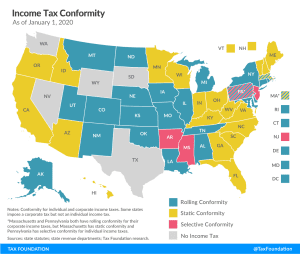
If states fail to update their income tax conformity, they will wind up taxing the federal lifeline to small businesses in the CARES Act: the Paycheck Protection Program (PPP) loans.
3 min read
Six states, which collectively account for over one-third of the U.S. population, are currently in a position to pay out fewer than 10 weeks of the unemployment compensation claims that have already come in since the start of the COVID-19 pandemic.
3 min read
Due to a quirk of some state tax codes, the recovery rebates in the CARES Act could increase your income tax liability in six states: Alabama, Iowa, Louisiana, Missouri, Montana, and Oregon.
4 min read
What could the next phase of relief look like and what role does tax policy play in ensuring the U.S. and countries around the world make a strong economic recovery?
1 min readState revenue stabilization funds, often called rainy day funds, are better funded now than they were at the start of the Great Recession and can be a valuable tool as states face a sharp pandemic-linked economic contraction.
18 min read
Many states are racing to pass budgets, emergency COVID-19 supplemental appropriations, and other must-pass legislation as quickly as possible. We’re tracking the latest state legislative responses to the coronavirus crisis.
66 min read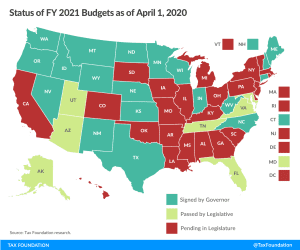
State options for closing FY 2020 shortfalls are limited and may ultimately include drawing on reserve funds and even accounting tricks
16 min read
Another 1.4 million Americans filed initial regular unemployment benefit claims, the eleventh week of a decline in the rate of new claims, but still among the highest levels in U.S. history. The total number of new and continued claims now stands at 19.3 million, a marked decline from the peak of 24.9 million a month ago.
7 min read
Every state with an individual income tax has made some adjustment to its filing or payment deadlines, but three—Idaho, Mississippi, and Virginia—have not followed the federal government’s date of July 15th or later.
3 min read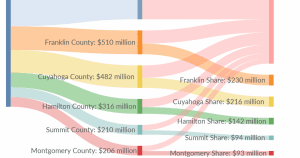
State and local governments across the country split $150 billion in federal aid under a provision of the Coronavirus Aid, Relief and Economic Security (CARES) Act, passed on March 30th.
7 min read
New Jersey is temporarily waiving corporate nexus arising from employees teleworking due to the COVID-19 pandemic—a response to the crisis that other states should follow.
3 min read
To be eligible for federal funding, state expenditures must meet certain conditions. We break down the state aid coronavirus provisions in the latest federal bill.
5 min read
During the present crisis, remote work has become a necessity for many people. The tax implications, however, are very real and potentially quite complex.
7 min read
Unemployment claims are going to tax state unemployment compensation trust funds beyond their limits. We need to start thinking about what to do about it.
5 min read
The federal government moved tax day from April 15 to July 15 in response to the coronavirus pandemic, granting more time for both filing and payment. But for many taxpayers, it might not matter much if states don’t follow suit.
3 min read
Governmental responses to the coronavirus outbreak will require creativity and flexibility—and one aspect of that may involve temporarily rethinking how we structure not only unemployment insurance (UI) benefits but also the taxes that pay for them.
5 min read