Unstable Taxes and an Unpredictable Future
When the tax code is stable and predictable, individuals, families, and businesses can set goals for the future and make plans to achieve them.


When the tax code is stable and predictable, individuals, families, and businesses can set goals for the future and make plans to achieve them.

Despite taxes playing a significant role in personal finances and being levied on a sizable portion of the U.S. population, most Americans are not just unhappy with the current tax code but also do not understand it.
4 min read
Portugal’s personal income tax system levies high tax rates on an unusually narrow set of high earners, striking a poor balance between earnings incentives and revenue contributions.
4 min read
Facts & Figures serves as a one-stop state tax data resource that compares all 50 states on over 40 measures of tax rates, collections, burdens, and more.
2 min read
Given that U.S. debt is roughly the size of our annual economic output, policymakers will face many tough fiscal choices in the coming years. The good news is there are policies that both support a larger economy and avoid adding to the debt.
6 min read
The 2021 tax year was the fourth since the Tax Cuts and Jobs Act (TCJA) made many significant, but temporary, changes to the individual income tax code to lower tax rates, widen brackets, increase the standard deduction and child tax credit, and more.
9 min read
Unless Congress acts, Americans are in for a tax hike in 2026.
3 min read
In his FY 2025 budget, Illinois Gov. Pritzker outlined a number of proposed tax changes, including to individual and corporate income taxes, state sales taxes, and sports betting excise taxes.
7 min read
The pandemic led to one of the largest fiscal responses in U.S. history, impacting households across the income distribution.
4 min read
 Short Form
Working from home is great. The tax complications? Not so much.
4 min read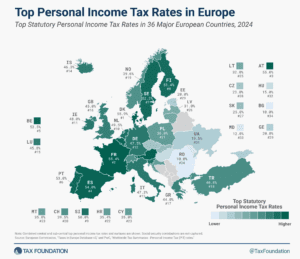
Denmark (55.9 percent), France (55.4 percent), and Austria (55 percent) have the highest top statutory personal income tax rates among European OECD countries.
3 min read
From a revenue standpoint, about $9 billion of the $11.7 billion in lost revenue would accrue to joint filers earning more than $200,000.
5 min read
The U.S. House of Representatives has passed a highly anticipated bipartisan tax deal. The Tax Relief for American Workers and Families Act now awaits action in the Senate.
6 min read
Historical evidence and recent studies have shown that retaliatory tax and trade proposals raise prices and reduce the quantity of goods and services available to U.S. businesses and consumers, resulting in lower incomes, reduced employment, and lower economic output.
5 min read
Portugal’s value-added tax (VAT) policy is a treasure trove of tax oddities. Thankfully, VAT base broadening is an ideal instrument to give the Portuguese government the fiscal room to implement pro-growth tax reforms
5 min read
After years of strong revenue growth, Kansas has substantial cash reserves on hand, and policymakers on both sides of the aisle have expressed a desire to return some of the extra revenue to taxpayers.
5 min read
In a rare change of pace, tax legislation passed out of the Ways and Means Committee last week with overwhelming, bipartisan support. In a more common turn of events, it may not get much further thanks to a small group of passionate, but misled lawmakers known as the “SALT Caucus.”

The House Ways and Means Committee has advanced a tax deal to the House floor that would temporarily—and retroactively—restore two major business deductions for cost recovery and expand the child tax credit through 2025.
10 min read
The expiration date on the Tax Cuts and Jobs Act (TCJA) of 2017 is rapidly approaching. Come 2026, most taxpayers will be in for a tax hike. Which 2024 presidential candidate will support sound tax policy?

Lawmakers should use the year ahead to thoroughly review and debate lasting, fundamental tax reform and prioritize policies that best boost work and investment incentives in a fiscally responsible manner.
4 min read