Skip to content

OECD

All Related Articles

Dominican Republic Tax Reform

Good Tax Reform Starts with Good Process

In June, the Dominican Republic rushed through a package of tax legislation in seven days. International examples demonstrate that consultation, transparency, and clarity are key factors for successful tax reform.

5 min read
Wealth Taxes, Government Revenue

Why Wealth Taxes Always Fail

Though they are often framed as affecting only the richest households, the economic effects of wealth taxes extend much further by reducing capital formation, discouraging entrepreneurship, curtailing wage and employment growth, and ultimately weakening the overall economy.

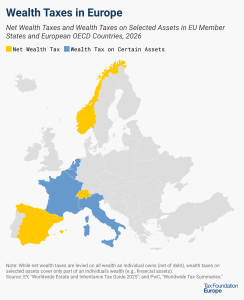
Wealth Taxes in Europe, 2026

Wealth Taxes in Europe, 2026

Wealth taxes not only collect little revenue and create legal uncertainty, but an OECD report argues that they can also disincentivize entrepreneurship, harming innovation and long-term growth.

5 min read
OECD Capital Cost Recover, 2026

Capital Cost Recovery across the OECD, 2026 Update

The ongoing economic uncertainty from global geopolitical threats, supply chain disruptions, rising interest rates, and lagging economic growth in many developed countries have highlighted the importance of private business investment.

32 min read
Withholding & Dividends Taxes | EU Tax Proposal

How Withholding Taxes Affect Cross-Border Investment in Europe

Because withholding taxes can create double taxation and administrative friction even where foreign tax credits are available, the European Commission’s 2026 Tax Omnibus proposal to eliminate them on dividend, interest, and royalty payments between EU companies regardless of holding percentage would foster stronger cross-border savings and investment.

6 min read
company disclosure; company tax disclosure tax disclosure tax transparency country by country reporting cbcr

Three Questions to Ask About New Tax Transparency Regimes

The new data disclosures will draw significant attention in 2026 and beyond. However, because the data is rooted in financial accounting concepts, affected by timing issues, and shaped by inconsistent reporting regimes, it is poorly suited for drawing strong conclusions about tax policy or corporate behavior.

7 min read
UN digital tax negotiations with European countries

What Europe’s UN Tax Turn Means for Multinationals

Europe’s turn toward the UN is ultimately not a sign that governments are ready to resolve fundamental disputes over taxing rights. If anything, international cooperation on the goal that matters most—fair treatment of cross-border trade—is crumbling.

Europe Tax Reform

Without Reform, the EU Cannot Afford New Taxes

Currently, the European Commission has plans to generate more tax revenue to fund the forthcoming MFF, the long-term budget running from 2028 to 2034. But the truth is, without serious reform, the EU isn’t ready for new taxation.

Digital Services Taxes in Europe, 2026

Digital Services Taxes in Europe, 2026

Currently, about half of all European OECD countries have either announced, proposed, or implemented a digital services tax. Because these taxes mainly impact US companies and are thus perceived as discriminatory, the US responded with retaliatory tariff threats.

5 min read
Tax Burden on Labor in Europe, 2026

Tax Burden on Labor in Europe, 2026

To make the taxation of labor more efficient, policymakers should understand their country’s tax wedge and how their tax burden funds government services.

5 min read
Global Tax Agreement, Pillar Two Implementation, Side-by-Side Agreement

Side-by-Side Implementation Is a Good Start, but It’s Just the Beginning

The side-by-side agreement is an important step in trans-Atlantic economic relations, however, there is more work to be done—on both sides of the Atlantic. If there’s a downside to the side-by-side agreement, it’s the risk of locking in mediocre tax policy choices for the long run.