A “Token Tax” Could Kill the Promise of AI
If we want to ensure that AI raises economic growth, we shouldn’t be pursuing tax policies that are stuck in the past and represent some of the worst ideas from the early internet age.

Senator and 2020 presidential candidate Elizabeth Warren (D-MA) has discussed and released several tax plans and proposals.

If we want to ensure that AI raises economic growth, we shouldn’t be pursuing tax policies that are stuck in the past and represent some of the worst ideas from the early internet age.

It is good to see senators talking about the Social Security crisis that is rapidly unfolding. But any serious proposal has to grapple with the trade-offs of different reforms and accept that the fix will come from both sides of the ledger: taxes and expenditures.
5 min read
This study simulates several large tax increases and consistently finds that even tax increases large enough to close the primary deficit in the near term will lose ground over time and fail to put the debt on a sustainable course.
41 min read
Recent discussions of a proposed wealth tax for the United States have included little information about trends in wealth taxation among other developed nations. However, those trends and the current state of wealth taxes in OECD countries can provide context for U.S. proposals.
4 min read
The arguments for a new surtax on corporate book income misconstrues why there are differences between a corporation’s taxable income and book income.
5 min read
The international experience with wealth taxes should serve as a warning to the U.S. A wealth tax would reduce the size of the economy, shrink national income, and significantly distort international capital flows.
4 min read
2020 Democratic presidential candidates have proposed various changes to the corporate income tax, which includes increasing the rate, ranging from 25 percent to 35 percent, imposing a corporate surtax or a minimum tax, and lengthening depreciation schedules.
17 min read
Several 2020 Democratic presidential candidates have proposed changes to federal payroll tax rates and the Social Security payroll tax wage base to raise revenue and maintain solvency for major federal entitlement programs.
24 min read
New modeling finds that the wealth taxes proposed by Sen. Warren and Sen. Sanders would raise significantly less revenue than promised, face serious administrative and compliance challenges, and would increase foreign ownership of U.S. capital.
38 min read
Biden, Sanders, and Warren have staked out similar plans to increase capital gains taxes on the wealthiest Americans. While all three candidates have called for taxing capital gains at ordinary income rates, the phase-in levels and top marginal tax rates vary.
5 min read
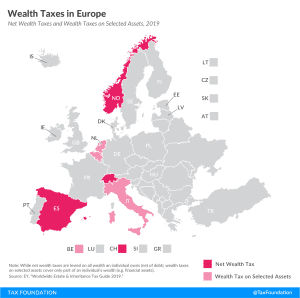
Only three European countries levy a net wealth tax, namely Norway, Spain, and Switzerland. Belgium, Italy, and the Netherlands levy wealth taxes on selected assets, but not on an individual’s net wealth per se.
3 min read
Taken together, these proposed tax changes would significantly raise marginal and effective tax rates and increase the cost of capital, all of which would lead to a reduced level of output and less revenue than anticipated.
5 min read


Elizabeth Warren released a detailed plan on how she would fund Medicare For All, proposing a wealth tax, financial transactions tax, mark-to-market taxation of capital gains income, and a country-by-county minimum tax, among other reforms.
5 min read
Warren’s comparison between the property tax and her proposed wealth tax makes a good sales pitch. However, there are important differences between the taxes. By no means is the property tax in many jurisdictions perfect, but it is generally better structured than a wealth tax.
4 min read
Sen. Elizabeth Warren introduced a 7 percent surtax on corporate profits called the “Real Corporate Profits Tax.” We estimate that this tax would reduce the incentive to invest in the United States, and result in a 1.9 percent smaller economy, a 3.3 percent smaller capital stock, and 1.5 percent lower wages. The surtax would raise $872 billion between 2020 and 2029 on a conventional basis and $476 billion on a dynamic basis. The tax would make the tax code more progressive, but it would fall on taxpayers in every income group.
9 min read