What a Democratic Congress Means for Federal Tax Policy in 2027
With Democrats retaking control of the US House of Representatives and US Senate, several new federal tax issues are on the table for 2027.
7 min read

With Democrats retaking control of the US House of Representatives and US Senate, several new federal tax issues are on the table for 2027.
7 min read
While the government will never close the tax gap or fully eliminate tax fraud, lawmakers and the IRS can institute several reforms to reduce the gap, including simplifying the tax code, increasing third-party information reporting, and coordinating anti-fraud efforts.
7 min read
Congress has passed some major simplifying reforms in recent years, but the tax code has still grown more complex over the past few decades. New carveouts, savings vehicles, and targeted tax increases would complicate it further.
8 min read
Senators Chris Van Hollen (D-MD) and Cory Booker (D-NJ) have each introduced proposals aimed at cutting taxes for lower- and middle-income taxpayers and raising them on high-income taxpayers.
9 min read
Explore the IRS inflation-adjusted 2026 tax brackets, for which taxpayers will file tax returns in early 2027.
5 min read
Explore the IRS inflation-adjusted 2025 tax brackets, for which taxpayers will file tax returns in early 2026.
4 min read
 Short Form
Since the inception of the modern federal individual income tax in 1913, the US tax code has generally become more progressive, not less. Will the recent tax changes made by the One Big Beautiful Bill Act (OBBBA) alter this?
4 min read
Our experts explain how this major tax legislation may affect you and how policymakers can better improve the tax code.
24 min read
As Republicans look for ways to offset the budgetary cost of extending the expiring provisions of the Tax Cuts and Jobs Act (TCJA) and potentially enacting other tax cuts, the latest estimates indicate several trillion dollars could be raised by reducing tax credits and other preferences in the tax code.
5 min read
On tax policy, Harris carries forward much of President Biden’s FY 2025 budget, including higher taxes aimed at businesses and high earners. She would also further expand the child tax credit (CTC) and various other tax credits and incentives while exempting tips from income tax.
17 min read
While federal tax collections—especially corporate taxes—have reached historically high levels, these gains have not kept pace with escalating spending, particularly on debt interest, leading to a substantial and concerning budget deficit in FY24.
6 min read
President Biden is proposing extraordinarily large tax hikes on businesses and the top 1 percent of earners that would put the US in a distinctly uncompetitive international position and threaten the health of the US economy.
19 min read
Explore the IRS inflation-adjusted 2024 tax brackets, for which taxpayers will file tax returns in early 2025.
4 min read
Lawmakers should simplify the tax code so that taxpayers can understand the laws and the IRS can administer them with minimum cost and frustration.

The latest tax gap report from the IRS has generated much media attention—and much misunderstanding.
6 min read
Income taxes impose steeper economic costs, and often steeper administrative and compliance costs, than consumption taxes. Moving to a consumption tax would end the tax bias against saving and investment and provide an opportunity to greatly simplify anti-poverty programs embedded in the tax code.
45 min read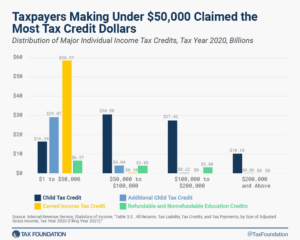
In tax year 2020, taxpayers claimed more than 159 million tax credits on their individual income tax returns worth a total of more than $277 billion. That was an increase of $35.3 billion from tax year 2019, largely due to an influx of pandemic relief administered through the tax code in 2020.
6 min read
Explore IRS clean energy tax credits, including Direct Pay, the IRA and CHIPS Act tax provisions, and Section 1603 grant program. See more.
7 min read
This tax reform plan would boost long-run GDP by 2.5%, grow wages by 1.4%, and add 1.3M jobs, all while collecting a similar amount of tax revenue as the current code and reducing the long-run debt burden.
38 min read
Lawmakers should focus on simplifying the federal tax code, creating stability, and broadly improving economic incentives. There are incremental steps that can be made on the path to fundamental tax reform.