Skip to content

Corporate Income Taxes

Academic studies show that higher corporate tax rates depress worker wages and lead to fewer jobs. An Organisation for Co-operation and Development (OECD) study has found that the corporate tax is the least efficient and most harmful way for governments to raise revenue.

Download Corporate Tax Rate Primer Learn more with TaxEDU

All Related Articles

Congressional Budget Office Projects Spending Growth Will Outpace Revenue Growth

Why the US Needs a Fiscal Commission to Help Solve the Debt Crisis

The federal government’s debt burden and interest on the debt are near record levels and headed higher, raising legitimate concerns about an eventual debt crisis. Given the increasingly dysfunctional budget process, the most viable option on the table to stave off such a crisis is a statutory bipartisan fiscal commission with buy-in from leaders of both parties.

6 min read
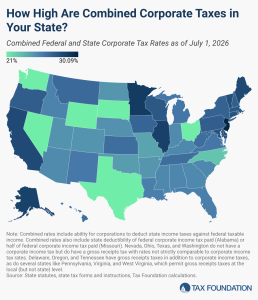

Combined state and federal corporate tax rates as of 2026

Combined State and Federal Corporate Income Tax Rates in 2026

Corporations in the United States pay federal corporate income taxes levied at a 21 percent rate. Forty-four states and DC also levy taxes on corporate income, with top marginal rates ranging from 2.5 percent in North Carolina to 11.5 percent in New Jersey.

2 min read
Colorado Income Tax | Amendment 87 & Proposition 136

Colorado’s Election Day Choice on Income Taxes

On Election Day, Coloradans will get to decide on two competing measures on income taxes: an initiated statute that would cap income taxes at the current 4.4 percent rate; and a constitutional amendment that would authorize a graduated-rate individual and corporate income tax, paired with an initiated statute setting new rates, with a top rate of 8.4 percent.

6 min read
TCJA compliance and TCJA complexity costs did the Tax Cuts and Jobs Act simplify the US tax code?

Top Five Options Guide Reforms to Simplify the Tax Code

Congress has passed some major simplifying reforms in recent years, but the tax code has still grown more complex over the past few decades. New carveouts, savings vehicles, and targeted tax increases would complicate it further.

8 min read
Federal Income Tax Complexity Now Costs the US Economy over $536 Billion Annually

Tax Complexity Now Costs the US Economy over $544 Billion Annually

Americans will spend 6.9 billion hours complying with IRS tax filing and reporting requirements in 2026, costing about $387 billion in lost productivity. Including an additional $157 billion in out-of-pocket costs, complying with the federal tax code will cost Americans more than $544 billion this year, over 1.7 percent of GDP.

10 min read
Corporate tax reform analysis including corporate tax hike economic growth impact

Three Facts Straightening Out the Debate Over Bonus Depreciation

Expensing for capital investment is not a special tax break. Expensing aligns the timing of tax deductions with the timing of actual capital expenditures so that the tax code does not discourage marginal investment projects. 

7 min read
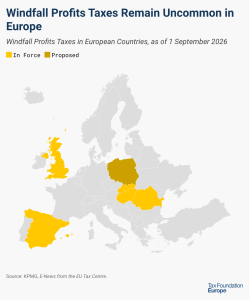
Windfall Profits Taxes in Europe, 2026

Windfall Profits Taxes in Europe, 2026

As energy prices have declined, European countries have switched the focus of their windfall profits taxes—a one-time tax levied on a company or industry when economic conditions result in large, unexpected profits—from energy providers to the banking and financial sector.

7 min read

Going Bold: Paul Ryan & Kevin Brady on Tax Reform

Ten years ago, then-Speaker Paul Ryan and Ways and Means Chairman Kevin Brady released the “Better Way” Tax Plan, the blueprint that would eventually become the Tax Cuts and Jobs Act of 2017—the largest overhaul of the US tax code in over 30 years.

Trump tariffs currency appreciation and Trump tariffs value of US dollar impact

Four Ways US Bond Markets Affect Tax Revenue

Federal government debt is over $32 trillion, around the size of the nation’s annual economic output (its gross domestic product, or GDP). Debt levels this high mean US borrowing costs are sensitive to interest rate changes that may otherwise seem small.

5 min read
Poland digital services tax, DST

How Poland’s Restrictive Tax Treatment of Losses Penalizes Risk-Taking and Business Expansion

Poland has one of the most restrictive approaches to the tax treatment of losses in the OECD. Loss carryover provisions allow businesses to deduct their losses in one year against taxable income in another, smoothing their taxable income over time. Their absence or restriction leads to firms with more variable profits and losses over time being taxed at higher rates, penalizing risky investment, such as research and development (R&D), and business expansion.

16 min read
Maryland Digital Tax

Maryland Court Strikes Down Digital Ad Tax

The Maryland Tax Court has struck down the state’s digital advertising tax and ordered that refunds be paid to taxpayers for five and a half years’ worth of collections under the unconstitutional tax.

5 min read
Dominican Republic Tax Reform

Good Tax Reform Starts with Good Process

In June, the Dominican Republic rushed through a package of tax legislation in seven days. International examples demonstrate that consultation, transparency, and clarity are key factors for successful tax reform.

5 min read

The Five Most Pro-Growth Options in the Options Guide

Some taxes have more powerful economic effects than others, and that’s a lesson policymakers should absorb as they work to craft a tax code that encourages growth and raises sustainable revenue.

8 min read