Though Tax Hikes Will Be Avoided, the House Bill Misses the Bigger Picture
The tax bill prioritizes politics over economic growth, writes Daniel Bunn.


The tax bill prioritizes politics over economic growth, writes Daniel Bunn.

The unique complexities of tax design for sports betting excise taxes make optimal tax design particularly challenging. Any reforms to the federal sports betting tax should ensure that both bettors and operators find legal markets more attractive than illicit markets.
6 min read
Tax simplification has two aspects. The first is a code without a mess of targeted provisions for various social policy goals. The second is a code with provisions that are simple and easy to comply with. The bill succeeds at the first, but fails at the second.
7 min read
In Washington, Gov. Ferguson (D) will soon have to act on legislation enacting a far more sweeping tax on Washington-based businesses than lawmakers imagined.
7 min read
The Polish government is considering converting its traditional corporate income tax into a tax on distributed profits. We estimate that this reform would result in greater investment, a larger productive capital stock, and higher economic output in the long run.
29 min read
Political popularity isn’t always a reliable gauge of sound policy—and that’s certainly true of President Donald Trump’s idea to eliminate taxes on tips, bonuses, and overtime pay.

The Republican party, led by President Trump, has decided that growth is no longer a priority. This is evident in the president’s trade war, the minimal opposition among Republican members of Congress, and the seemingly endless supply of bad policy ideas that will do little to support growth.

Pairing permanent TCJA individual tax cuts with new limits on business SALT deductions would shrink the economy, reduce American incomes, and increase the federal budget deficit, undermining the policy goals of TCJA permanence.
3 min read
The Trump administration advocates an “energy dominance” agenda to boost US energy production and lower costs. Its tariff agenda runs directly counter to it.
5 min read
Catastrophic rhetoric about US manufacturing is not justified. The tariffs are extremely counterproductive. Still, all is not well in the US manufacturing sector. What should we do?
7 min read
The economic literature overwhelmingly suggests that an income tax increase of this magnitude would negatively affect economic growth and opportunity in Rhode Island.

As Congress debates expensing and other policies impacting business investment, lawmakers should consider the importance of business investment in research and development (R&D) as a driver for economic growth. Recent studies suggest that the economic benefits of R&D spending are even greater than previously understood.
7 min read
Lawmakers should push against efforts to lift the SALT cap, and they should keep an eye toward bringing additional transparency to the tax system.

A tax preference originally designed to level the playing field now has the opposite effect, creating preferences for one class of financial institutions even though the distinctions between credit unions and banks are increasingly blurred.
6 min read
Tax Foundation Europe’s Sean Bray had the opportunity to interview Professor of International Taxation at the University of Mannheim Business School, Christoph Spengel, about the future of the EU tax mix.
15 min read
The Institute for Policy Studies (IPS) only succeeds in demonstrating that America has more millionaires than it used to, not that high-tax states are doing well in attracting or retaining them.
7 min read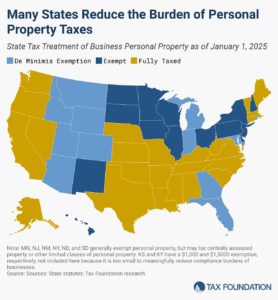
Does your state have a small business exemption for machinery and equipment?
4 min read
President Trump has repeatedly floated the idea of entirely replacing the federal income tax with new tariffs. Recently, he has said that when tariff revenues come in, he will use them to replace or substantially cut income taxes for people making under $200,000.
8 min read
Raising the top income tax rate would raise several hundred billion dollars but would offset most of the pro-growth effects of making the TCJA’s individual tax provisions permanent by reducing incentives to work and invest.
5 min read
By implementing a more sophisticated and nuanced trigger system for its tax reduction goals, North Carolina can sustain its trajectory toward lower tax rates, reinforce its reputation as a business-friendly state, and ensure long-term fiscal stability in an ever-changing economic landscape.
4 min read