
Skip to content
Cristina Enache Tax Foundation
Expert

Cristina Enache

Economist

Cristina Enache writes on the economics of tax policy and is the author of the Spanish Regional Tax Competitiveness Index. She was formerly the Director of Research at Civismo, an economic research organization based in Spain. She also served as head of research at Institución Futuro, a regional think tank based in Navarra in northern Spain. She is also currently Secretary-General at the World Taxpayers Associations and General Manager of the Spanish Taxpayers Union, which she joined in 2016.

Cristina has a degree in economics from the Academy of Economic Studies in Bucharest and a master’s degree in Economics and Finance from the University of Navarra.

Latest Work

Canada Full Expensing Made Permanent, Capital Investment and Cost Recovery

Full Expensing to Be Made Permanent in Canada

On September 15th, Canada announced that full expensing for machinery, equipment, and patent rights will be made permanent and broadened from around 15 percent to two thirds of business capital investment.

6 min read
Windfall Profits Taxes in Europe, 2026

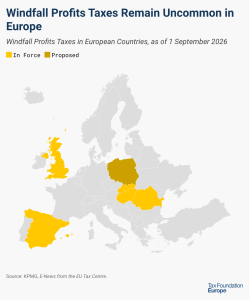
Windfall Profits Taxes in Europe, 2026

As energy prices have declined, European countries have switched the focus of their windfall profits taxes—a one-time tax levied on a company or industry when economic conditions result in large, unexpected profits—from energy providers to the banking and financial sector.

7 min read
Wealth Taxes, Government Revenue

Why Wealth Taxes Always Fail

Though they are often framed as affecting only the richest households, the economic effects of wealth taxes extend much further by reducing capital formation, discouraging entrepreneurship, curtailing wage and employment growth, and ultimately weakening the overall economy.

Wealth Taxes in Europe, 2026

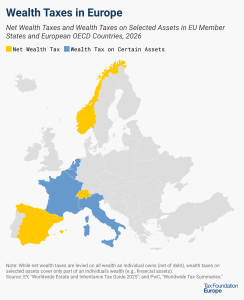
Wealth Taxes in Europe, 2026

Wealth taxes not only collect little revenue and create legal uncertainty, but an OECD report argues that they can also disincentivize entrepreneurship, harming innovation and long-term growth.

5 min read
OECD Capital Cost Recover, 2026

Capital Cost Recovery across the OECD, 2026 Update

The ongoing economic uncertainty from global geopolitical threats, supply chain disruptions, rising interest rates, and lagging economic growth in many developed countries have highlighted the importance of private business investment.

32 min read
2026 capital allowances europe expensing and cost recovery policies to encourage capital investment

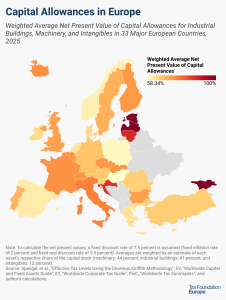
Capital Allowances in Europe, 2026

Although sometimes overlooked in discussions about corporate taxation, capital allowances play an important role in a country’s corporate tax base and can impact investment decisions—with far-reaching economic consequences.

6 min read
Digital Services Taxes and the European Budget

Testimony: Are Digital Services Taxes a Viable Solution for the EU Budget?

Digital services taxes address a real concern—the need to adapt taxation to the digital economy—but they are not the right solution. They raise limited revenue, are often passed on to consumers rather than large digital firms, create economic distortions, increase complexity and compliance costs, negatively impact innovation and competitiveness, and risk international retaliation.

Digital Services Taxes in Europe, 2026

Digital Services Taxes in Europe, 2026

Currently, about half of all European OECD countries have either announced, proposed, or implemented a digital services tax. Because these taxes mainly impact US companies and are thus perceived as discriminatory, the US responded with retaliatory tariff threats.

5 min read
Windfall Profits Taxes on Oil and Gas in Europe

Windfall Profits Taxes on Oil and Gas Should Be Left in the Past

Windfall taxes, particularly those imposed on the oil and gas industry, often appear as a quick fix for governments seeking to raise revenue during periods of high commodity prices. However, while these taxes may offer short-term revenues, they can also trigger negative consequences that undermine their intended purpose.

21 min read
Dividend Tax Rates in Europe, 2026

Dividend Tax Rates in Europe, 2026

Many countries’ personal income tax systems tax various sources of individual income—including investment income such as dividends and capital gains.

4 min read
Poland digital services tax, DST

Poland Considering a Second Harmful Digital Tax

Poland is proposing to broaden and raise its digital services tax (DST) from 1.5 percent to 3 percent. Because DSTs tax revenues, not profits, a company with a 10 percent profit margin would face a 30 percent effective tax rate on digital services provided in Poland.

6 min read
EU VAT Compliance Gap, Europe Tax Revenue Government

The EU’s Questionable VAT Policy

The value-added tax (VAT) compliance gap—the additional VAT revenue that could be collected if all taxpayers, consumers, and businesses fully complied with VAT rules—continues to increase, reaching €128 billion in 2023.

8 min read