

Economy Loses More than Revenue Gains in the House Build Back Better Act
Due to the House Build Back Better tax plan’s economically costly and inefficient tax increases, our analysis finds that long-run GDP would drop by a little over $1 for every $1 in new tax revenue.
6 min read
Comparing Tax Provisions in Different Versions of the House Build Back Better Act
The most recent versions of President Biden’s Build Back Better plan are improvements on the original proposal, but would still reduce economic growth and average after-tax incomes for the top 80 percent of earners in the long run.
7 min read
Complexity Harms Tobacco Tax Design in Cigarette-Popular Indonesia
Indonesia, the world’s second-largest cigarette market, has a uniquely complex system when it comes to taxing its tobacco consumption, which is almost exclusively cigarettes (98 percent).
4 min read
Despite Slip in International Tax Competitiveness Index, Germany Retains Top G7 Rank
More often than not, by looking at Germany’s tax code as an example, G7 countries can improve the stability of their revenues and the lives of those they represent.
5 min read
Spain’s 2022 Budget Unsurprisingly Comes with More Tax Hikes
While other countries in Europe are working towards introducing tax cuts or delaying the introduction of new taxes to stimulate economic recovery by supporting business investment and employment, Spain is putting more fiscal pressure on businesses.
3 min read
Wrong Tax Base Leads to Multiple Issues for Federal Nicotine Tax Proposal
The nicotine tax proposal in the Build Back Better Act neglects sound excise tax policy design and by doing so risks harming public health. Lawmakers should reconsider this approach to nicotine taxation.
8 min read
Tracking 2021 Election Results: State Tax Ballot Measures
Through 10 ballot measures across four states—Colorado, Louisiana, Texas, and Washington—voters will decide significant questions of state tax policy.
7 min read
Austria’s Budget Comes with Tax Cuts and Carbon Levies
Austria should not shy from lowering the corporate income tax rate sooner or even implementing a more ambitious tax reform to improve its tax competitiveness and contribute to greater economic growth.
3 min read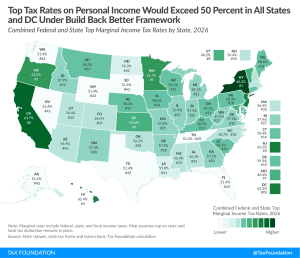
Top Tax Rate on Personal Income Would Be Highest in OECD under New Build Back Better Framework
Under the latest iteration of the House Build Back Better Act (BBBA), the average top tax rate on personal income would reach 57.4 percent, giving the U.S. the highest rate in the Organisation for Economic Co-operation and Development (OECD).
2 min read
Federal Deductibility Is Distorting Tax Liability in Six States
The intentions behind federal deductibility are undoubtedly pro-taxpayer. Unfortunately, that is not what happens in practice. Tax liability is not reduced. It is distorted.
7 min read