Tax Foundation Response to OECD Consultation on Amount A of Pillar One
Pillar One Amount A is meant to reallocate taxable profits of large multinationals, mitigate double taxation of profits, and avoid a harmful tax and trade war.
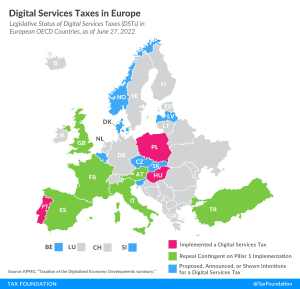
About half of all European OECD countries have either announced, proposed, or implemented a digital services tax.
7 min read
As the Czech EU presidency considers a plan to manage various tax-related files, it would be wise to consider principled tax policy that broadens the tax base and reduces the tax wedge on strategic investment.
4 min read
Congress should prioritize evaluation of recent international tax trends and the model rules and adjust U.S. rules in a way that supports investment and innovation and moves towards simplicity.
25 min read
The Biden administration has been supportive of the negotiations, but the changes should be reviewed in the context of recent policy changes in the U.S. and elsewhere, the general landscape of business taxation in the U.S., and potential challenges and risks arising from the global tax deal.
3 min read
Treasury Secretary Janet Yellen offered estimates from the EU Tax Observatory as evidence that the Polish government would benefit from supporting the global tax deal. Unfortunately, evidence was, at best, out of date.
2 min read
Over the course of the last year, it has become clear that Democratic lawmakers want to change U.S. international tax rules. However, as proposals have been debated in recent months, there are clear divides between U.S. proposals and the global minimum tax rules.
5 min read
Complex tax policies that work well “in theory” can often have a hard time when the rubber meets the road. One instance of this is the challenge that the OECD has created for itself with the global tax deal, also fondly known as Pillar 1 and Pillar 2.
7 min read
The current prospect for the global minimum tax requires the attention of U.S. lawmakers. Otherwise, a tax benefit at home will just mean a tax increase abroad.
6 min read
Recent discussions of a proposed wealth tax for the United States have included little information about trends in wealth taxation among other developed nations. However, those trends and the current state of wealth taxes in OECD countries can provide context for U.S. proposals.
3 min read
As 2021 comes to a close, countries are moving toward harmonizing tax rules for multinationals, but stalled talks on the Build Back Better Act in the United States means new uncertainties for a global agreement and for taxpayers.
5 min read
The new OECD global minimum tax rules are complex, and some countries may opt to put them in place on top of preexisting rules for taxing multinational companies. However, countries should also consider ways to reform their existing rules in response to the minimum tax.
7 min read
In general, the effective tax rates on the foreign profits of U.S. multinationals are not that low relative to the U.S. tax rate, contrary to popular rhetoric.
7 min read
As Congress prepares to rewrite some portion of the current international tax rules, it’s hoped that they are able to achieve a more principled approach and one that is not so subject to obfuscation and misinterpretation.
7 min read
The recent effort to change international tax rules has been one of significant contradictions. The proposals have been driven by arguments about the need to raise additional revenues, to stabilize corporate tax rates, or to prevent offshoring. However, upon closer examination, these three arguments fail to capture what is occurring.
The proposed restructuring of the GILTI and FDII regimes makes several changes to the tax base that are largely offsetting, leaving virtually all the revenue potential to be determined by the tax rates on GILTI and FDII and the haircuts on foreign tax credits. Lawmakers should carefully weigh the trade-offs between higher tax revenues and competitiveness.
There are many ways the U.S.’s international tax rules could be changed, reformed, improved, or worsened. Reflexively jacking up taxes on U.S. multinationals does not necessarily accomplish the goal of reducing or eliminating profit shifting, and it would in fact worsen it.
6 min read
This interaction between the U.S. proposals and those that may be put into law in foreign jurisdictions should give lawmakers caution when evaluating the revenue potential of changes to GILTI.
7 min read
Changes to international tax rules are likely on the way, and it is therefore important for lawmakers to understand how various reform options would impact U.S. tax burdens on multinational companies. Moreover, policymakers should also recognize the need for prudent policies that do not put U.S.-based multinationals at a competitive disadvantage or severely curtail investment and hiring.
9 min read
The United Nations (UN) recently released its annual “World Investment Report,” which shows the dramatic fall in global foreign direct investment (FDI) caused by the COVID-19 crisis.
3 min read