Changing Tax Policy Landscape Will Worsen U.S. Competitiveness
Policymakers on Capitol Hill should prioritize permanent pro-growth policy in the coming years as the economy struggles with inflation and the recovery from the pandemic.


Policymakers on Capitol Hill should prioritize permanent pro-growth policy in the coming years as the economy struggles with inflation and the recovery from the pandemic.


Any move to repeal the cap or enhance the deduction would disproportionately benefit higher earners, making the tax code more regressive.


By extending bonus depreciation and introducing neutral cost recovery, the RSC budget would significantly improve the treatment of investment leading to increased growth, expanded employment, and higher wages.


As we near this year’s “lame duck” session of Congress, there has been renewed interest in reforming the child tax credit as part of a tax deal. Our new analysis highlights the trade-offs that policymakers will face


The United States needs to grow its way out of inflation and set the economy up for continued growth—the tax code provides tools for policymakers to do just that.


By reducing the tax code’s current barriers to investment and saving and simplifying its complex rules, lawmakers would greatly enhance the ability of Americans to pursue new ideas, create more opportunities, and build financial security for themselves and their families.


Policymakers and taxpayers should understand the scope of tax changes necessary to fully pay for the large-scale social spending programs that would be initiated under the Build Back Better Act.


Senior policy analyst Garrett Watson joins host Jesse Solis to discuss the Build Back Better Act’s prospects and what tax changes—ranging from the SALT deduction to the Child Tax Credit—could change in order to gain enough support for passage.


The persistently high inflation in recent months has made some lawmakers question the need for additional deficit spending, In the short term, the Build Back Better Act would likely contribute to inflation, but the magnitude of that contribution is unclear.


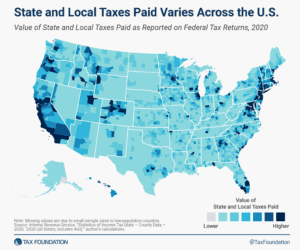
Two major provisions in the federal tax code have been limited since the Tax Cuts and Jobs Act (TCJA) of 2017: the state and local tax (SALT) deduction and the home mortgage interest deduction (MID).


Our analysis illustrates how restoring the SALT deduction now would be more regressive than under prior law, strengthening the case for keeping the cap in place.


It is important to understand how the SALT deduction’s benefits have changed since the SALT cap was put into place in 2018 before repealing the cap or making the deduction more generous. Doing so would disproportionately benefit higher earners, making the tax code more regressive.


Expanding the generosity of tax credits for lower-income individuals can help make the tax code more progressive, but it also reduces federal revenue. Pairing a credit expansion with a tax offset may sustain federal revenue but can also hamper economic growth.


As President Biden’s tax plans are considered in Congress, the future of the $10,000 cap for state and local tax deductions (SALT) is becoming an important part of the tax debate.


Learn more about the recent Alabama tax reform measures (House Bill 170), which combines pandemic-era tax policy responses with broader tax policy reforms.


Some lawmakers have expressed interest in repealing the SALT cap, which was originally imposed as part of the Tax Cuts and Jobs Act (TCJA) in late 2017. It is important to understand who benefits from the SALT deduction as it currently exists, and who would benefit from the deduction if the cap were repealed.


Our new study provides a 360-degree assessment of New York’s budget crisis, analyzes proposed revenue options, and offers solutions to raise revenue without driving more taxpayers out of the state or undoing recent positive reforms


President Joe Biden’s tax plan would yield combined top marginal state and local rates in excess of 60 percent in three states: California, Hawaii, and New Jersey (also New York City).


Making the Tax Cuts and Jobs Act’s individual provisions permanent combined with a carbon tax can be a revenue-neutral trade and increase the long-run size of the economy by 1 percent, making it a sustainable pro-growth option.