New Congressional Data Center Tax Proposals Threaten US AI Investment
US policymakers have put forward two new tax proposals to address concerns about how artificial intelligence (AI) will impact land, energy, and the workforce.
7 min read
US policymakers have put forward two new tax proposals to address concerns about how artificial intelligence (AI) will impact land, energy, and the workforce.
7 min read
The OBBBA made substantial improvements to cost recovery, but more opportunities remain for policymakers looking to improve the investment climate in the US.
48 min read
The EU Tax Omnibus proposal would create an EU-wide minimum standard for full expensing, but it confines that standard to qualifying tangible assets used in research and development (R&D) rather than to broader asset classes.
16 min read
The Tax Foundation uses and maintains a General Equilibrium Model, known as our Taxes and Growth (TAG) Model to simulate the effects of government tax and spending policies on the economy and on government revenues and budgets.
9 min read
Foreign R&D generally complements domestic innovation rather than substituting for it, so penalizing foreign R&D weakens US firms in cross-border mergers and acquisitions and in domestic production that depends on global scale.
7 min read
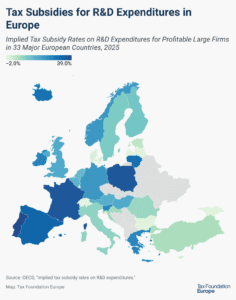
Many countries incentivize business investment in research and development (R&D), intending to foster innovation. A common approach is to provide direct government funding for R&D activity. However, a significant number of jurisdictions also offer R&D tax incentives.
5 min read
The European Commission’s new Tax Omnibus proposal marks a notable step towards improving the simplicity and competitiveness of the EU Single Market.
8 min read
Policymakers should broaden and make permanent full expensing for additional asset classes and pursue structural reforms that reduce distortions in how businesses are taxed. A more consistent and predictable policy environment, paired with targeted improvements to loss treatment, R&D incentives, and compliance burdens, would give small business owners greater confidence to invest, hire, and grow.
The evidence overall paints a far different picture than American Compass presents, and a consistent theoretical framework undercuts its assertions of how tariffs should be expected to impact the economy moving forward.
25 min read
The OBBBA significantly boosted economic prospects by improving the treatment of investment. By making key expensing provisions permanent, the OBBBA created better conditions for long-term growth. However, there’s still work to be done, and the OBBBA provided a blueprint for policymakers to follow.
4 min read
Notably, the OBBBA makes permanent the individual tax changes first put in place by the TCJA, which avoids a tax hike on an estimated 62 percent of tax filers in 2026.
4 min read
Near-term corporate tax payments may fall, and financial statement data may appear unusual, but over time, revenues will stabilize, book-tax gaps will fade, and the US tax code will incentivize domestic investment.
8 min read
Our analysis of the major tax provisions included in the OBBBA finds it will increase long-run GDP by 0.7 percent. The major tax provisions will reduce federal tax revenue by nearly $5.2 trillion between 2025 and 2034, on a conventional basis.
12 min read
As European countries have undertaken a series of tax reforms designed for budgetary stability, policymakers should focus on consumption taxes by making them more neutral and efficient.
15 min read
Delaware Governor Matt Meyer’s proposal to decouple from the full expensing provision of the OBBBA would make the state’s tax code less friendly toward investment and undermine long-term growth.
5 min read
Some state lawmakers are considering decoupling from the pro-growth expensing provisions of the OBBBA due to revenue concerns, but it is valuable to recognize just how much the corporate tax base has expanded over the past decade.
6 min read
Expensing for manufacturing structures is a significant step forward for the tax treatment of structures, but it could be improved in several ways.
7 min read
The industry breakdown of the OBBBA corporate tax cuts shows firms in industries involved with tangible production, such as manufacturing, are the biggest winners, as measured by changes in tax liability.
3 min read
Congress may have passed the One Big Beautiful Bill Act (OBBBA), but state lawmakers now face big choices. Most states link their tax codes to the federal system, meaning OBBBA’s provisions—good and bad—are about to ripple across state budgets.
For Congress, work on the One Big Beautiful Bill Act is done. But in state capitols, the work has not yet begun. Many of the tax changes in the federal reconciliation act flow through to state tax codes—automatically in some states, and subject to an update in states’ Internal Revenue Code conformity date in others.
39 min read