Tax Trends in European Countries
As European countries have undertaken a series of tax reforms designed for budgetary stability, policymakers should focus on consumption taxes by making them more neutral and efficient.
15 min read
As European countries have undertaken a series of tax reforms designed for budgetary stability, policymakers should focus on consumption taxes by making them more neutral and efficient.
15 min read
Delaware Governor Matt Meyer’s proposal to decouple from the full expensing provision of the OBBBA would make the state’s tax code less friendly toward investment and undermine long-term growth.
5 min read
Some state lawmakers are considering decoupling from the pro-growth expensing provisions of the OBBBA due to revenue concerns, but it is valuable to recognize just how much the corporate tax base has expanded over the past decade.
6 min read
Expensing for manufacturing structures is a significant step forward for the tax treatment of structures, but it could be improved in several ways.
7 min read
The industry breakdown of the OBBBA corporate tax cuts shows firms in industries involved with tangible production, such as manufacturing, are the biggest winners, as measured by changes in tax liability.
3 min read
Congress may have passed the One Big Beautiful Bill Act (OBBBA), but state lawmakers now face big choices. Most states link their tax codes to the federal system, meaning OBBBA’s provisions—good and bad—are about to ripple across state budgets.
We estimate the OBBBA will reduce federal taxes on average for individual taxpayers in every state. Across all individual tax filers throughout the US, the average tax cut per taxpayer will be over $3,700 in 2026.
4 min read
For Congress, work on the One Big Beautiful Bill Act is done. But in state capitols, the work has not yet begun. Many of the tax changes in the federal reconciliation act flow through to state tax codes—automatically in some states, and subject to an update in states’ Internal Revenue Code conformity date in others.
39 min read
Our experts explain how this major tax legislation may affect you and how policymakers can better improve the tax code.
24 min read
However states choose to respond to other tax provisions of the One Big Beautiful Bill Act, they should conform to the pro-growth provisions, which represent a marked improvement in the corporate tax code.
12 min read
The administration has a strong desire to boost manufacturing investment and there are many provisions in the new tax bill that support this aim. But the administration’s erratic trade policy is driving up the costs of key inputs that manufacturers rely on to build things in the US.
Several major new tax breaks are scheduled to expire at the end of 2028, setting the stage for another tax fight to either extend them or allow them to expire.
5 min read
The aim of patent boxes is generally to encourage and attract local research and development (R&D) and to incentivize businesses to locate IP in the country. However, patent boxes can introduce another level of complexity to a tax system, and some recent research questions whether patent boxes are actually effective in driving innovation.
4 min read
The One Big Beautiful Bill Act makes many of the individual tax cuts and reforms of the TCJA permanent. It improves upon the TCJA by making expensing for R&D and equipment permanent. However, for the most part, it does not include further structural reforms, and instead introduces many new, narrow tax breaks to the code, adding complexity and raising revenue costs.
7 min read
Alabama’s 2025 legislative session mostly demonstrates a commitment to pro-growth tax policies that enhance competitiveness and reduce compliance burdens.
4 min read
We estimate the One Big Beautiful Bill Act would increase long-run GDP by 1.2 percent and reduce federal tax revenue by $5 trillion over the next decade on a conventional basis.
11 min read
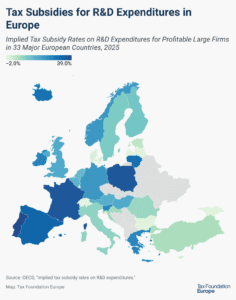
Many countries incentivize business investment in research and development (R&D), intending to foster innovation. A common approach is to provide direct government funding for R&D activity. However, a significant number of jurisdictions also offer R&D tax incentives.
4 min read
Senator Ted Cruz’s (R-TX) CREATE JOBS Act prioritizes permanence for the most cost-effective tax reforms—expensing and Neutral Cost Recovery (NCRS)—to boost growth in a relatively fiscally responsible way.
4 min read
Our preliminary analysis finds the tax provisions increase long-run GDP by 0.8 percent and reduce federal tax revenue by $4.0 trillion from 2025 through 2034 on a conventional basis before added interest costs.
9 min read
The House of Representatives just passed President Trump’s “One Big Beautiful Bill,” marking a critical step in the Republican tax agenda. At first glance, the bill might appear to complete the legacy of the 2017 Tax Cuts and Jobs Act (TCJA). But it falls short of emulating the TCJA’s core strengths in two key respects: it doesn’t prioritize economic growth, and it doesn’t simplify the tax code.