FAQ: The One Big Beautiful Bill, Explained
Our experts explain how this major tax legislation may affect you and how policymakers can better improve the tax code.
24 min read
Explore our latest tax policy research, analysis, and commentary of the One Big Beautiful Bill Act (OBBB).
Our experts explain how this major tax legislation may affect you and how policymakers can better improve the tax code.
24 min read
How will recent federal tax changes affect you?
4 min read
Notably, the OBBBA makes permanent the individual tax changes first put in place by the TCJA, which avoids a tax hike on an estimated 62 percent of tax filers in 2026.
4 min read
Our analysis of the major tax provisions included in the OBBBA finds it will increase long-run GDP by 0.7 percent. The major tax provisions will reduce federal tax revenue by nearly $5.2 trillion between 2025 and 2034, on a conventional basis.
12 min read
The One Big Beautiful Bill Act makes many of the individual tax cuts and reforms of the TCJA permanent. It improves upon the TCJA by making expensing for R&D and equipment permanent. However, for the most part, it does not include further structural reforms, and instead introduces many new, narrow tax breaks to the code, adding complexity and raising revenue costs.
7 min read
For Congress, work on the One Big Beautiful Bill Act is done. But in state capitols, the work has not yet begun. Many of the tax changes in the federal reconciliation act flow through to state tax codes—automatically in some states, and subject to an update in states’ Internal Revenue Code conformity date in others.
39 min read
The 2017 Tax Cuts and Jobs Act (TCJA) simultaneously increased tax progressivity and decreased redistribution in the tax code. Our estimates suggest the OBBBA similarly combines a more progressive tax system with a lower degree of tax redistribution.
4 min read
Expensing for manufacturing structures is a significant step forward for the tax treatment of structures, but it could be improved in several ways.
7 min read
We break down the House GOP’s One, Big, Beautiful Bill—a sweeping tax package designed to extend key parts of the 2017 Tax Cuts and Jobs Act before they expire in 2026.

Americans will spend almost 7.1 billion hours complying with IRS tax filing and reporting requirements in 2025. This is equal to 3.4 million full-time workers—almost the population of Los Angeles and nearly 38 times the workforce the IRS employed in FY 2024—doing nothing but tax return paperwork for a full year.
9 min read
In a surprising tax code alteration that has frustrated Americans who enjoy gambling, a provision in the One Big Beautiful Bill Act limits gambling losses that can be used to offset gambling winnings to 90 percent of their value. This provision introduces a steep tax penalty for professional gamblers and certain casual bettors.
5 min read
While the One Big Beautiful Bill Act tries to buoy manufacturing, President Trump’s tariffs are an anvil dragging the sector down.

The OBBBA moved the US international tax system in the right direction on several fronts. However, some of the changes, while encouraging certain domestic activity and exports, may harm physical activity abroad that supports US competitiveness and domestic activity.
8 min read
The One Big Beautiful Bill Act (OBBBA) significantly alters the Inflation Reduction Act (IRA) green energy subsidies.
6 min read
For Congress, work on the One Big Beautiful Bill Act is done. But in state capitols, the work has not yet begun. Many of the tax changes in the federal reconciliation act flow through to state tax codes—automatically in some states, and subject to an update in states’ Internal Revenue Code conformity date in others.
39 min read
Even when international relations are frayed, there is value in finding ways to combat corporate profit shifting while also fostering a healthy commercial atmosphere and positive trade relations.
7 min read
Who are Trump Accounts really for, and will they actually help families save? With yet another savings vehicle added to an already confusing system, do these accounts solve a real problem—or just add more complexity?
Our experts explain how this major tax legislation may affect you and how policymakers can better improve the tax code.
24 min read
However states choose to respond to other tax provisions of the One Big Beautiful Bill Act, they should conform to the pro-growth provisions, which represent a marked improvement in the corporate tax code.
12 min read
The administration has a strong desire to boost manufacturing investment and there are many provisions in the new tax bill that support this aim. But the administration’s erratic trade policy is driving up the costs of key inputs that manufacturers rely on to build things in the US.

Several major new tax breaks are scheduled to expire at the end of 2028, setting the stage for another tax fight to either extend them or allow them to expire.
5 min read
If the federal government really wanted to make saving more accessible for taxpayers, it would swap the proposal for Trump Accounts to replace the complicated mess of savings accounts currently available with universal savings accounts.
5 min read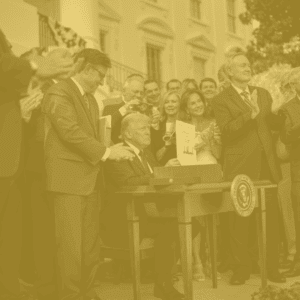
The One Big Beautiful Bill is now law—but what does it actually do? In this episode, we break down the new tax law’s key provisions, including who benefits, who doesn’t, and what it means for the economy, tax certainty, and the federal deficit.
The One Big Beautiful Bill Act makes many of the individual tax cuts and reforms of the TCJA permanent. It improves upon the TCJA by making expensing for R&D and equipment permanent. However, for the most part, it does not include further structural reforms, and instead introduces many new, narrow tax breaks to the code, adding complexity and raising revenue costs.
7 min read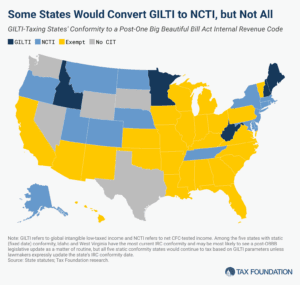
The One Big Beautiful Bill’s changes to the taxation of international income have surprising implications for state codes, yielding tax increases and a revised tax base that, through quirks of state incorporation, bears very little resemblance to the federal base and almost nothing of its purpose.
10 min read
Policymakers continue to debate international tax rules after the US gained agreement on a new approach at the G7 that could result in US anti-avoidance policies existing side-by-side with the global minimum tax.
4 min read
President Trump signed the One Big Beautiful Bill Act into law on July 4, 2025.
18 min read
We are living in an age of hyperbole, or as writer Matthew Hennessey calls it, the “Age of Excusability,” in which our politicians succeed by making outlandish claims. So it goes with the One Big Beautiful Bill, which will usher in a new golden age or send us down the tubes for good, depending on your sources.
Lawmakers should consider maintaining QBAI and applying the several billion dollars from the Senate’s change toward other pro-growth international tax reforms instead.
6 min read