Taxing Capital – An International Comparison
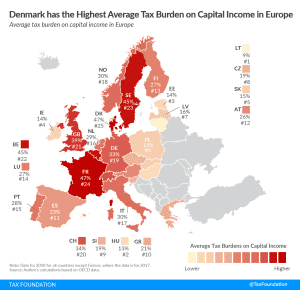
The taxation of capital—at both the individual and the corporate level—is much debated and affects economic growth by lowering the incentives to save and invest.
6 min read
The taxation of capital—at both the individual and the corporate level—is much debated and affects economic growth by lowering the incentives to save and invest.
6 min read
Today, the U.S. Treasury issued an interim final rule on the $350 billion in State and Local Fiscal Recovery Funds provided under the American Rescue Plan Act (ARPA). The proposed rule resolves several important questions but continues to involve the federal government in state finances at an extraordinary level.
7 min read
Digital advertising, social media, and data tax proposals have been introduced in nine states following enactment of Maryland’s digital advertising tax, which has since been postponed a year due to administrative and legal challenges.
14 min read
As countries move closer to agreement on how the OECD Pillar 1 Amount A will work and which companies will be impacted by it, it is incredibly important for policymakers to continue to evaluate not just the intended effects but also the potential unintended consequences.
6 min read
The Biden administration’s proposed American Families Plan includes several major tax changes. Explore the tax proposals in the American Families Plan.
10 min read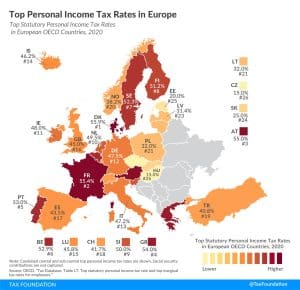
Most countries’ personal income taxes have a progressive structure, meaning that the tax rate paid by individuals increases as they earn higher wages. The highest tax rate individuals pay differs significantly across Europe, with Denmark (55.9 percent), France (55.4 percent), and Austria (55 percent) having the highest top statutory personal income tax rates among European OECD countries.
3 min read
Location Matters is an account of tax complexity and the ways that tax structure affect competitiveness. For policymakers, it represents an opportunity to explore the seemingly more arcane tax provisions that can have a significant impact on business tax burdens, and to discover how their tax code—often completely by accident—picks winners and losers.
4 min read
A landmark comparison of corporate tax costs in all 50 states, Location Matters provides a comprehensive calculation of real-world tax burdens, going beyond headline rates to demonstrate how tax codes impact businesses and offering policymakers a road map to improvement.
8 min read
After three years of deliberations, more than two-thirds of members in both the Senate and the House enacted tax reform and relief legislation Monday over the veto of Gov. Laura Kelly (D).
4 min read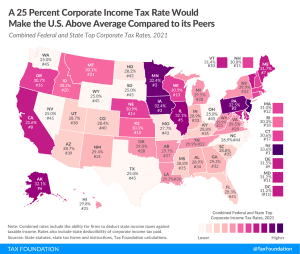
Some lawmakers have expressed concerns about President Biden’s proposal to raise the federal corporate income tax rate from 21 percent to 28 percent, and instead suggest raising the rate to 25 percent.
3 min read
While strong economic growth—fueled by higher levels of investment, productivity, and jobs—will lift after-tax incomes over time, policies that provide relief by immediately boosting after-tax incomes of lower-income households are also available. As lawmakers consider such policies, they should keep in mind the trade-offs among them.
4 min read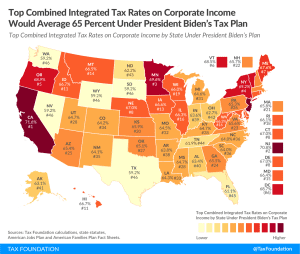
Under President Biden’s tax plan, the United States would tax corporate income at the highest top rate in the industrialized world, averaging 65.1 percent.
3 min read
As President Biden’s tax plans are considered in Congress, the future of the $10,000 cap for state and local tax deductions (SALT) is becoming an important part of the tax debate.
3 min read
There’s a useful contrast between two revenue options related to President Biden’s infrastructure push. The president’s American Jobs Plan includes a proposal to raise the corporate tax rate to 28 percent. Meanwhile, historically, the gas tax is the main revenue source for transportation funding.
8 min read
State and local tax policy have always mattered, but the rise of remote work is bringing tax burdens and economic competitiveness to the forefront. It is a development that states cannot afford to ignore.
5 min read
In his first 100 days as president, Joe Biden has proposed more than a dozen significant changes to the U.S. tax code that would raise upwards of $3 trillion in revenue and reduce incentives to invest, save, and work in the United States.
4 min read
Kansas has the revenue cushion it needs to provide tax relief to individuals and businesses and improve the structure of its tax code in the process. These pro-growth reforms would not only help taxpayers amid the pandemic but would also promote economic recovery and growth in a state that is lagging behind its competitors.
7 min read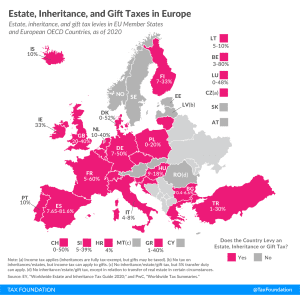
Estate tax is levied on the property of the deceased and is paid by the estate itself. Inheritance taxes, in contrast, are only levied on the value of assets transferred and are paid by the heirs. Gift taxes are levied when property is transferred by a living individual. The majority of European countries covered in today’s map currently levy estate, inheritance, or gift taxes.
3 min read
Taxes on goods and services were on average the greatest source of tax revenue for Latin American and Caribbean countries
5 min read
While many of the tax proposals work in tandem, some conflicts continue to exist. If lawmakers were able to repeal federal deductibility, reduce income tax rates, finish the job on inventory taxation, and phase out the capital stock tax, this would represent a marked improvement in the state’s tax climate, eliminating several of the most uncompetitive features of the current code.
6 min read