





All Related Articles
260 Results
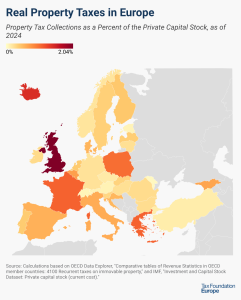
Real Property Taxes in Europe, 2026
High property taxes levied not only on land but also on buildings and structures can discourage investment in infrastructure, which businesses would have to pay additional tax on.
3 min read
2026 Spanish Regional Tax Competitiveness Index
The 2026 Spanish Regional Tax Competitiveness Index allows policymakers and taxpayers to evaluate and measure how their regions’ tax systems compare.
8 min read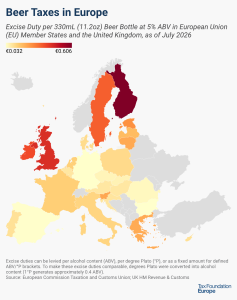
Beer Taxes in Europe, 2026
With much of the continent celebrating Oktoberfest, it is a great time to examine beer taxes across Europe. Hefty beer taxes increase the price consumers pay for their libations.
5 min read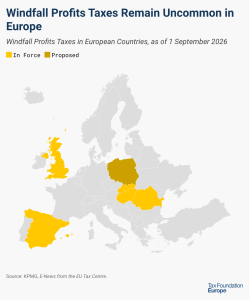
Windfall Profits Taxes in Europe, 2026
As energy prices have declined, European countries have switched the focus of their windfall profits taxes—a one-time tax levied on a company or industry when economic conditions result in large, unexpected profits—from energy providers to the banking and financial sector.
7 min read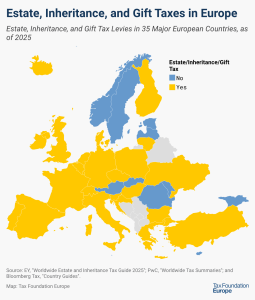
Estate, Inheritance, and Gift Taxes in Europe, 2026
Twenty-four out of the 35 European countries covered in this map currently levy estate, inheritance, or gift taxes.
4 min read
How Poland’s Restrictive Tax Treatment of Losses Penalizes Risk-Taking and Business Expansion
Poland has one of the most restrictive approaches to the tax treatment of losses in the OECD. Loss carryover provisions allow businesses to deduct their losses in one year against taxable income in another, smoothing their taxable income over time. Their absence or restriction leads to firms with more variable profits and losses over time being taxed at higher rates, penalizing risky investment, such as research and development (R&D), and business expansion.
16 min read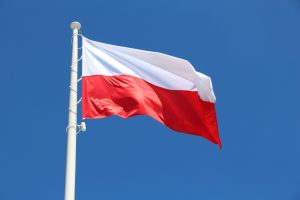
How Tax Cliffs Hold Back Poland’s Individual Business Owners
Poland taxes its individual business owners through alternative regimes and a series of thresholds, several of them sharp notches that imply significant tax costs for businesses crossing them.
11 min read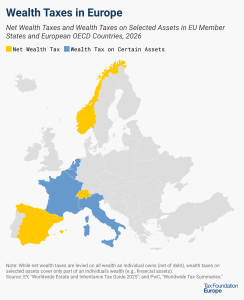
Wealth Taxes in Europe, 2026
Wealth taxes not only collect little revenue and create legal uncertainty, but an OECD report argues that they can also disincentivize entrepreneurship, harming innovation and long-term growth.
5 min read
Does the EU Tax Omnibus’ R&D Expensing Proposal Make the EU More Competitive?
The EU Tax Omnibus proposal would create an EU-wide minimum standard for full expensing, but it confines that standard to qualifying tangible assets used in research and development (R&D) rather than to broader asset classes.
16 min read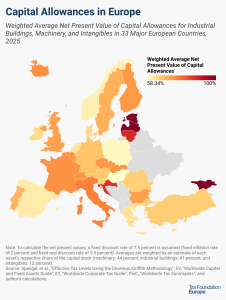
Capital Allowances in Europe, 2026
Although sometimes overlooked in discussions about corporate taxation, capital allowances play an important role in a country’s corporate tax base and can impact investment decisions—with far-reaching economic consequences.
6 min read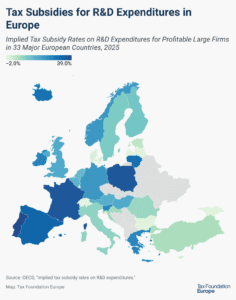
Tax Subsidies for R&D Expenditures in Europe, 2026
Many countries incentivize business investment in research and development (R&D), intending to foster innovation. A common approach is to provide direct government funding for R&D activity. However, a significant number of jurisdictions also offer R&D tax incentives.
5 min read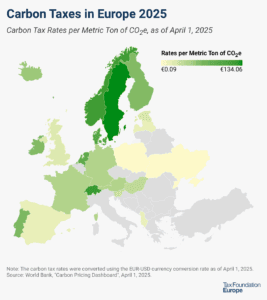
Carbon Taxes in Europe, 2026
In recent years, several countries have taken measures to reduce carbon emissions, including instituting environmental regulations, emissions trading systems (ETSs), and carbon taxes.
5 min read
Are Digital Services Taxes a Viable Solution for the EU Budget?
Since digital services taxes generate little revenue, place the cost on European consumers and not on large digital companies as intended, and risk escalating trade disputes, policymakers should rethink their strategy.
14 min read
VAT Exemption Thresholds in Europe, 2026
Worldwide, 175 countries—including all major European countries—levy a value-added tax (VAT) on goods and services. However, to reduce compliance and administrative costs, most countries have VAT exemption thresholds: if a business is below a certain annual revenue threshold, it is not required to participate in the VAT system.
3 min read
Financial Transaction Taxes in Europe, 2026
Fourteen countries in Europe—Belgium, Finland, France, Greece, Hungary, Ireland, Italy, Malta, Poland, the Slovak Republic, Spain, Switzerland, Turkey, and the United Kingdom—currently levy a type of financial transaction tax.
3 min read
Competitive Corporate Tax Policy Is Essential for European Economic Growth
Debates over tax fairness and anti-avoidance rules have dominated European tax policy circles for over a decade. However, as geoeconomic pressures increase around the world, policymakers are looking for ways to boost European competitiveness and economic growth.
18 min read
Net Operating Loss Carryforward and Carryback Provisions in Europe, 2026
Carryover provisions help businesses “smooth” their risk and income, making the tax code more neutral across investments and over time.
5 min read
Digital Services Taxes in Europe, 2026
Currently, about half of all European OECD countries have either announced, proposed, or implemented a digital services tax. Because these taxes mainly impact US companies and are thus perceived as discriminatory, the US responded with retaliatory tariff threats.
5 min read
Tax Burden on Labor in Europe, 2026
To make the taxation of labor more efficient, policymakers should understand their country’s tax wedge and how their tax burden funds government services.
5 min read
Windfall Profits Taxes on Oil and Gas Should Be Left in the Past
Windfall taxes, particularly those imposed on the oil and gas industry, often appear as a quick fix for governments seeking to raise revenue during periods of high commodity prices. However, while these taxes may offer short-term revenues, they can also trigger negative consequences that undermine their intended purpose.
21 min read