Skip to content

Social Security

Social Security is by far the largest federal government spending program, constituting 21 percent of the federal budget, or $1.3 trillion, in FY 2023—larger than the entire nondefense discretionary budget. The latest trustees report shows the program is on a fiscally unsustainable path that will exacerbate the US debt crisis if its imbalances are not addressed in the near term. By 2035, the Old-Age, Survivors, and Disability Insurance (OASDI) Trust Fund will be depleted, and current payroll taxes will only be able to fund 83 percent of the scheduled Social Security benefits. Absent any reforms, Social Security recipients would immediately face a 17 percent cut in benefits.

All Related Articles

Testimony: The Fiscal State of the Union

Testimony: The Fiscal State of the Union

Federal spending, deficits, and debt are at unsustainable levels. The proposed federal budget is laden with redundant programs, obsolete programs, corporate welfare, and nationalized industries. As Congress begins to craft the FY 2024 federal budget, it needs to establish a process of systematically reviewing programs and priorities.

Deteriorating federal budget deficits highlight need to stabilize federal debt. See federal deficit taxes contextualized amid push to balance the budget

Deteriorating Federal Budget to Run $1.4 Trillion Deficit in 2023, CBO Projects

Immediately balancing the $20 trillion budget shortfall would take drastic, unwanted policy changes. Instead, lawmakers should target a more achievable goal, such as stabilizing debt and deficits with an eye toward comprehensive tax reform that can produce sufficient revenue with minimal economic harm.

4 min read
Tax treatment of Social Security benefits remains a confusing matter for taxpayers Social Security cost of living adjustment Social Security tax

Tax Treatment of Social Security Benefits Remains a Confusing Matter for Taxpayers

The Social Security Administration (SSA) announced the cost-of-living adjustment for Social Security payments based on inflation over the previous year. This has brought renewed attention to how the tax code treats Social Security benefits, which can be a confusing subject for taxpayers.

4 min read
wealth inequality trends cbo bernie sanders wealth gap social security benefits

Focusing on Wealth Inequality Is Counterproductive

While there is more we can do to encourage lower- and middle-class households to save more and build wealth, a closer, more comprehensive look at the data and trends in other countries suggests that America’s wealth gap is not as alarming as some may think.

5 min read

Sources of Personal Income, Tax Year 2019

Reviewing reported income helps to understand the composition of the federal government’s revenue base and how Americans earn their taxable income. The individual income tax, the federal government’s largest source of revenue, is largely a tax on labor.

10 min read
tax wedge US tax burden on labor payroll tax burden an average wage worker with no children tax burden

The U.S. Tax Burden on Labor, 2022

Although the U.S. has a progressive tax system and a relatively low tax burden compared to the OECD average, average-wage workers still pay nearly 30 percent of their wages in taxes.

4 min read
Church taxes, tax churches, what if we taxed churches? #Taxthechurches, tax treatment of churches in the US. If taxes paid taxes, taxing churches

What If We Taxed Churches?

Whether spurred by a belief that government is improperly favoring religious institutions, an antipathy to wealthy celebrity pastors, or a hope that taxing houses of worship could bring down personal tax bills, the taxation of religious bodies is hotly debated online, but barely on the radar of actual elected officials. But is that true? How much, if any, tax revenue is forgone, and what do the policies look like? 

7 min read
Asian pacific countries revenue loss. Tax revenue Africa. Tax revenue Asia. Tax revenue Latin America. 2021

Asian and Pacific Countries Faced Revenue Loss Prior to COVID-19 Outbreak

As economies are starting to recover and growth is expected to rebound in the region during 2021, Asian and Pacific countries should start exploring changes to their fiscal tax policies while carefully evaluating the optimal time for eliminating fiscal stimulus and temporary tax relief.

4 min read
wealthy inequality, pensions and social security, new research from federal reserve bank of boston Massachusetts ban on flavored cigarettes, Massachusetts ban on flavored tobacco

New Research Suggests Estimates of Wealth Inequality Likely Overstated

New research from Federal Reserve Bank of Boston economists suggests wealth inequality has grown less than previously estimated and that shares of wealth held by top earners drops significantly when accounting for sources of lower- and middle-class wealth that are often overlooked.

2 min read
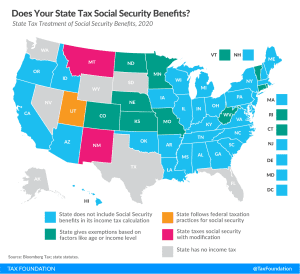
How Does Your State Treat Social Security Income Does Your State Tax Social Security Benefits Compare States that tax Social Security benefits

How Does Your State Treat Social Security Income?

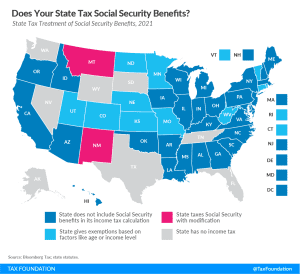
Thirteen states tax Social Security benefits, a matter of significant interest to retirees. Each of these states has its own approach to determining what share of benefits is subject to tax, though these provisions can be grouped together into a few broad categories.

4 min read

Spain Recovery Plan Tax Hikes 2020 Spanish Regional Tax Competitiveness Index, Spain economic recovery, Spain recovery budget, Spain recovery plan

More Tax Hikes Than Investment Projects?

Tax hikes implemented in the near term might undermine Spain’s economic recovery. Spain should focus on implementing tax reforms that have the potential to stimulate economic recovery by supporting private investment and employment while increasing its internal and international tax competitiveness.

5 min read
Does my state tax social security benefits? States that tax social security benefits

Does Your State Tax Social Security Benefits?

The question, “Does my state tax Social Security benefits?” may be simple enough, but the answer includes a lot of nuance. Many states have unique and specific provisions regarding the taxation of Social Security benefits, which can be broken into a few broad categories.

3 min read