Two Virginia Income Tax Proposals Would Make the State Less Affordable
Should both HB 979 and HB 378 pass, Virginia would have the nation’s highest top marginal rate on investment income.
8 min read
Should both HB 979 and HB 378 pass, Virginia would have the nation’s highest top marginal rate on investment income.
8 min read
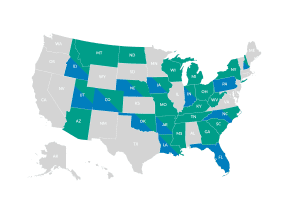
The State Tax Competitiveness Index enables policymakers, taxpayers, and business leaders to gauge how their states’ tax systems compare. While there are many ways to show how much state governments collect in taxes, the Index evaluates how well states structure their tax systems and provides a road map for improvement.
122 min read
Oklahoma can continue to enhance its competitiveness by pursuing a variety of reforms to the corporate and individual income tax, but it should avoid policies that would negatively impact the economy, like enacting a wholesale elimination of the property tax.
6 min read
New Jersey’s residents deserve tax relief, and the state must stem the tide of out-migration. Affordable reforms in the near term could pave the way for more sweeping, and competitive, reforms to take root in the future.
Facing a projected $3 billion budget deficit in fiscal year 2026, with forecasts of a growing gap over the next five years, Governor Wes Moore (D) has included about $1 billion in proposed tax increases in his budget proposal.
7 min read
As lawmakers prepare for the debate over the expiration of the 2017 Tax Cuts and Jobs Act (TCJA), they may face increasing pressure to offset the cost of lowering tax rates by changing other parts of the tax code. One potential option to raise additional revenue to cover the cost of the TCJA’s reforms—like lower rates, a larger standard deduction, and a larger child tax credit—would be to repeal the head of household filing status.
5 min read
The State Tax Competitiveness Index enables policymakers, taxpayers, and business leaders to gauge how their states’ tax systems compare. While there are many ways to show how much state governments collect in taxes, the Index evaluates how well states structure their tax systems and provides a road map for improvement.
115 min read
From a revenue standpoint, about $9 billion of the $11.7 billion in lost revenue would accrue to joint filers earning more than $200,000.
5 min read
In recognition of the fact that there are better and worse ways to raise revenue, our Index focuses on how state tax revenue is raised, not how much. The rankings, therefore, reflect how well states structure their tax systems.
111 min read
In the closing days of the 2023 legislative session, Oklahoma lawmakers repealed the state’s corporate franchise tax and eliminated the marriage penalty in its individual income tax. Both tax changes represent a positive step forward for the state.
4 min read
From income tax changes to cannabis legalization and taxation, here’s what voters decided on Election Day.
6 min read
When Coloradans go to the polls this November, they will be given the opportunity to permanently lower their income taxes—or to increase those tax burdens.
4 min read
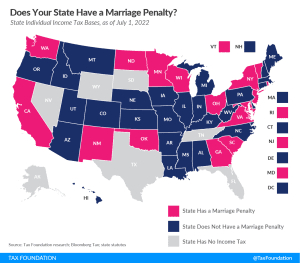
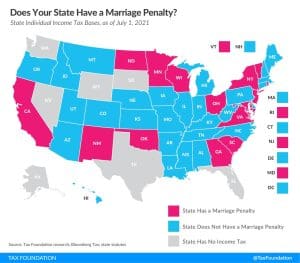
A marriage penalty exists when a state’s income brackets for married taxpayers filing jointly are less than double the bracket widths that apply to single filers. In other words, married couples who file jointly under this scenario have a higher effective tax rate than they would if they filed as two single individuals with the same amount of combined income.
3 min read
In a time of increased mobility and tax competition, a lower rate and simpler tax structure would help Georgia stand out among states. Lawmakers would be wise to consider reforming the state’s income tax to improve the state’s competitiveness.
3 min read
Fifteen states have a marriage penalty built into their bracket structure. Does your state have one?
2 min read
A rosy revenue outlook has allowed Ohio to join eight other states in providing tax relief this legislative session. The Ohio legislature agreed on a two-year budget, which includes individual income tax cuts.
4 min read
As Wisconsin emerges from the pandemic, state policymakers have a rare opportunity to reinvest excess revenues in a structurally sound manner that will make the state more attractive to individuals and businesses, promote a quicker and more robust economic recovery, and put the state on the path to increased in-state investment and growth for many years to come.
7 min read
Ohio is one of a growing number of states which experienced revenue increases despite the economic slowdown from the coronavirus pandemic and is now looking to return some of that through tax relief.
5 min read
While strong economic growth—fueled by higher levels of investment, productivity, and jobs—will lift after-tax incomes over time, policies that provide relief by immediately boosting after-tax incomes of lower-income households are also available. As lawmakers consider such policies, they should keep in mind the trade-offs among them.
4 min read