2027 Tax Brackets
Explore the IRS inflation-adjusted 2027 tax brackets, for which taxpayers will file tax returns in early 2028.
5 min read

Alex Durante is an Senior Economist at the Tax Foundation, working on federal tax policy and model development. He previously served as a Taxes and Growth Fellow at the Tax Foundation from 2015 to 2016.
Alex worked as a research assistant for three years at the Federal Reserve Board on a household survey, where he coauthored reports on the “Economic Well-Being of U.S. Households.” From 2019 through 2020, he served as a staff economist on the Council of Economic Advisers, working primarily on trade policy and contributing economic analysis to the “Economic Report to the President.” He holds a BS in Economics from The College of New Jersey and an MS in Applied Economics from Johns Hopkins University.
Originally from New Jersey, Alex currently lives in Washington, D.C. His hobbies include tennis, boxing and mixed martial arts, and playing bass and drums.

Explore the IRS inflation-adjusted 2027 tax brackets, for which taxpayers will file tax returns in early 2028.
5 min read
A new paper shows raising top income tax rates on the current tax base may not yield as much revenue as previously estimated, due to opportunities to shift income to different tax bases within the tax code.
5 min read
With Social Security insolvency rapidly approaching and policymakers exploring changes to benefits and taxation, Congress could look to base-broadening reforms like the ECT as a guide for how to think about taxing compensation and broadening the tax base.
4 min read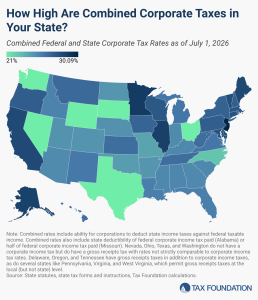
Corporations in the United States pay federal corporate income taxes levied at a 21 percent rate. Forty-four states and DC also levy taxes on corporate income, with top marginal rates ranging from 2.5 percent in North Carolina to 11.5 percent in New Jersey.
2 min read
Studies have repeatedly shown that US businesses and consumers are bearing a disproportionate share of the tariff burden.
7 min read
A new paper finds that foreign exporters absorbed 47 percent of the tariff burden, passing on a smaller share to US importers than estimated by other studies.
6 min read
When properly measured, consistent with how we assess progressivity in tax policy, Social Security benefits are progressive.
5 min read
While uncapping the payroll tax and raising individual income tax rates are often the go-to reform options for policymakers, base broadeners like ESI and other fringe benefits are much better alternatives. They can raise significant revenue, while improving the neutrality of the tax code and preventing the need for increases in statutory tax rates.
6 min read
Full expensing under the One Big Beautiful Bill Act does not neutralize the tariff burden on imported goods, as former White House Council of Economic Advisers chair Stephen Miran asserts.
8 min read
President Donald Trump has decided against a clean extension of the US-Mexico-Canada Agreement (USMCA), allowing the bloc of countries to enter a prolonged period of annual reviews, renegotiations, and, possibly, a shift to bilateral deals.

It is good to see senators talking about the Social Security crisis that is rapidly unfolding. But any serious proposal has to grapple with the trade-offs of different reforms and accept that the fix will come from both sides of the ledger: taxes and expenditures.
5 min read
With nearly 2 million US jobs tied to trade with Canada and Mexico, stalling renewal — or withdrawing outright — would compound tariff uncertainty at exactly the wrong time.
6 min read
Testifying to Congress, United States Trade Representative Jamieson Greer argued that “President Trump’s trade policy is working.” The data present a different picture: President Trump’s trade agenda is actually holding back the economy.

The evidence overall paints a far different picture than American Compass presents, and a consistent theoretical framework undercuts its assertions of how tariffs should be expected to impact the economy moving forward.
25 min read
Senator Bernie Sanders introduced a proposed 5 percent annual wealth tax on billionaires to fund direct payments to Americans and expand social welfare programs.
5 min read
Thought the Trump administration has not yet imposed new, industry-specific tariffs on drugs or active pharmaceutical ingredients, such tariffs would be a hidden cost on Americans: they would shrink incomes, reduce investment, and lead to less innovation.
7 min read
President Trump and those in his administration have insisted that consumers are not bearing any of the tariffs. But the latest data show exactly the opposite.
5 min read
The tariffs now in effect threaten to offset much of the GDP growth from the tax cuts, while falling short of paying for them.
3 min read
The Supreme Court ruling against the IEEPA tariffs provides immediate relief to US businesses and workers and is a welcome rebuke of President Trump’s overreach of executive authority to unilaterally impose significant tax hikes on the US economy.
6 min read
The increased senior deduction with the phaseout would deliver a larger tax cut to lower-middle- and middle-income taxpayers compared to exempting all Social Security benefits from income taxation and would not weaken the trust funds as much. But given the temporary nature of the policy, it would increase the deficit-impact of the reconciliation bills without boosting long-run economic growth.
3 min read