Details and Analysis of the American Families and Jobs Act
Details and analysis of the latest House GOP tax plan, the American Families and Jobs Act. Learn more about the House Republican tax plan.
7 min read

Alex Durante is an Senior Economist at the Tax Foundation, working on federal tax policy and model development. He previously served as a Taxes and Growth Fellow at the Tax Foundation from 2015 to 2016.
Alex worked as a research assistant for three years at the Federal Reserve Board on a household survey, where he coauthored reports on the “Economic Well-Being of U.S. Households.” From 2019 through 2020, he served as a staff economist on the Council of Economic Advisers, working primarily on trade policy and contributing economic analysis to the “Economic Report to the President.” He holds a BS in Economics from The College of New Jersey and an MS in Applied Economics from Johns Hopkins University.
Originally from New Jersey, Alex currently lives in Washington, D.C. His hobbies include tennis, boxing and mixed martial arts, and playing bass and drums.

Details and analysis of the latest House GOP tax plan, the American Families and Jobs Act. Learn more about the House Republican tax plan.
7 min read
This tax reform plan would boost long-run GDP by 2.5%, grow wages by 1.4%, and add 1.3M jobs, all while collecting a similar amount of tax revenue as the current code and reducing the long-run debt burden.
38 min read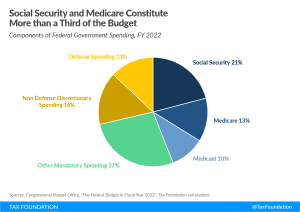
Any serious proposal to tackle the emerging debt and deficit crisis must also address our largest mandatory spending programs: Social Security and Medicare. Together, these two programs will be responsible for nearly 80 percent of the deficit’s rise between 2023 and 2032, according to Congressional Budget Office (CBO) projections.
8 min read
As policymakers look to tackle America’s debt and deficit crisis, they should consider international experiences on successful fiscal consolidations.
6 min read
The overall U.S. tax and transfer system is overwhelmingly progressive, and understanding the extent—and source—of that progressivity is essential for lawmakers considering the trade-offs associated with each tax policy decision.
23 min read
President Biden’s new budget proposal outlines several major tax increases targeted at businesses and high-income individuals that would bring U.S. income tax rates far out of step with international norms.
7 min read
As we near this year’s “lame duck” session of Congress, there has been renewed interest in reforming the child tax credit as part of a tax deal. Our new analysis highlights the trade-offs that policymakers will face
5 min read
The business tax changes originally introduced in the TCJA are scheduled to increase tax burdens on businesses at a time when economic headwinds and broader uncertainty are higher than they have been in decades.
12 min read
The IRS recently released the new inflation adjusted 2023 tax brackets and rates. Explore updated credits, deductions, and exemptions, including the standard deduction & personal exemption, Alternative Minimum Tax (AMT), Earned Income Tax Credit (EITC), Child Tax Credit (CTC), capital gains brackets, qualified business income deduction (199A), and the annual exclusion for gifts.
4 min read
Repealing LIFO, as some policymakers have proposed, is not sound policy. LIFO helps firms avoid the penalty on inventory investment created by FIFO and is neither a targeted tax break nor a subsidy (as some opponents suggest).
17 min read
While there is more we can do to encourage lower- and middle-class households to save more and build wealth, a closer, more comprehensive look at the data and trends in other countries suggests that America’s wealth gap is not as alarming as some may think.
5 min read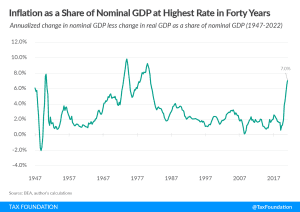
A new CBO report reveals that lower- and middle-income households are disproportionately shouldering the burden of this current inflation wave. And historical analysis suggests there is much more to come.
5 min read
The Section 232 tariffs on imports of steel and aluminum raised the cost of production for manufacturers, reducing employment in those industries, raising prices for consumers, and hurting exports.
14 min read
The Inflation Reduction Act calls for a new 1 percent excise tax on stock buybacks, the argument being it would be better for the economy if firms invested their surplus cash in the business, rather than returning this value to shareholders.
3 min read
How will the Inflation Reduction Act taxes impact inflation, economic growth, tax revenue, and everyday taxpayers? See Inflation Reduction Act tax changes.
12 min read
In the rush to pass the Inflation Reduction Act, which features an ill-conceived tax on the book income of U.S. corporations, it is worth reminding policymakers of a well-established finding in the economic literature.
3 min read
Policymakers should continue to focus on longer term impacts rather than emphasizing the short-term stimulus effects of tax cuts.
3 min read
With inflation continuing to skyrocket, especially for food, which reached 10.4 percent in June, it is worth examining how the ongoing U.S. trade war with China and U.S. tariff policy overall has impacted U.S. agriculture and food prices.
3 min read
Academic research indicates foreign direct investment (FDI) is highly responsive to the corporate effective tax rate (ETRs); that is, the tax rate after accounting for all deduction and credits available to corporations.
3 min read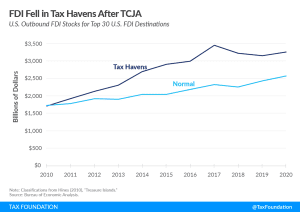
Overall, the data shows outbound FDI shifted from low-tax to other jurisdictions, while inbound FDI remained largely unchanged.
3 min read