
The Misguided Notion of Government-Set Prices for Prescription Drugs
Government-set pricing of prescription drugs is not a fix for today’s rampant inflation and further, it would give rise to new problems of its own.
6 min readAlex Durante is an Senior Economist at the Tax Foundation, working on federal tax policy and model development. He previously served as a Taxes and Growth Fellow at the Tax Foundation from 2015 to 2016.
Alex worked as a research assistant for three years at the Federal Reserve Board on a household survey, where he coauthored reports on the “Economic Well-Being of U.S. Households.” From 2019 through 2020, he served as a staff economist on the Council of Economic Advisers, working primarily on trade policy and contributing economic analysis to the “Economic Report to the President.” He holds a BS in Economics from The College of New Jersey and an MS in Applied Economics from Johns Hopkins University.
Originally from New Jersey, Alex currently lives in Washington, D.C. His hobbies include tennis, boxing and mixed martial arts, and playing bass and drums.
Government-set pricing of prescription drugs is not a fix for today’s rampant inflation and further, it would give rise to new problems of its own.
6 min read
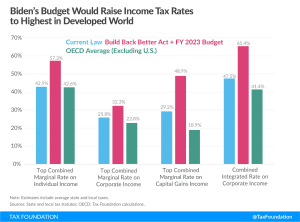
The FY 2023 budget proposes several new tax increases, which in combination with the Build Back Better Act, would give the U.S. the highest top tax rates on individual and corporate income in the developed world.
4 min read
The Biden administration should lift the Trump administration’s tariffs, as they have failed in their objective to bring better trading practices and instead brought about significant damage to U.S. businesses and workers.
6 min read
Policymakers actively marginalized the manufacturing sector by saddling them with cost recovery rules that prevent them from deducting the full cost of investment in physical plant and equipment. Going forward, policymakers should avoid haphazard fixes, targeted measures, and protectionism.
50 min read
By reducing the tax code’s current barriers to investment and saving and simplifying its complex rules, lawmakers would greatly enhance the ability of Americans to pursue new ideas, create more opportunities, and build financial security for themselves and their families.
40 min read
As the U.S. grapples with rising price inflation, a large and growing national debt, as well as a possible economic slowdown due to Omicron, the decision to provide additional fiscal support will prove to be a difficult one. Policymakers can debate how much stimulus is appropriate, but what is clear is that the U.S. fiscal support so far during the pandemic outranks nearly every industrialized country.
3 min readLearn more about the House Build Back Better Act, including the latest details and analysis of the Biden tax increases and reconciliation bill tax proposals.
15 min read
Low-skilled workers have been the hardest hit by the pandemic-induced economic slowdown. When deciding on bonus depreciation, which is currently set to expire in 2026, policymakers should remember that disadvantaged workers would be the most likely to benefit from making it permanent.
2 min read
When looking at the tax burden on businesses over time, it is important to provide a complete picture by accounting for the different types of businesses in the U.S. and the timing effects of the 2017 tax law. Doing so provides important context on existing tax burdens and for considering the impact of raising taxes on corporations and pass-through firms.
3 min read
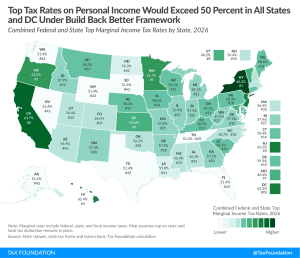
Under the latest iteration of the House Build Back Better Act (BBBA), the average top tax rate on personal income would reach 57.4 percent, giving the U.S. the highest rate in the Organisation for Economic Co-operation and Development (OECD).
2 min read
Congress is debating new ways to raise revenue that would make the tax code more complex and more difficult to administer. The new proposals—imposing an alternative minimum tax on corporate book income, applying an excise tax on stock buybacks, and, at one point this week, a tax on unrealized capital gains for billionaires—are unreliable and highly complex ways to raise revenue.
10 min read
When examining how tax policy impacts the economy, researchers typically look at labor supply and investment responses. One other channel through which taxes impact the economy has been less studied: innovation.
3 min read
President Biden expanded and fundamentally changed the Child Tax Credit (CTC) for one year in the American Rescue Plan (ARP) passed in March 2021. Policymakers are now deciding the future of the expansion as part of the proposed reconciliation package, but a wide range of estimates for the effects of a permanent expansion is confusing the debate.
7 min read
Under the House Ways and Means plan to raise taxes on corporations and individuals, the integrated tax rate on corporate income would rise to the third highest in the OECD. To reduce this burden, policymakers could explore integrating the individual and corporate tax systems.
8 min read
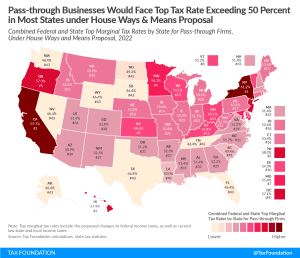
Under the House Democrats’ reconciliation plan, the top tax rate on pass-through business income would exceed 50 percent in most states. Pass-through businesses, such as sole proprietorships, S corporations, and partnerships, make up a majority of businesses and majority of private sector employment in the United States.
3 min read
The Biden administration recently cited an analysis from Treasury claiming that “the President’s agenda will protect 97 percent of small business owners from income tax rate increases.” However, the figure is misleading. To assess the economic effect of higher marginal tax rates, it matters how much income or investment will be affected—not how many taxpayers.
3 min read
Sen. Wyden recently introduced the Small Business Tax Fairness Act—the impact of which we modeled—to reform the Section 199A pass-through business deduction created in the Tax Cuts and Jobs Act (TCJA) of 2017. The provision currently allows taxpayers to deduct up to 20 percent of their qualified business income from their taxable income, subject to certain limitations.
2 min read
The Biden administration has targeted U.S. businesses, including corporations and passthrough entities, to raise revenue to fund new spending. However, individual taxpayers across America will end up footing the bill.
4 min read
New research from Federal Reserve Bank of Boston economists suggests wealth inequality has grown less than previously estimated and that shares of wealth held by top earners drops significantly when accounting for sources of lower- and middle-class wealth that are often overlooked.
2 min read
The Biden administration has primarily focused on increasing taxes on top earners to generate revenue to fund its spending priorities. However, these proposals would hit many pass-through businesses and much of pass-through business income, including small businesses, family-owned businesses, and farms.
3 min read