
Details and Analysis of The CREATE JOBS Act
Senators Ted Cruz and Martha McSally introduced the CREATE JOBS Act that would make two significant changes to incentivize investment in the United States.
3 min readErica York is Senior Economist with Tax Foundation’s Center for Federal Tax Policy. Her analysis has been featured in The Wall Street Journal, The Washington Post, Politico, and other national and international media outlets.
She previously worked as an auditor at a large community bank in Kansas and interned at Tax Foundation’s Center for State Tax Policy. She holds a master’s degree in Economics from Wichita State University and an undergraduate degree in Business Administration and Economics from Sterling (KS) College, where she is currently an adjunct professor. Erica lives in Kansas with her husband and their two children.
Senators Ted Cruz and Martha McSally introduced the CREATE JOBS Act that would make two significant changes to incentivize investment in the United States.
3 min read
Rather than limit improvements to certain sectors, lawmakers could pursue a broader policy of full expensing for all capital investment and neutral cost recovery for structures and clear the tax policy hurdles that currently stand in the way of private investment.
3 min read
Cost recovery is the way the tax code permits firms to recover (or deduct) the cost of making investments. Cost recovery plays an important role in defining a business’ taxable income and can impact investment decisions.
We estimate that moving to permanent full expensing and neutral cost recovery for structures would add more than 1 million full-time equivalent jobs to the long-run economy and boost the long-run capital stock by $4.8 trillion.
4 min read
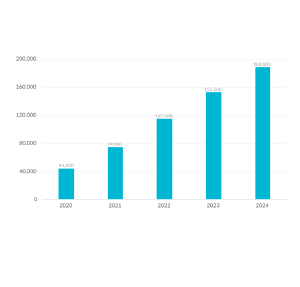
In the first year of enactment alone, we estimate the combination of full expensing and neutral cost recovery would increase full-time equivalent employment by more than 44,000 jobs. The cumulative impact by year five of the policy would be nearly 200,000 new jobs.
4 min read
A neutral cost recovery system lowers the short-term cost of the policy to the federal government while providing nearly equivalent economic benefits. While neutral cost recovery is not a new idea, there are several policy questions lawmakers will want to consider when designing this system.
6 min read
One idea that would help the nation’s economic recovery during the coronavirus crisis would be moving to full expensing of capital investment. The depreciation debate might seem confusing, so the question at hand is: how, when, and by what amount can businesses recognize (or recover) the cost of a capital investment, like a piece of equipment or a new warehouse, on their income tax return?
6 min read
As stated by Rep. Jack Kemp in 1985, “Neutral cost recovery is designed to provide the present value of investment expensing without some of its practical problems.”
5 min read
Improving the tax treatment of structures is one of the most cost-effective tax policy changes available to lawmakers as they consider how to remove investment barriers in the tax code to hasten the economic recovery. Policymakers must weigh the trade-offs among long-run economic output goals, revenue constraints, and the existing stock of structures.
13 min read
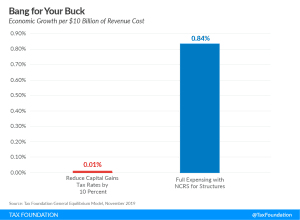
When considering long-term policies for increasing long-run levels of investment and economic growth, full expensing and neutral cost recovery are better targeted than policies like a capital gains cut.
6 min read
Permanent full expensing for all types of investment is an effective policy change lawmakers can use to encourage additional investment and economic growth.
9 min read
One of the most cost-effective policy changes would be to make full expensing of machinery and equipment permanent and extend this important tax treatment to structures as well as for firms in a net operating loss position.
7 min read
Congress recently passed the largest economic relief bill in American history (CARES Act). We’ve created a FAQ portal to better inform policymakers, journalists, and taxpayers across the country on the new law.
13 min read
As lawmakers debate how to respond to the coronavirus crisis, they should focus the legislative response to the emergency at hand, using principled policy solutions to provide relief to those affected. Attempts to use the crisis to make other, unrelated policy changes should be avoided.
3 min read
The timing from enactment to distribution has varied from about one and a half months to more than two months, indicating that it has historically taken a significant amount of time for individual taxpayers to receive their rebates after the policies have been put in place.
4 min read
The U.S. Treasury Department has pushed the April 15 tax payment deadline to July 15. However, taxpayers still have to file their tax returns by the usual April 15 deadline.
3 min read
The House bill would provide two weeks of paid sick leave to workers who must quarantine, take care of a family member who is sick with coronavirus, or care for their children whose school or daycare has closed due to the public health emergency.
2 min read
Taxes present one policy tool available to ease the impending liquidity crunch brought on by the coronavirus crisis, which policymakers are already pursuing by postponing the tax payment deadline and waiving interest and penalties.
3 min read
The bill, the Families First Coronavirus Response Act, would expand federal medical leave, create an emergency paid sick leave requirement, and provide tax credits against employer-side payroll taxes to help offset the cost of these two programs, among other provisions.
3 min read
Joe Biden and Bernie Sanders have each proposed changes to the individual income tax, one of the largest sources of federal revenue. Our new analysis compares the economic, revenue, and distributional effects of the various proposals.
13 min read