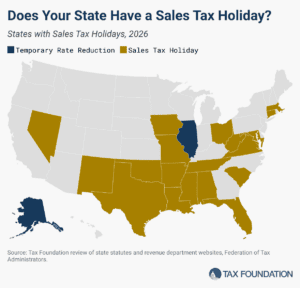
Sales Tax Holidays by State, 2026
However well-intended they may be, sales tax holidays remain the same as they always have been—ineffective and inefficient.
12 min read
However well-intended they may be, sales tax holidays remain the same as they always have been—ineffective and inefficient.
12 min read
The EU public country-by-country data provides information on taxes and profits that do not align with standard financial disclosure requirements.
6 min read
Because withholding taxes can create double taxation and administrative friction even where foreign tax credits are available, the European Commission’s 2026 Tax Omnibus proposal to eliminate them on dividend, interest, and royalty payments between EU companies regardless of holding percentage would foster stronger cross-border savings and investment.
6 min read
A destination-based value-added tax (VAT) or goods and services tax (GST) is a better instrument for taxing digital consumption by avoiding cascading. Recent experience shows that governments can tax digital consumption with a better structure than DSTs.
15 min read
The European Commission’s new Tax Omnibus proposal marks a notable step towards improving the simplicity and competitiveness of the EU Single Market.
8 min read
Pennsylvania lawmakers are looking to impose the Commonwealth’s existing telecom gross receipts tax (GRT) on companies providing digital advertising services in Pennsylvania.
5 min read
The new data disclosures will draw significant attention in 2026 and beyond. However, because the data is rooted in financial accounting concepts, affected by timing issues, and shaped by inconsistent reporting regimes, it is poorly suited for drawing strong conclusions about tax policy or corporate behavior.
7 min read
With nearly 2 million US jobs tied to trade with Canada and Mexico, stalling renewal — or withdrawing outright — would compound tariff uncertainty at exactly the wrong time.
6 min read
Digital services taxes address a real concern—the need to adapt taxation to the digital economy—but they are not the right solution. They raise limited revenue, are often passed on to consumers rather than large digital firms, create economic distortions, increase complexity and compliance costs, negatively impact innovation and competitiveness, and risk international retaliation.
Since digital services taxes generate little revenue, place the cost on European consumers and not on large digital companies as intended, and risk escalating trade disputes, policymakers should rethink their strategy.
14 min read
Worldwide, 175 countries—including all major European countries—levy a value-added tax (VAT) on goods and services. However, to reduce compliance and administrative costs, most countries have VAT exemption thresholds: if a business is below a certain annual revenue threshold, it is not required to participate in the VAT system.
3 min read
Illinois plans to impose a complicated, legally fraught new social media tax based on a few pages of confused, contradictory, and almost laughably incomplete legislative text embedded in the new budget.
10 min read
Oregon’s Extended Producer Responsibility program to incentivize recycling does so with a complicated and unprincipled series of regulations, including confidentially determined tax rates on various materials derived from a revenue goal.
8 min read
Debates over tax fairness and anti-avoidance rules have dominated European tax policy circles for over a decade. However, as geoeconomic pressures increase around the world, policymakers are looking for ways to boost European competitiveness and economic growth.
18 min read
Carryover provisions help businesses “smooth” their risk and income, making the tax code more neutral across investments and over time.
5 min read
The carbon tax is often considered the ideal climate policy. However, existing carbon taxes do not match the ideal theoretical policy. More than two dozen carbon taxes exist in the world today, and they vary widely in terms of design.
61 min read
Most Americans don’t understand how the tax code works, and it’s costing them.
California lawmakers are considering mandating worldwide combined reporting, bringing back a policy the state abandoned in the 1980s due to strong pushback from international trading partners and the federal government. The policy failed to work as intended then and doesn’t make any better sense now.
8 min read
Policymakers should broaden and make permanent full expensing for additional asset classes and pursue structural reforms that reduce distortions in how businesses are taxed. A more consistent and predictable policy environment, paired with targeted improvements to loss treatment, R&D incentives, and compliance burdens, would give small business owners greater confidence to invest, hire, and grow.
The US, as the world’s largest services exporter, has a stronger interest in combating discriminatory services taxation than in pursuing tariffs.
44 min read