Tax Burden on Labor in Europe, 2022
To make the taxation of labor more efficient, policymakers should understand the inputs into the tax wedge, and taxpayers should understand how their tax burden funds government services.
4 min read
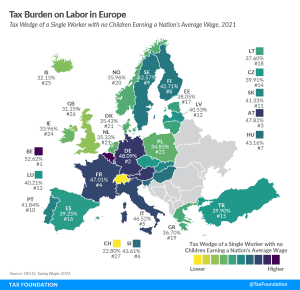
To make the taxation of labor more efficient, policymakers should understand the inputs into the tax wedge, and taxpayers should understand how their tax burden funds government services.
4 min read
Governments often justify higher tax burdens with more extensive public services. However, the cost of these services can be more than half of an average worker’s salary.
21 min read
A higher tax burden on labor often leads to lower employment rates and wages. That’s important for policymakers to remember as they look for ways to help their economies recover from coronavirus-induced shutdowns. If their goal is to encourage employment, policies that lower the tax burden on labor could prove a powerful tool.
20 min read
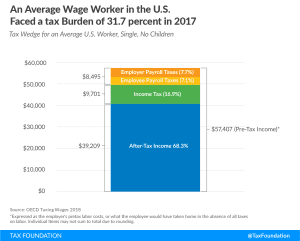
Before accounting for state and local sales taxes, the tax burden that a single average wage earner faces in the U.S. is 31.7 percent of pretax earnings, amounting to $18,198 in taxes in 2017.
18 min read



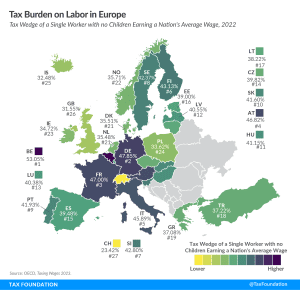
To make the taxation of labor more efficient, policymakers should understand the inputs into the tax wedge, and taxpayers should understand how their tax burden funds government services.
4 min read
The 2026 Regional Tax Competitiveness Index for Spain highlights a growing divergence between regions that have embraced tax reform and those whose tax systems have remained largely unchanged.
7 min read
Retail prices make poor targets for excise tax policy, often reflecting factors that have little to do with the underlying reasons for which an excise tax is levied in the first place. Unfortunately, the World Health Organization (WHO) has a growing preference for using tax share of retail price (tax incidence) as a primary policy target.
6 min read
Policymakers are increasingly considering taxes on data processing and other businesses’ digital services, but these taxes increase costs at many stages of the production process for virtually all businesses, not just tech-oriented businesses.
7 min read
President Donald Trump has decided against a clean extension of the US-Mexico-Canada Agreement (USMCA), allowing the bloc of countries to enter a prolonged period of annual reviews, renegotiations, and, possibly, a shift to bilateral deals.

 Short Form
Just as many parts of American life have transformed over the past 250 years, so too has the federal tax system. While most taxes levied in the 18th century are still levied in some form today, the federal government’s reliance on them, the complexity of the tax code, and Americans’ overall tax burdens have shifted considerably.
5 min read
The Reform UK proposal to exempt overtime pay from income tax—framed as a “hard work bonus”—may be politically appealing, but it’s a flawed idea that undermines economic fairness, distorts labor markets, and jeopardizes tax revenues.
4 min read
Currently, the European Commission has plans to generate more tax revenue to fund the forthcoming MFF, the long-term budget running from 2028 to 2034. But the truth is, without serious reform, the EU isn’t ready for new taxation.

Shifting Germany’s tax mix away from labor to consumption remains a sound policy route to strengthen the country’s labor supply, but further eroding the VAT base with preferential rates for selected goods and services would counteract this goal by depleting the extra revenue for labor tax cuts while providing less-targeted relief for low-income households.
6 min read
To make the taxation of labor more efficient, policymakers should understand their country’s tax wedge and how their tax burden funds government services.
5 min read
Gas tax prices are soaring across the country, and lawmakers are naturally looking for ways to alleviate the pain at the pump. While gas tax holidays—which temporarily suspend fuel taxes to artificially lower the price of gas—are a politically welcomed intervention, taxpayers shouldn’t be so quick to celebrate.

Poland is proposing to broaden and raise its digital services tax (DST) from 1.5 percent to 3 percent. Because DSTs tax revenues, not profits, a company with a 10 percent profit margin would face a 30 percent effective tax rate on digital services provided in Poland.
6 min read
Assessment limits are not sound tax policy. While well-intended, with hopes of preventing owners from being “taxed out of their homes,” the tax shifts, lock-in effects, and housing supply issues created by assessment limits make housing affordability worse.

Formulary apportionment, global tax harmonization, and broad tax increases on services all face design, implementation, and economic barriers. When designing tax systems, policymakers should focus on doing the basic things well and avoid harmful policies that could stunt growth.
7 min read
Though politically popular, “no tax on tips and overtime” is a short-sighted gimmick that risks derailing West Virginia’s path to prosperity.

Data centers face high tax burdens and are particularly substantial contributors to local coffers, but poor tax structure can drive these operations to other locations and deprive local governments of a major revenue stream.
22 min read
The recently proposed UK budget contains several tax measures that put a greater burden on the working class and ultimately fails to tackle the deeper structural problems of the UK’s tax code.
6 min read
Who really pays for European welfare states? Many assume the answer is obvious: high-income earners contribute while low-income earners benefit. However, that assumption is only partly true, and often misleading.
6 min read
New Jersey’s residents deserve tax relief, and the state must stem the tide of out-migration. Affordable reforms in the near term could pave the way for more sweeping, and competitive, reforms to take root in the future.
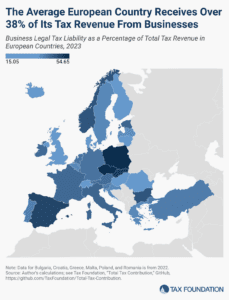
Without businesses as their taxpayers and tax collectors, governments would not have the resources to provide even the most basic services.
5 min read
On average, businesses in the OECD are liable for collecting, paying, and remitting more than 85 percent of the total tax collection.
15 min read