A “Token Tax” Could Kill the Promise of AI
If we want to ensure that AI raises economic growth, we shouldn’t be pursuing tax policies that are stuck in the past and represent some of the worst ideas from the early internet age.

2020 Presidential candidate and Senator Bernie Sanders (I-VT) has proposed a number of changes to the U.S. tax code, including a corporate income tax increase, changes to payroll taxes, and an “extreme wealth tax.” You can explore all of our research and analysis of Bernie Sanders’s tax plans below.

If we want to ensure that AI raises economic growth, we shouldn’t be pursuing tax policies that are stuck in the past and represent some of the worst ideas from the early internet age.

This study simulates several large tax increases and consistently finds that even tax increases large enough to close the primary deficit in the near term will lose ground over time and fail to put the debt on a sustainable course.
41 min read
AI is everywhere, and now it’s in the tax policy debate.

Senator Bernie Sanders introduced a proposed 5 percent annual wealth tax on billionaires to fund direct payments to Americans and expand social welfare programs.
5 min read
AI technology has a wide range of potential economic outcomes. It would be a mistake to tailor tax policy to the extreme end of that range. Still, policymakers shouldn’t do nothing: they should instead make tax reforms that are sound regardless of which AI scenario emerges.
7 min read
In an effort to rein in perceived excesses in executive compensation, Sen. Bernie Sanders (I-VT) and other co-sponsors have proposed to increase a company’s corporate income tax rate progressively based on the difference between median worker pay and CEO pay.
4 min read
Joe Biden and Bernie Sanders have each proposed changes to the individual income tax, one of the largest sources of federal revenue. Our new analysis compares the economic, revenue, and distributional effects of the various proposals.
13 min read

2020 Democratic presidential candidates have proposed various changes to the corporate income tax, which includes increasing the rate, ranging from 25 percent to 35 percent, imposing a corporate surtax or a minimum tax, and lengthening depreciation schedules.
17 min read
Several 2020 Democratic presidential candidates have proposed changes to federal payroll tax rates and the Social Security payroll tax wage base to raise revenue and maintain solvency for major federal entitlement programs.
24 min read
New modeling finds that the wealth taxes proposed by Sen. Warren and Sen. Sanders would raise significantly less revenue than promised, face serious administrative and compliance challenges, and would increase foreign ownership of U.S. capital.
38 min read
Biden, Sanders, and Warren have staked out similar plans to increase capital gains taxes on the wealthiest Americans. While all three candidates have called for taxing capital gains at ordinary income rates, the phase-in levels and top marginal tax rates vary.
5 min read
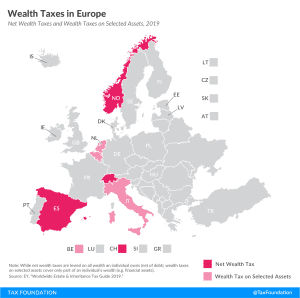
Only three European countries levy a net wealth tax, namely Norway, Spain, and Switzerland. Belgium, Italy, and the Netherlands levy wealth taxes on selected assets, but not on an individual’s net wealth per se.
3 min read

Bernie Sanders recently became the second major Democratic presidential candidate to propose a wealth tax.
2 min read

While progressivity may look appealing—particularly at a time when policymakers in Congress seem to be competing on how best to extract revenue from the wealthiest in the country—it may not raise the revenue intended.
2 min read