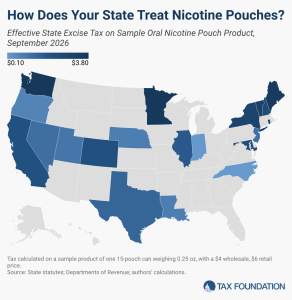
New Taxes on Nicotine Pouches in the EU Could Hamper Health Goals
Academic research has continually found that making alternative nicotine products to cigarettes more expensive results in fewer smokers switching to less harmful products.
7 min read
Academic research has continually found that making alternative nicotine products to cigarettes more expensive results in fewer smokers switching to less harmful products.
7 min read
Tax collections vary widely by state, making per capita collections figures—a measure of collections per person—especially useful, as they allow comparisons across differences in tax rates and bases, economic capacities, and policy decisions that impact the size and scope of government.
5 min read
Rental cars are some of the most heavily taxed transactions in the US. Rather than levying additional taxes on rental cars by trying to export the tax burden to nonresidents, municipalities should enact principled, neutral transportation tax policy that is unlikely to discourage visitors, tourists, and other economic activity.
5 min read
Two bills in Oklahoma and Louisiana shift towards a weight-based system for taxing moist snuff tobacco (MST), a policy that ensures neutral taxation across products and less revenue volatility.
4 min read
The economic literature overwhelmingly finds that an income tax increase of this magnitude would negatively affect economic growth and opportunity in Rhode Island.
The carbon tax is often considered the ideal climate policy. However, existing carbon taxes do not match the ideal theoretical policy. More than two dozen carbon taxes exist in the world today, and they vary widely in terms of design.
61 min read
A new bill introduced in the Minnesota House seeks to tax non-real assets, imposing an annual tax of 1 percent on “taxable wealth” exceeding $10 million for individuals and trusts from tax year 2026 onward.
6 min read
The Trump tariffs have not meaningfully altered the trade balance and amount to an average tax increase per US household of $700 in 2026.
56 min read
Currently, about half of all European OECD countries have either announced, proposed, or implemented a digital services tax. Because these taxes mainly impact US companies and are thus perceived as discriminatory, the US responded with retaliatory tariff threats.
5 min read
Testifying to Congress, United States Trade Representative Jamieson Greer argued that “President Trump’s trade policy is working.” The data present a different picture: President Trump’s trade agenda is actually holding back the economy.
From coast to coast, lawmakers are embracing wealth and millionaires’ taxes. Many of these proposals will face their ultimate test at the ballot box this November, and we should be rooting for these measures to fail.
This study simulates several large tax increases and consistently finds that even tax increases large enough to close the primary deficit in the near term will lose ground over time and fail to put the debt on a sustainable course.
41 min read
Most Americans don’t understand how the tax code works, and it’s costing them.
Shifting Germany’s tax mix away from labor to consumption remains a sound policy route to strengthen the country’s labor supply, but further eroding the VAT base with preferential rates for selected goods and services would counteract this goal by depleting the extra revenue for labor tax cuts while providing less-targeted relief for low-income households.
6 min read
A pair of bills introduced in the Minnesota House—HF 3954 (overtime) and HF 3955 (tips)—would further erode the state’s tax climate by exempting certain overtime pay and tip income from Minnesota’s income tax.
5 min read
Illinois’ proposed Millionaire’s Tax would raise taxes on Illinois families and businesses in an economically damaging way, further harming the state’s competitiveness and reducing economic opportunity even for those Illinois residents who would not owe the tax directly.
California lawmakers are considering mandating worldwide combined reporting, bringing back a policy the state abandoned in the 1980s due to strong pushback from international trading partners and the federal government. The policy failed to work as intended then and doesn’t make any better sense now.
8 min read
To make the taxation of labor more efficient, policymakers should understand their country’s tax wedge and how their tax burden funds government services.
5 min read
Millions of Americans, along with significant amounts of income and economic activity, are moving from high-tax states to those with more competitive tax systems and lower overall costs of living.
8 min read