Trade Strengthens Economies
Whether we look at it as consumers of these goods, or as middle-class workers who transform them, low-cost goods have been the underpinning of American prosperity.


Daniel Bunn is President and CEO of the Tax Foundation. Daniel has been with the organization since 2018 and, prior to becoming President, successfully built its Center for Global Tax Policy, expanding the Tax Foundation’s reach and impact around the world.
Prior to joining the Tax Foundation, Daniel worked in the United States Senate at the Joint Economic Committee as part of Senator Mike Lee’s (R-UT) Social Capital Project and on the policy staff for both Senator Lee and Senator Tim Scott (R-SC). In his time in the Senate, Daniel developed legislative initiatives on tax, trade, regulatory, and budget policy.
He has a master’s degree in Economic Policy from Central European University in Budapest, Hungary, and a bachelor’s degree in Business Administration from North Greenville University in South Carolina.
Daniel lives in Halethorpe, Maryland, with his wife and their three children.

Whether we look at it as consumers of these goods, or as middle-class workers who transform them, low-cost goods have been the underpinning of American prosperity.
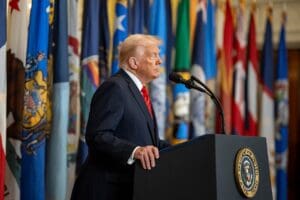
President Donald Trump surprised many in the tax community by making the global tax deal a day one issue. His Jan. 20 memorandum gave his Treasury secretary 60 days to recommend interactions with tax treaties and possible protective measures to ensure the minimum tax rules have no force or effect in the US.
If Republicans want a successful year for tax reform, they must put aside the extensive demands for niche provisions and, instead, approach this debate with a principles-first mindset.

Republican policymakers in Congress are considering options to raise revenue as part of their expected legislative package in 2025. One such option involves raising the tax rate on university endowments first put in place as part of the TCJA in 2017.
4 min read
With so much emphasis on politics and procedure, the actual policy debate suffers.
What will the future of tax policy look like? In this episode, we dive into the critical challenges and opportunities looming on the horizon, especially with major tax cuts set to expire, which could increase taxes for 62 percent of filers.

 Short Form
The holiday season is marked by time with friends and family, joy, and gift-giving. But could tax policy make the sticker shock from your shopping list next year tariff-ying?
4 min read
As we prepare for the tax code’s “move,” it’s time to start cleaning out the proverbial attic of our messy system. For the sake of our economy, moves toward growth must win the day.

If lawmakers are serious about pro-growth policies and fiscal responsibility, they will need to put policies forward that achieve those goals. Simply adjusting the baseline doesn’t reduce actual deficits in the coming years.
7 min read
“Full expensing” may not sound like the most exciting policy, but it’s the strongest tool in our tax code to help our small businesses.
 Short Form
Today marks 55 years since two students sent the first message across the Advanced Research Projects Agency Network (ARPANET) between computers at four universities, which would later become the internet we enjoy today.
5 min read
Congress has the power to stop this trade war, and for the sake of our economy, they should.
 Short Form
Smart tax policy takes into account how policy changes impact real people. Understanding who bears the burden of the corporate tax and the effects of a higher rate are essential to sound policymaking.
4 min read
The stakes for next year’s expiring tax provisions are quite high. If Congress does nothing, then 62 percent of households will see their taxes go up in January of 2026.

The global tax deal and Pillar Two are shaking up the tax landscape worldwide, introducing a web of complexity and confusion.
As members of Congress prepare to address the expiration of the TCJA, they should appreciate how revenues have evolved since 2017.
4 min read
European Union Member States are in the process of implementing the global minimum tax in line with a directive unanimously agreed to at the end of 2022.
3 min read
Lawmakers should aim for policies that support investment and hiring in the United States and refining anti-avoidance measures to improve administrability and lower compliance costs.
Given that U.S. debt is roughly the size of our annual economic output, policymakers will face many tough fiscal choices in the coming years. The good news is there are policies that both support a larger economy and avoid adding to the debt.
6 min read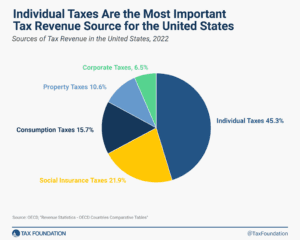
Different taxes have different economic effects, so policymakers should always consider how tax revenue is raised and not just how much is raised.
3 min read