Ideas, Not Mandates: Lessons Learned from a Decade of International Tax Reform
The past decade’s record suggests that countries have reliable legislative methods to improve their tax systems through ordinary tax reforms.
22 min read
The past decade’s record suggests that countries have reliable legislative methods to improve their tax systems through ordinary tax reforms.
22 min read
While the Council of DC is right to consider decoupling its tax code from several revenue-reducing provisions in the OBBBA, they should maintain conformity with the business expensing reforms that are strongly pro-growth, better align with sound tax principles, and primarily change the timing of revenues.
4 min read
Expensing for manufacturing structures is a significant step forward for the tax treatment of structures, but it could be improved in several ways.
7 min read
If Canada doesn’t make full expensing provisions permanent, it will drop to 13th place in the capital cost recovery ranking, once provisions expire in 2028.
5 min read
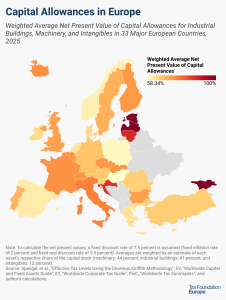
Although sometimes overlooked in discussions about corporate taxation, capital allowances play an important role in a country’s corporate tax base and can impact investment decisions—with far-reaching economic consequences.
6 min read
Senator Ted Cruz’s (R-TX) CREATE JOBS Act prioritizes permanence for the most cost-effective tax reforms—expensing and Neutral Cost Recovery (NCRS)—to boost growth in a relatively fiscally responsible way.
4 min read
The ongoing economic uncertainty from Russia’s war in Ukraine, economic recovery, supply chain disruptions, and rising interest rates have highlighted the importance of business investment.
30 min read
Broad, pro-investment tax policy matters for growth, and the US has plenty of opportunities to make improvements, particularly given the advantages our cross-Pacific rival confers on its firms.
5 min read
Supernormal profits are an important concept, but we should be wary of analysis that both defines supernormal profits very broadly and equates all supernormal profits with monopoly profits that can be easily taxed without negative economic effects.
23 min read
Allowing full deductibility of residential structures would mean more housing construction, particularly multifamily housing—a practical solution to address housing affordability challenges.
6 min read
Rather than adopt temporary policies that phase out and expire, policymakers should focus their efforts on long-term reforms to support investment.
6 min read
To recover from the pandemic and put the global economy on a trajectory for growth, policymakers need to aim for more generous and permanent capital allowances. This will spur real investment and can also contribute to more environmentally friendly production across the globe.
31 min read
As lawmakers consider which policies to prioritize in the upcoming tax policy debates, better cost recovery for all investment should be top of mind.
7 min read
While not perfect, Senator Scott provided a more detailed and sound tax plan than other 2024 candidates, and he prioritized pro-growth tax reforms like full cost recovery.
4 min read
By extending bonus depreciation and introducing neutral cost recovery, the RSC budget would significantly improve the treatment of investment leading to increased growth, expanded employment, and higher wages.
3 min read
Making expensing permanent is especially important now, when the economy is threatened with a recession and inflation remains high.
7 min read
Reforming the Low-Income Housing Tax Credit (LIHTC) and providing neutral cost recovery for residential structures would tackle the problem of housing affordability in a complementary fashion.