Testimony: The Role of Corporate Taxation in the European Union’s Future Tax Policy Mix
As policymakers shift their focus away from tax rates and look to harmonize the EU’s corporate tax base, they should understand the benefits of full expensing.

As policymakers shift their focus away from tax rates and look to harmonize the EU’s corporate tax base, they should understand the benefits of full expensing.
Permanent full expensing is an efficient and neutral tax policy that will allow markets to allocate private investment effectively while moving the economy towards the climate goals of the EU.
33 min read
In our latest report, we consider several theoretical arguments for carbon taxes and the evidence from carbon taxes implemented around the world related to emissions, economic growth, distribution and revenue recycling options, other environmental taxes, green subsidies, and environmental regulations.
49 min read
When it comes to EU-level tax policy ideas, competitiveness seems to be less of a priority than raising revenue or pursuing social objectives.
4 min read
The Carbon Border Adjustment Mechanism (CBAM) is a key aspect of the EU’s broader Fit for 55 package which aims to cut 55 percent of net greenhouse gas (GHG) emissions in the EU by 2030. The growing number of competing climate policies between the EU and U.S., such as tax provisions in the Inflation Reduction Act, could present policymakers on both sides of the Atlantic an opportunity to work together.
5 min read
While some temporary policies can help in a crisis, policymakers should focus their efforts on sustainable policies that support growth and the resilience of businesses (and government coffers) over the long term.
6 min read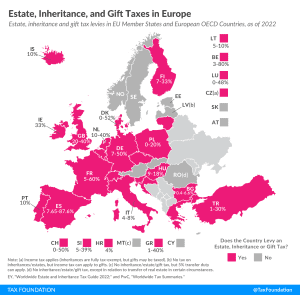
As tempting as inheritance, estate, and gift taxes might look—especially when the OECD notes them as a way to reduce wealth inequality—their limited capacity to collect revenue and their negative impact on entrepreneurial activity, saving, and work should make policymakers consider their repeal instead of boosting them.
3 min read
Our recent policy conference brought together academics and political leaders to present research on some of the most pressing issues in global tax policy and to discuss solutions that can unlock genuine global growth.
9 min read
Younger and healthier Brits have created a $17.1 billion budget hole by smoking and drinking less. Yet, despite this resounding piece of positive news, some see any decline in tax revenues as a public finance crisis. Excise taxes target a tax base that is intended to shrink. Less consumption is a stated goal of the policy.
3 min read
Focusing on the “threat” to European industry caused by the Inflation Reduction Act rather than internal tax system flaws puts the EU at risk of slower economic growth and possibly losing some of its important industrial base. It is also contrary to the EU’s geopolitical goals.
4 min read
If the EU wants to strategically compete with economic powers like the United States or China, it needs principled, pro-growth tax policy that prioritizes efficient ways to raise revenue over geopolitical ambitions.
6 min read
When it comes to providing economic relief to those in need, wartime energy security, and principled tax policy, the EU can do all three. But a windfall profits tax is not the policy to achieve these goals.
8 min read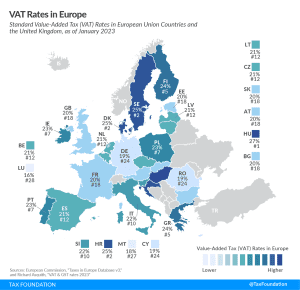
The EU countries with the highest standard VAT rates are Hungary (27 percent), Croatia, Denmark, and Sweden (all at 25 percent). Luxembourg levies the lowest standard VAT rate at 16 percent, followed by Malta (18 percent), Cyprus, Germany, and Romania (all at 19 percent).
4 min read
Before EU policymakers rush to implement massive reforms, they should remember the goals of the Single Market, its international limitations, and the role of tax policy.
4 min read
The EU’s unilateral approach with carbon taxes, faster track on the global minimum tax, and threat of renewed efforts on DSTs means that U.S. policymakers face some hard choices. Policymakers on both sides of the Atlantic should keep in mind pro-growth tax and trade principles that promote a rules-based international order and increase opportunity.
7 min read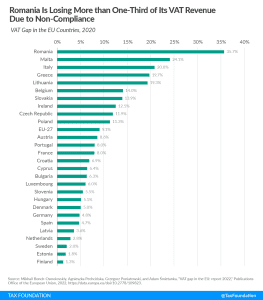
Since VAT revenues are such a significant and stable contributor to overall government revenues, EU policymakers should pay particular attention to how efficiently those revenues are raised.
22 min read
As it stands, Pillar One would usher in the end of many digital services taxes (though perhaps not all) at the cost of increased complexity (in an already complex and uncertain system).
4 min read
When it comes to international economic competition, people often frame the argument as the U.S. versus China. But across the Atlantic, nation-states in the European Union have been working hard to show the world that they deserve to be considered an economic force. Rising up to this challenge for the EU is easier said than done.

Later this week, the European Union is expected to release a new Tobacco Tax Directive, the first update in more than a decade. Early reports indicate that the EU will propose a significant increase to the existing minimum cigarette tax rates levied across the Union and expand the product categories that are taxed, including a block-wide vaping tax.
7 min read
French President Macron is coming to Washington, D.C., this week to ask President Biden the question on the minds of European leaders: “Why did you do this to us?”
6 min read